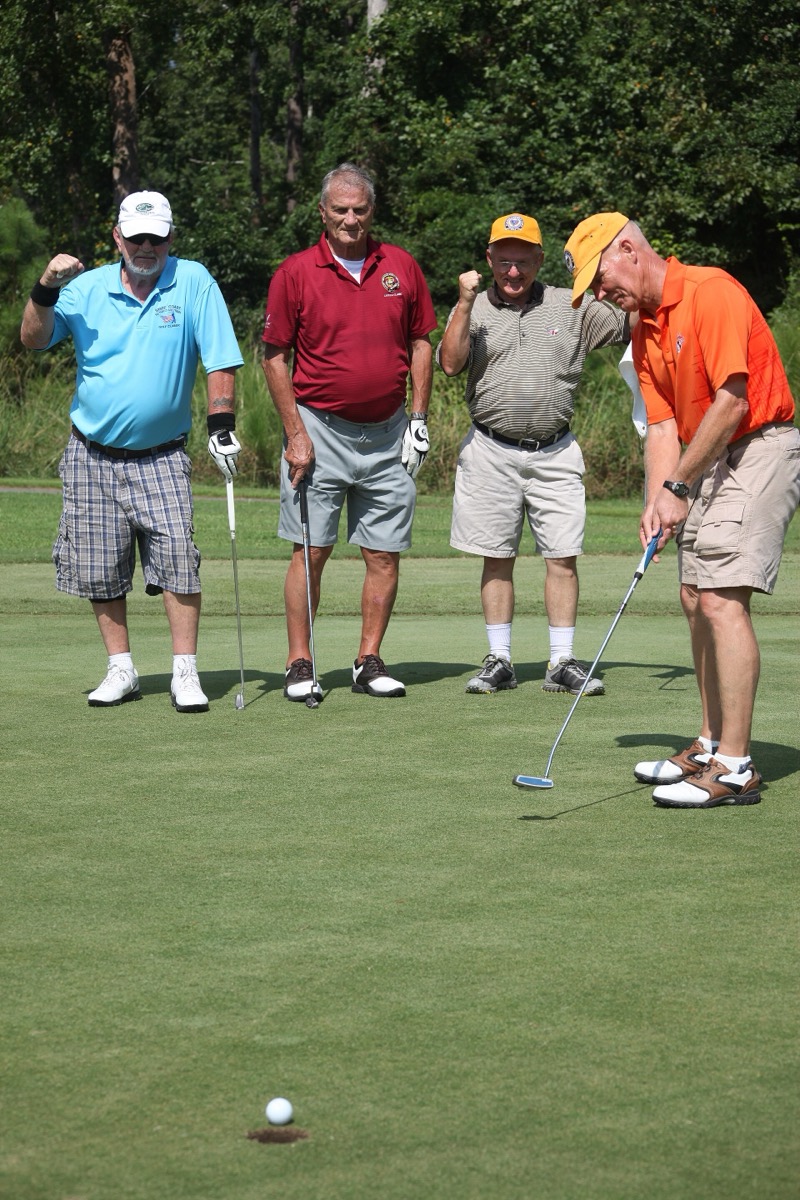
Possibly. Dhungana and Jankovic reviewed the literature and their own clinical experience on golfer’s , an intermittent tremor, jerk or spasm that appears mainly when a player tries to chip or putt. Recent work suggests it may be a form of in the hand and arm, which would make it a movement disorder rather than a failure of composure.
The reclassification carries a treatment with it. Task-specific dystonias and tremors respond best to injections, so the authors raise that as a possible therapy for the yips. The condition is common in amateurs and professionals alike, and other movement disorders, including ordinary tremors and dystonia, can interfere with playing golf without being the yips at all.
Golf asks for precise motor coordination and a balance between mobility and stability, and the yips are where that balance fails. The review describes them as an intermittent motor disturbance, showing up as a transient tremor, jerk or spasm, and occurring primarily when the player is trying to chip or make a putt. They are frequently encountered in amateur and professional golfers alike.
The common assumption is that this is anxiety. Dhungana and Jankovic report that recent studies suggest something else: that the yips may be a form of task-specific focal dystonia involving the hand and arm. That puts the condition alongside writer’s cramp and musician’s dystonia, where a single overlearned movement becomes the only one the limb cannot perform.
The classification has a practical consequence. Task-specific dystonias and tremors are best treated by botulinum toxin injections, and the authors therefore raise the possibility that the same therapy may be effective for the yips. That is a hypothesis drawn from the family resemblance rather than a result from golfers.
The review also separates the yips from its neighbors. Other movement disorders, such as tremors and dystonia, can interfere with playing golf without being the yips, which matters for anyone trying to work out what they have. Two cautions sit at the heart of the paper. The pathophysiology remains poorly understood, and the dystonia account rests on recent studies rather than on established evidence.
wat. The twitch that ruins a putt may belong to a neurologist, not a sports psychologist.
wat wat
What you call it decides who treats it. A psychological failing sends a player to a coach, while a focal dystonia sends them to a neurologist, and the two paths offer very different things.
How do we know?
A systematic review of the published literature on the yips and other movement disorders in golfers, set alongside the authors’ own clinical experience at a movement disorders clinic.
What is still unknown
The authors state that the pathophysiology of the yips remains poorly understood, and the dystonia account comes from recent studies rather than from settled evidence. Botulinum toxin is raised as a possibility, not reported as a tested treatment.
Learn something?
Where to next
 A scorpion gave up its tail to escape. How does it live on with no anus?movement
 Does a bee see the world differently once it starts moving?movement
 Why would a fish choose the turbulent water over the smooth?movement