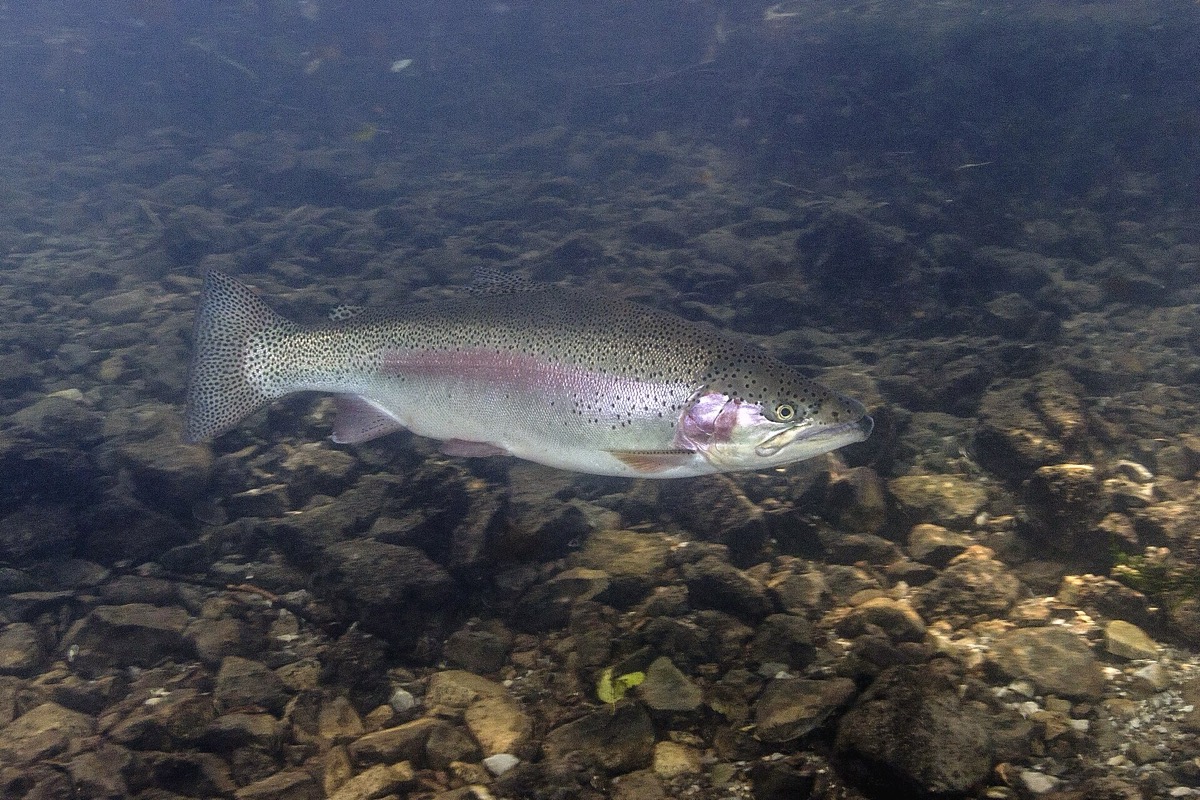
Field observers keep finding fish holding station in churning water when calmer flow is available a body length away. Behind an obstacle a trout adopts the , swinging its body wide and beating its tail in time with the vortices coming off the cylinder. The obvious reading is that it is hiding in the slack water. Liao put electrodes in the swimming muscles to see what they were doing. How much work is the fish putting in?
Far less than in smooth flow, and sometimes none. During the Karman gait the muscle activity was significantly reduced though still rhythmic, and the trout used only its anterior , abandoning the front-to-back wave that drives ordinary swimming. When the paired fins were active, no axial muscle activity registered at all. A dead trout towed behind the same cylinder confirmed the point: the vortices themselves can push a body upstream.
Fish in rivers often prefer turbulent water to uniform current, which looks like a bad choice. Behind a rock or a piling, a trout will adopt the Karman gait: body swinging in large lateral oscillations, tail beating at exactly the frequency the obstacle sheds its vortices.
The easy explanation is drafting. Water immediately behind a cylinder moves more slowly, so a fish there has less current to fight. Liao tested that by recording electromyograms from the red and white axial muscles of rainbow trout holding station in a .
The muscle pattern came out significantly reduced but still rhythmic compared with steady swimming, and selective in a telling way. The trout activated only anterior red axial muscle and abandoned the front-to-back wave of activity that drives undulatory swimming. Head motion during the gait was no longer correlated with that muscle activity, meaning the vortices, not the fish, determined where the head went.
The sharpest observation came from the moments when the paired fins were active and no axial muscle activity appeared at all. Dead trout towed behind the same cylinder confirmed it: a body with no muscle activity whatever can be carried against turbulent flow. Holding the gait for long stretches still demands a shift in neural control, which the author reads as a entrained by the vortices themselves.
wat. The fish is not sheltering behind the rock. It is riding the spinning water the rock leaves behind.
wat wat
Turbulence is usually modeled as a cost that a swimmer has to overcome. Here a fish extracts energy from it, which inverts the accounting for anything moving through moving water.
How do we know?
Liao recorded electromyograms from the red and white axial muscles of rainbow trout holding station in a vortex street, comparing them against steady swimming and against dead trout towed in the same flow.
What is still unknown
One species in a flow tank behind a cylinder, which is a far tidier vortex street than a river produces. Passive thrust appears at moments rather than continuously, and holding the gait for long still takes neural control.
Learn something?
Where to next
 A scorpion gave up its tail to escape. How does it live on with no anus?movement
 A fish has no cortex like ours. So how does it tell faces apart?fish
 Does a bee see the world differently once it starts moving?movement