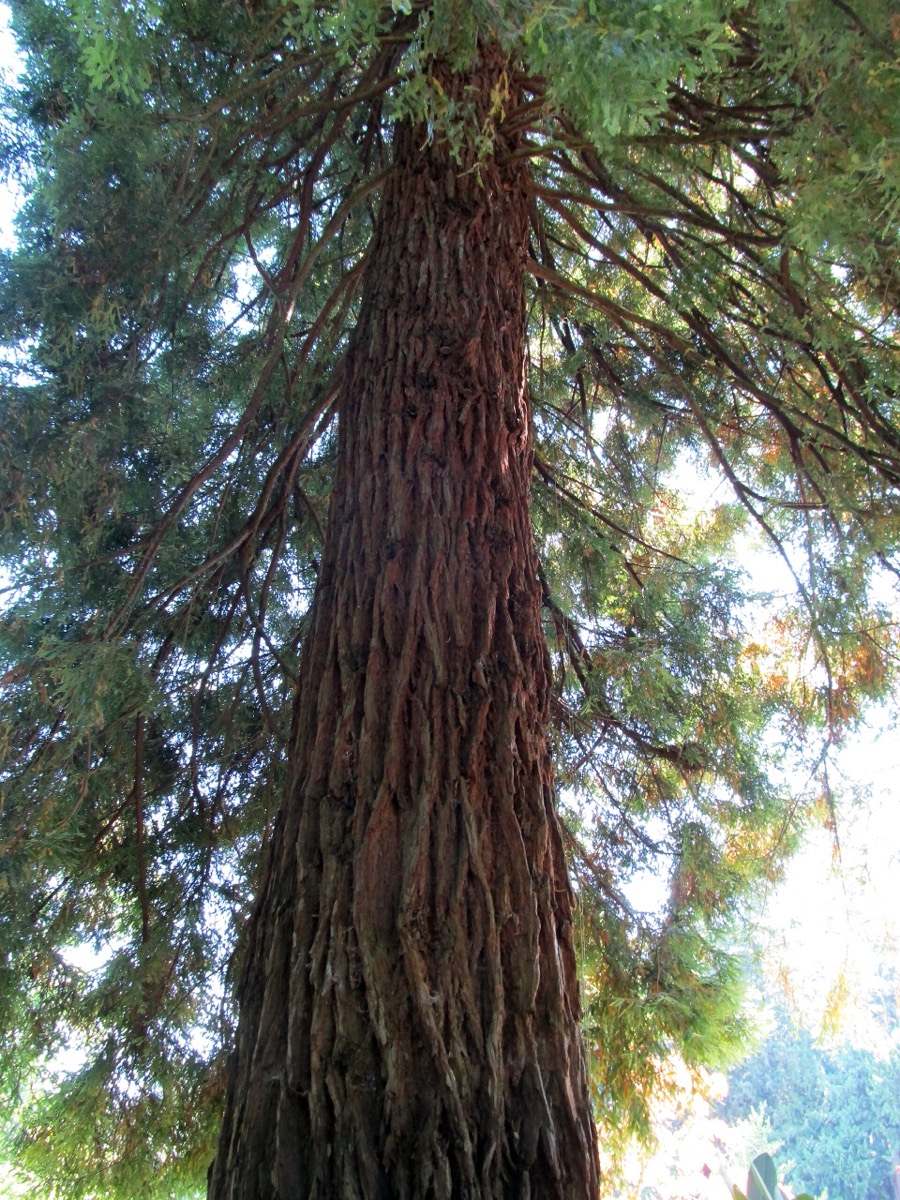
A tree has no pump. Evaporation from the leaves puts the column of water inside its vessels under tension, and that tension is what pulls the water up. The taller the tree, the more tension it takes. Where does that stop?
At some height the tension reaches the point where air bubbles form inside the vessel and the flow breaks, a process called . Which is why the leaves at the top of a giant tree are smaller and more tightly packed: they live in chronic water shortage, their runs low, and adding height stops paying for itself. The tree is not felled by an event. It slowly suffocates at the top.
The limit here is not mechanical strength, which is the usual guess. A tree does not collapse under its own weight, and it stops growing long before it would. The limit is hydraulic: how to get water to the top.
The mechanism is simple and rather beautiful. No pump anywhere, only evaporation: a water molecule leaving the leaf drags the next one after it. And because water molecules cling to one another, from root to leaf sits under tension the whole way, like a rope pulled taut.
The taller the tree, the more tension it takes, and the likelier it becomes that a bubble forms and breaks the column. Around a hundred and thirty meters this turns serious. The demonstration took the direct route: climb tall , sample leaves at several heights, and measure water tension and photosynthesis at each.
What they found is that the leaves at the top live in chronic water shortage. They are smaller and more tightly packed, and their photosynthesis is lower. So a tree is not stopped by anything dramatic; it slowly suffocates at its upper end, until another meter of height no longer pays. The limit depends on species and climate, which makes it a range and not a line. It is also what worries people about tall forests if the air gets drier.
wat. The leaves at the top of a giant tree are smaller, because at that height the water barely reaches them.
wat wat
It explains why tree heights around the world converge on a similar range, and what would happen to tall forests if the air got drier.
How do we know?
Researchers climbed tall redwoods and sampled leaves at different heights, measuring water tension and the rate of photosynthesis at each one.
What is still unknown
The limit depends on the species and the local climate, so the number is a range rather than a sharp line.
Learn something?
Where to next
 How does one rodent survive 18 minutes with no oxygen?physiology
 Which street trees actually feed the birds of a city?trees
 Is there a best angle for skipping a stone?water