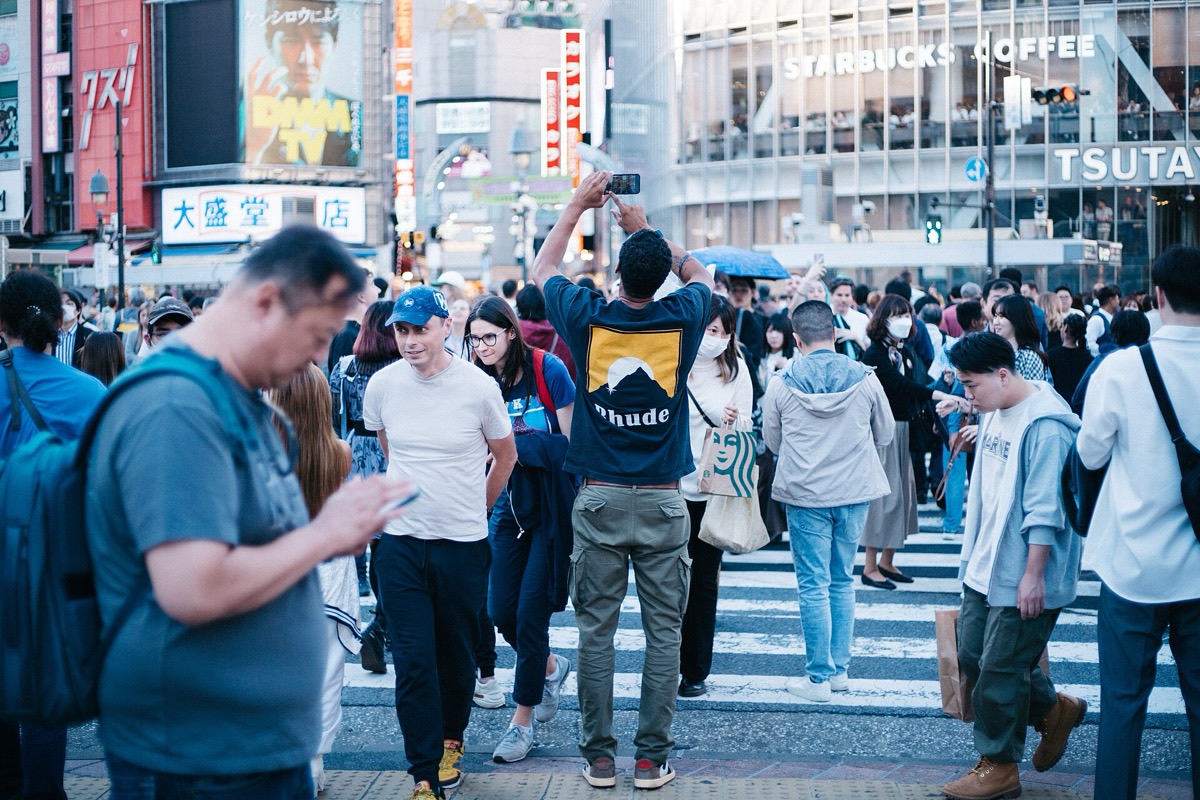
Walking through a station, you continuously adjust your path to keep a comfortable distance from strangers and to avoid hitting them, and you do it without deciding to. Modeling that has been hard because real avoidance events are buried inside enormous, messy tracking data. Corbetta and colleagues had six months of it from a train station. What does the maneuver look like?
Two forces, long and short range. The model treats avoidance as a sight-based long-range force plus a hard-contact short-range one, laid over a random-walk description of how a person moves when nobody is in the way. It reproduces the statistics of real avoidance: how far people step aside, how fast they pass, and even the rare actual bumps.
The behavior is so ordinary it is easy to miss as a problem. While in motion, pedestrians continuously adapt their walking paths, trying to preserve mutual comfort distances and to avoid collisions, and the adaptation starts well before contact would occur.
The data set is what makes a quantitative answer possible. Several million real-life trajectories, drawn from about six months of high-resolution pedestrian tracking in a train station using state-of-the-art observational experiments, in diluted crowds where encounters are mostly between two people.
The model layers interaction onto motion. Noninteracting walking is described by a dynamics with fast random velocity fluctuations over the slow dynamics of a hidden variable, the intended walking path. Onto that the authors superimpose long-range forces, based on sight, and short-range ones for hard-contact avoidance, and they allow those social forces to act on the intended path as well as the walked one. The result reproduces the statistics of collision avoidance: , passing speed, and the rare occurrences of actual bumping.
A second problem hid inside the first. Comparing against a database of very heterogeneous real conditions means finding, automatically, just the events that are avoidance interactions. The authors propose a general approach based on a graph representation of pedestrian trajectories, reducing the complexity enough to classify and select the relevant data. The work took the Physics Prize, for experiments on why pedestrians do not constantly collide with each other.
wat. You start steering around a stranger before anything could touch, and the model needs your intended path as well as your actual one.
wat wat
The model has a hidden variable in it: the path you intend to walk. Social forces act on that intention as well as on the path you actually take.
How do we know?
A physics paper built on several million real-life pedestrian trajectories, from about six months of high-resolution tracking in a train station. A graph representation of those trajectories picks out the binary avoidance events inside the database.
What is still unknown
Diluted crowds and binary encounters, which is two people at a time in a thin flow. Dense crowds and group behavior are not what this addresses, and the whole thing rests on one station.
Learn something?
Where to next
 Why does applause spread through a hall even when the person beside you is silent?crowds
 Does a mindful walk have to be in nature to do you any good?walking
 If you were attacked in the street, would anybody actually step in?crowds