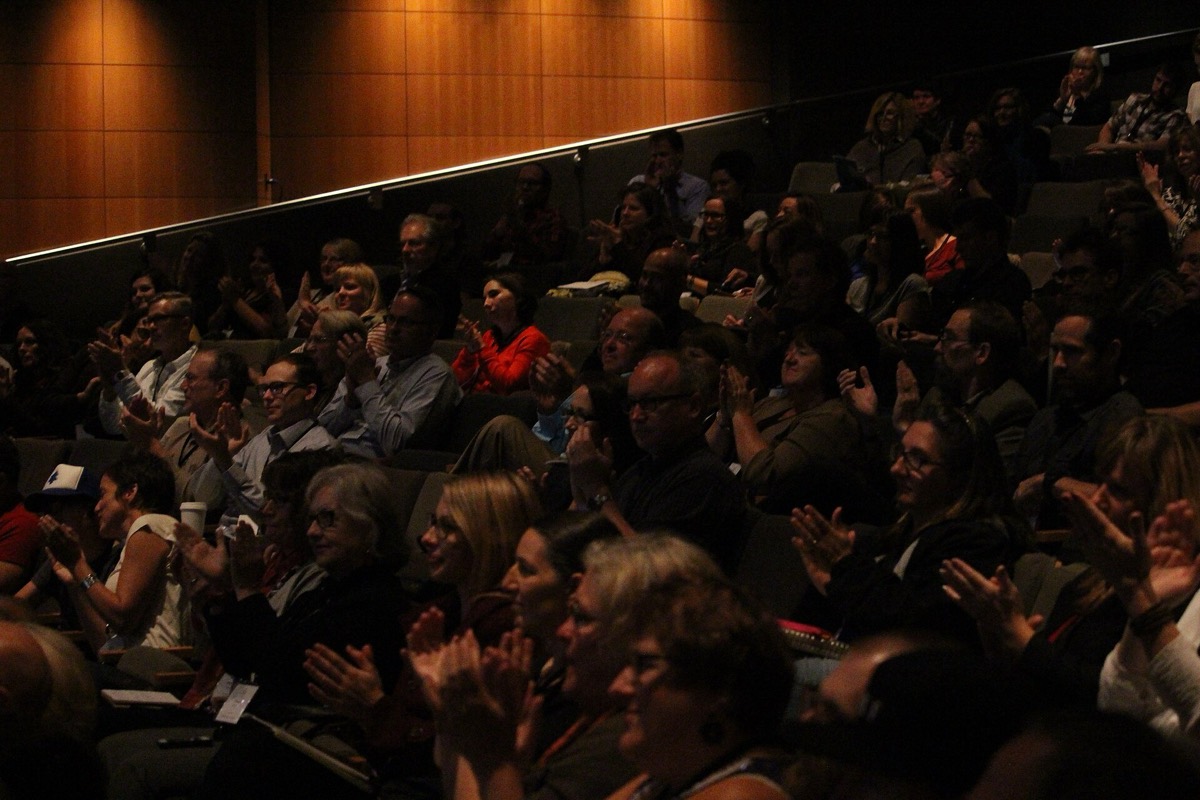
At the end of a talk one person starts clapping and the rest join, and the natural assumption is that it travels from neighbor to neighbor like a cough. has plenty of mathematical models and very little data to test them against. Researchers recorded a real audience and compared the models. What actually makes a person clap?
The count, not the neighbor. A person’s probability of starting to clap rose in proportion to how many in the room were already clapping, with no clear dependence on how close those people were sitting. was socially driven too, tempered by a reluctance to clap too many times. People also differed consistently in how readily they started and stopped.
How long an audience claps feels like a measurement of what just happened on stage. Clapping is also a social act, since everybody hears everybody else and decides whether to join or to stop.
Models of social contagion are abundant and rarely tested. So the researchers recorded when each person in an audience started and stopped clapping after academic talks, and used Bayesian model selection to let the hypotheses compete against data.
The probability of starting rose in proportion to the number already clapping, with no clear role for . Stopping was socially mediated as well, with a personal reluctance to clap too long acting against it, and the between people were consistent.
The consequence is uncomfortable for anybody who reads an ovation as a verdict. The model predicts that the time an audience spends clapping can vary considerably with no difference whatever in the quality of the talk. The setting is academic, so the numbers belong to that room, and the mechanism is not flattering anywhere.
wat. In a lecture audience, the number of people already clapping mattered more for joining in than how near they were.
wat wat
The length of an ovation reads like a score for the speaker, and a large part of it is the audience responding to itself.
How do we know?
Mann and colleagues used Bayesian model selection on the start and stop times of clapping in audiences after academic presentations, testing competing hypotheses about how the behavior spreads.
What is still unknown
The setting was academic talks. Nothing here establishes that the same dynamics govern a rock concert, a ceremony or a very small room, and it does not claim that audiences never respond to content.
Learn something?
Where to next
 Why do two people walking toward each other almost never collide?crowds
 If you were attacked in the street, would anybody actually step in?crowds
 How does a swarm of bees agree on where to live?modeling