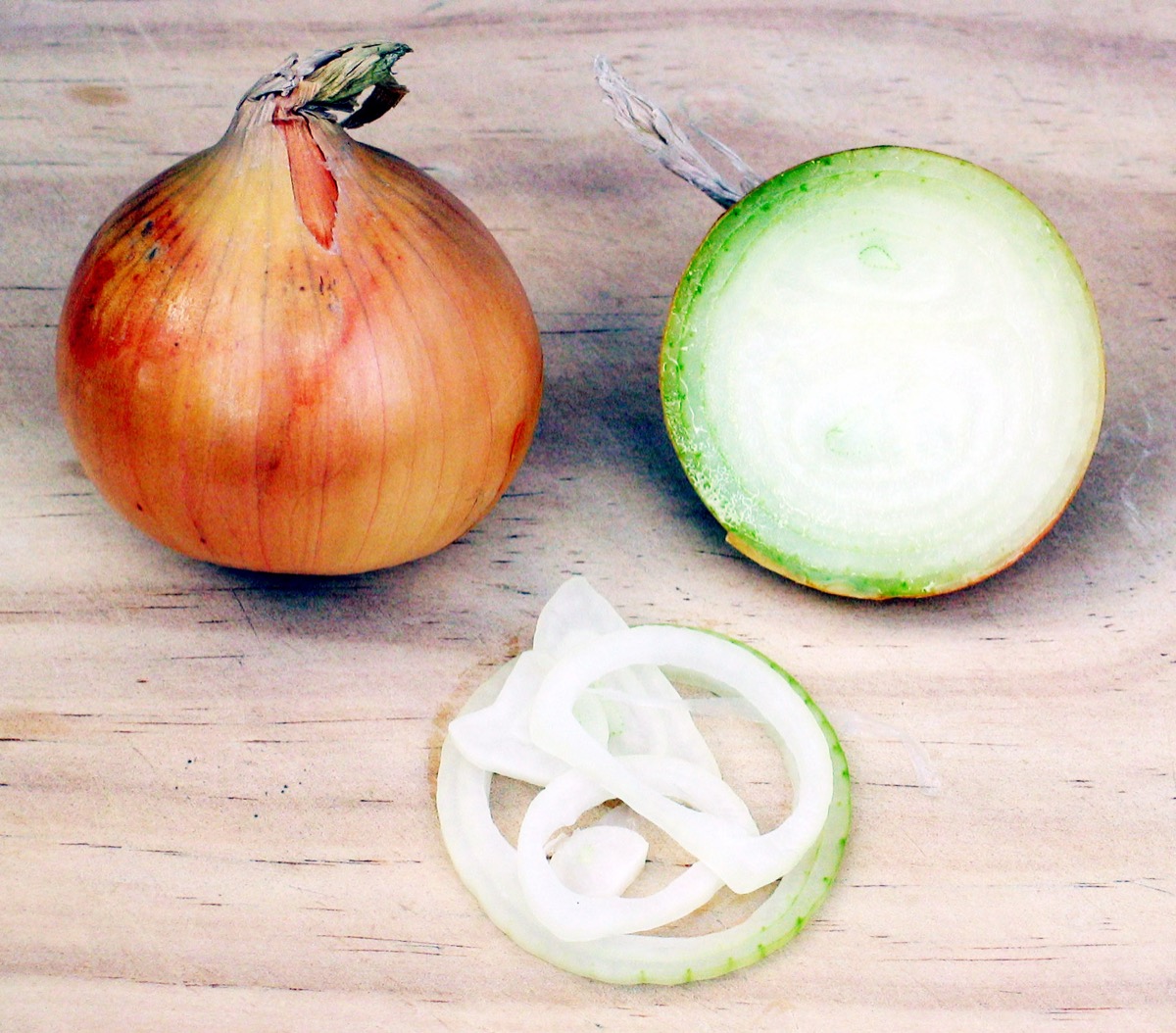
Cut any Allium and an enzyme cleaves its sulfur compounds into reactive pieces. In garlic those pieces condense into allicin and its relatives. In onion they take a detour: one more enzyme converts the key intermediate into the irritant that stings your eyes. Eady and colleagues silenced that enzyme. The interesting part is not the tears. It is what appeared instead.
Compounds that onions were not known to contain. Silencing the enzyme shifted the breakdown pathway, so more of the intermediate condensed into a thiosulfinate nobody had ever found in an onion. Downstream came a isomer and other volatile sulfur compounds, previously seen in traces or not at all, forming without any enzyme at the final step.
Allium species build a unique set of sulfur compounds from the amino acid cysteine. When tissue is disrupted, the enzyme cleaves those compounds into sulfenic acids, and volatile sulfur products follow, carrying the flavor and the bioactivity of each species. In garlic the dominant precursor yields allicin, and then the disulfide it decomposes into, which is the dominant volatile the plant releases.
Onion starts from a different precursor, which ought to produce the analogous pair. It does not. Nobody had ever found the predicted thiosulfinate in an onion, and the corresponding disulfide only tentatively, in trace amounts. What dominates instead is propanthial S-oxide, the , along with a methane thiosulfinate and a dipropyl disulfide. Imai and colleagues showed in two thousand and two that one enzyme, lachrymatory factor synthase, performs that conversion.
The prediction was that removing the enzyme would let the unstable intermediate condense with itself instead. Eady and colleagues silenced the gene with in six plants of a crop that resists genetic transformation, reducing the enzyme activity by up to fifteen hundredfold. Wounded onions produced significantly less of the irritant, and a novel colorimetric assay confirmed the pathway had shifted toward the thiosulfinate.
The downstream effect is the finding. The raised thiosulfinate level drove a marked increase in compounds forming without any enzyme: a zwiebelane isomer, the propenyl disulfide, and a mercapto-dimethyl-dihydrothiophene, none of which anyone had found in onion except in traces. Analogues of these in garlic are associated with antiinflammatory, antiplatelet, anticancer and lipid-lowering attributes, which is why the authors discuss consequences for health and flavor rather than only for tears.
wat. Switch off the enzyme that makes you cry and the onion starts producing the chemistry everyone values in garlic.
wat wat
The tear-inducing enzyme had been quietly diverting the pathway away from the garlic-like compounds that carry much of the health interest in this plant family.
How do we know?
Eady and colleagues used RNA interference silencing of the lachrymatory factor synthase gene in six onion plants, then tracked the sulfur compounds with a novel colorimetric assay and volatile analysis.
What is still unknown
Six plants, in a crop the authors call recalcitrant: a large genome, heterozygous, slow to generate and poor to manipulate. The consequences for health and flavor are discussed rather than measured.
Learn something?
Where to next
 How did a color experiment in Berlin create a blue painters had never known?chemistry
 Why did ancient pots hide some of the plants cooked in them?plants
 Why is a ship that survived three hundred years in water falling apart on land?chemistry