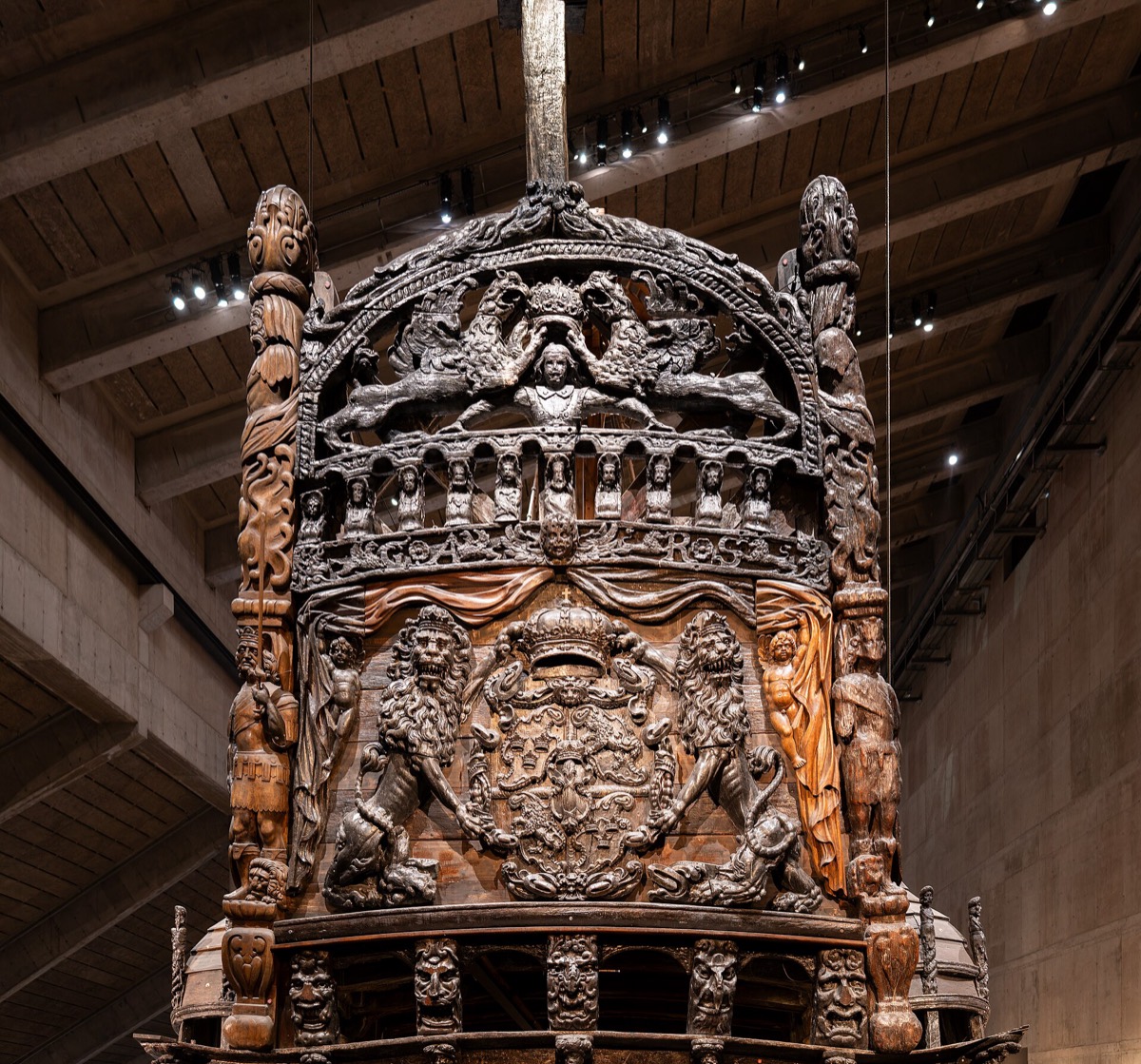
The Vasa sank in Stockholm harbour on her maiden voyage in 1628 and was raised almost intact after 333 years. The cold, brackish water preserved the wood better than any storehouse, and the ship was dried, treated and put in a museum of her own. Then, after years in a climate-controlled hall, salt stains appeared on the timbers and the acidity jumped. What is happening to the wood?
Curiosity counts. Here is the answer.
The mud on a harbour floor holds almost no oxygen, and hydrogen sulfide formed there seeped into the wood and settled in it as sulfur. While the ship was under water this did her no harm. The iron that now speeds the oxidation comes from two sources: the original bolts, which corroded away completely, and bolts added after the ship was raised. Part of the problem was created during the rescue.
The sea left a chemical charge inside her. Sulfur accumulated in the timbers in its elemental form, between 0.2 and 4 per cent of the weight of the wood, alongside sulfur compounds in intermediate . While the ship lay in oxygen-poor water this did no harm. In air the sulfur oxidizes and becomes , which breaks down the cellulose. The paper puts a ceiling on it: up to 5,000 kilograms of sulfuric acid if all of it oxidized.
The rescue itself was an achievement. The Vasa sank in relatively shallow water, and the floor of the Baltic has none of the shipworm that eats wood in the Mediterranean and the ocean, so the hull stayed almost whole. In 1961 the ship was raised, and years of treatment followed. The water in the wood was slowly replaced with a soluble wax, which holds the cell walls in place instead of the water that washed out.
The problem appeared much later. White salt stains formed on many wooden surfaces, and the local acidity rose to levels dangerous for cellulose. A simple question became urgent: is this a surface phenomenon that can be cleaned, or a sign of something happening deep inside the timber.
The answer required measuring a state rather than a quantity. Methods that identify oxidation state showed elemental sulfur inside the wood, between 0.2 and 4 per cent of the weight, alongside compounds at intermediate stages. Most of the sulfur has not yet become acid, and the salt on the surface is only the part that has already oxidized.
The source is the period when the ship was safe. In the oxygen-poor mud of the harbour, formed, seeped into the saturated wood and settled there. As long as there was no oxygen, nothing happened. The moment the ship came into the air the oxidation began. The rate is driven by iron released from the bolts: the original ones, which corroded away completely, and others added as part of the rescue.
From this follows a practical conclusion that obliges the whole field. Treating cannot stop at mechanical stabilization and drying; it has to include removing sulfur and iron compounds before the object is exposed to air for long. What looks like a successful rescue can be the start of a ticking clock.
wat. Sulfur that seeped into the Vasa’s timbers while she lay on the harbour floor oxidizes in air into sulfuric acid, and takes the ship apart from inside.
wat wat
Conservation had assumed the enemy was rot, and that drying and climate control solve it. Here the object turned out to carry a chemical charge accumulated precisely while it was safe, with exposure to air as the trigger. That changed the priorities for treating waterlogged archaeological wood everywhere.
How do we know?
Spectroscopic methods examined samples from the ship’s oak timbers, identifying not only how much sulfur is present but which oxidation state it is in. That is the difference between salt already formed and a reservoir still waiting. Published in Nature in 2002.
What is still unknown
The large number is a theoretical ceiling rather than a forecast: it describes what would happen if all the sulfur in the wood oxidized completely, which is not what actually occurs. The rate of oxidation depends on humidity, temperature and the availability of iron, so it varies from area to area within the same ship.
Learn something?
Where to next
 What is actually fading The Scream?conservation
 How did a color experiment in Berlin create a blue painters had never known?chemistry
 Why does an old book have a smell you can actually archive?conservation