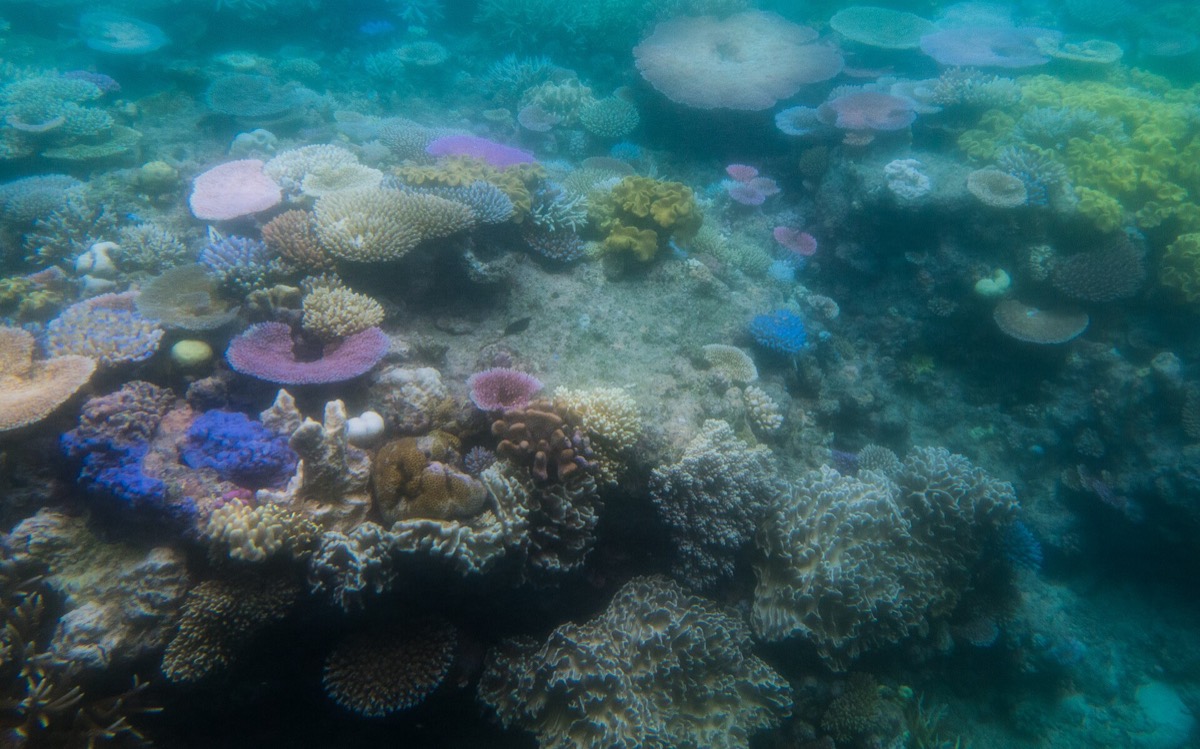
Its tenants, and its food supply with them. Bleaching is the process by which corals lose the that give them their distinctive colors and their main energy sources. The white is the coral’s own skeleton showing through tissue that has been emptied. If the bleaching is severe, disease and death become likely.
Mass bleaching, where corals bleach across tens, hundreds or even thousands of kilometers at once, was first observed in the early nineteen eighties. NOAA calls it one of the most visible and damaging marine ecological impacts of persistently rising ocean temperatures. Events have become more extensive, more frequent and more intense, and they now reach reefs that had never bleached before.
Coral reefs are among Earth’s most diverse ecosystems, and the benefits they provide have been valued globally at around ten trillion United States dollars each year. They are threatened by an increasing array of impacts, primarily , unsustainable fishing practices and land-based pollution. The first of those is the one that turns a reef white.
Bleaching is the process by which corals lose the symbiotic algae that give them their distinctive colors and their main energy sources. That sentence contains the whole problem. The algae are not decoration, they are the food supply, so an expelled population leaves an animal that is still alive and no longer fed. If a coral is severely bleached, disease and death become likely.
, where corals bleach over a wide area spanning tens, hundreds or even thousands of kilometers, was first observed in the early nineteen eighties. It has become one of the most visible and damaging marine ecological impacts of persistently rising ocean temperatures. Severe bleaching is now more extensive, more frequent and more intense, as both heat stress events and new multi-decadal observation datasets show.
The 2014 to 2017 global event is the example NOAA reaches for, described as the longest, most widespread and most damaging bleaching event on record. Events now often last many months, are becoming annual, and are reaching reefs that never bleached before. NOAA established the Coral Reef Watch program in 2000 for exactly this, combining satellite, modeled and in-situ data into a global . One caution: this is a program overview, so it states the picture rather than measuring any part of it.
wat. A bleached coral is still alive, and has just lost what was feeding it.
wat wat
The color is an early-warning signal that can be seen from orbit. A reef that has gone white has not died yet, which is the window in which anything can be done.
How do we know?
NOAA’s Coral Reef Watch program, established in 2000, uses satellite remote sensing together with modeled and in-situ data to predict, observe and issue alerts on heat stress affecting coral reefs worldwide.
What is still unknown
A program overview rather than a research paper. It summarizes the state of knowledge and the case for monitoring, and gives no measurements of how much heat stress produces how much bleaching.
Learn something?
Where to next
 Where has almost all the trapped heat actually gone?oceans
 If trees cancel almost half the urban heat effect, why does the thermometer barely move?heat
 Why does the ocean get colder the deeper you go?oceans