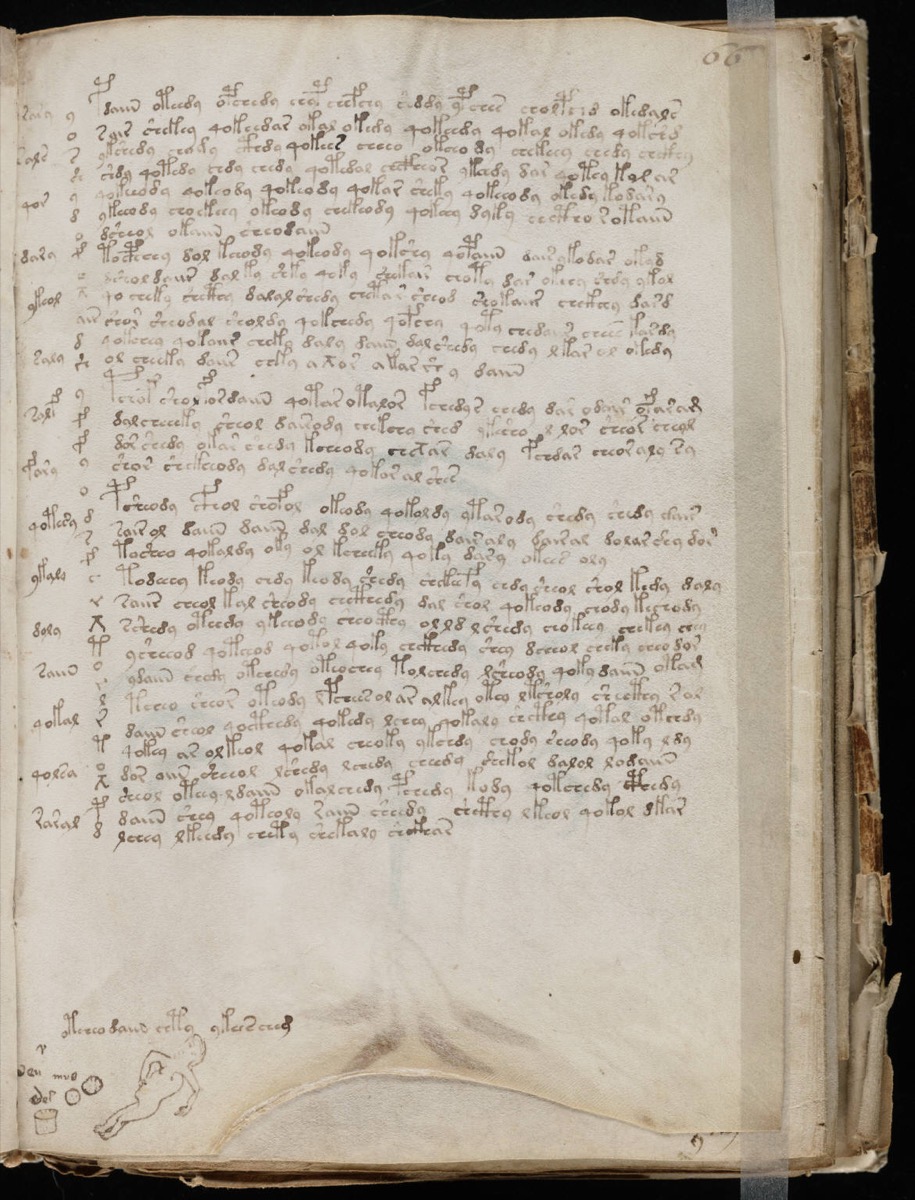
The book was written in Central Europe in the fifteenth century: two hundred and forty-six pages of covered in a looping script of twenty-five to thirty characters. Drawings of plants, planets, castles, dragons and naked figures run among them. Alan Turing could not unscramble it. In two thousand eighteen a pair of computing scientists at Alberta ran an algorithm at it. Did that settle anything?
Not really, and the method shows why. The team trained an algorithm on three hundred and eighty translations of one UN declaration, then fed in the first ten pages, and eighty percent of the encoded words came back matching Hebrew. They handed the opening sentence to a native Hebrew speaker who could not translate it coherently, then used Google Translate. Other scholars are skeptical.
The physical object is unassuming: a book slightly larger than a modern paperback, two hundred and forty-six pages of vellum, with no index and foldouts long since missing. An elegant looping script of twenty-five to thirty characters runs left to right in short paragraphs, among detailed illustrations in green, brown, yellow, blue and red. Based on those pictures, scholars divide it into six sections: herbal, astronomical, biological, cosmological, pharmaceutical and recipes.
Its history is a chain of people who also could not read it. A German emperor bought it from an English astrologer in the late sixteenth century for six hundred Venetian ducats, believing it to be a work of Roger Bacon. It passed from there to a Bohemian pharmacist. bought it from a Jesuit library in nineteen twelve and tried to interest translators. Alan Turing, of Enigma fame, got nowhere with it either.
The Alberta attempt began with a guess about the . Suspecting a vowel-less , the researchers trained an algorithm on three hundred and eighty language versions of the Universal Declaration of Human Rights. Once it matched anagrams to modern words with a ninety-seven percent success rate, they fed in the first ten pages. Eighty percent of the encoded words came back as Hebrew.
The next steps are where it frays. A native Hebrew speaker could not render the opening sentence coherently, so the team turned to Google Translate because no other scholars were available. After correcting spelling they got a sentence that is strange but almost sensible. The objections are listed plainly: training on modern rather than medieval languages, and a fifth of the text matching Malay, Arabic or Amharic instead. Whether the manuscript is coded, constructed, or means nothing at all stays open.
wat. Eighty percent matched Hebrew, which leaves a fifth of the book matching Malay, Arabic and Amharic instead.
wat wat
The manuscript is the hardest kind of decipherment problem, because the code is unknown and so is the language. Anything that solves only one of those is not yet a solution.
How do we know?
Elaina Zachos reported the Alberta study for National Geographic, setting out the manuscript’s physical description, its history, the method behind the claim and the objections to it.
What is still unknown
The article lists the problems squarely. The algorithm was trained on modern languages rather than fifteenth-century ones, twenty percent of the text matched other languages entirely, and nobody knows whether the text is coded, constructed, or meaningless.
Learn something?
Where to next
 How many people does it take before two of them share a birthday?cryptography
 How did a blue stone in a nun’s teeth change what we knew about manuscripts?manuscripts
 How do scraps of paper from a synagogue reveal whole lives?manuscripts