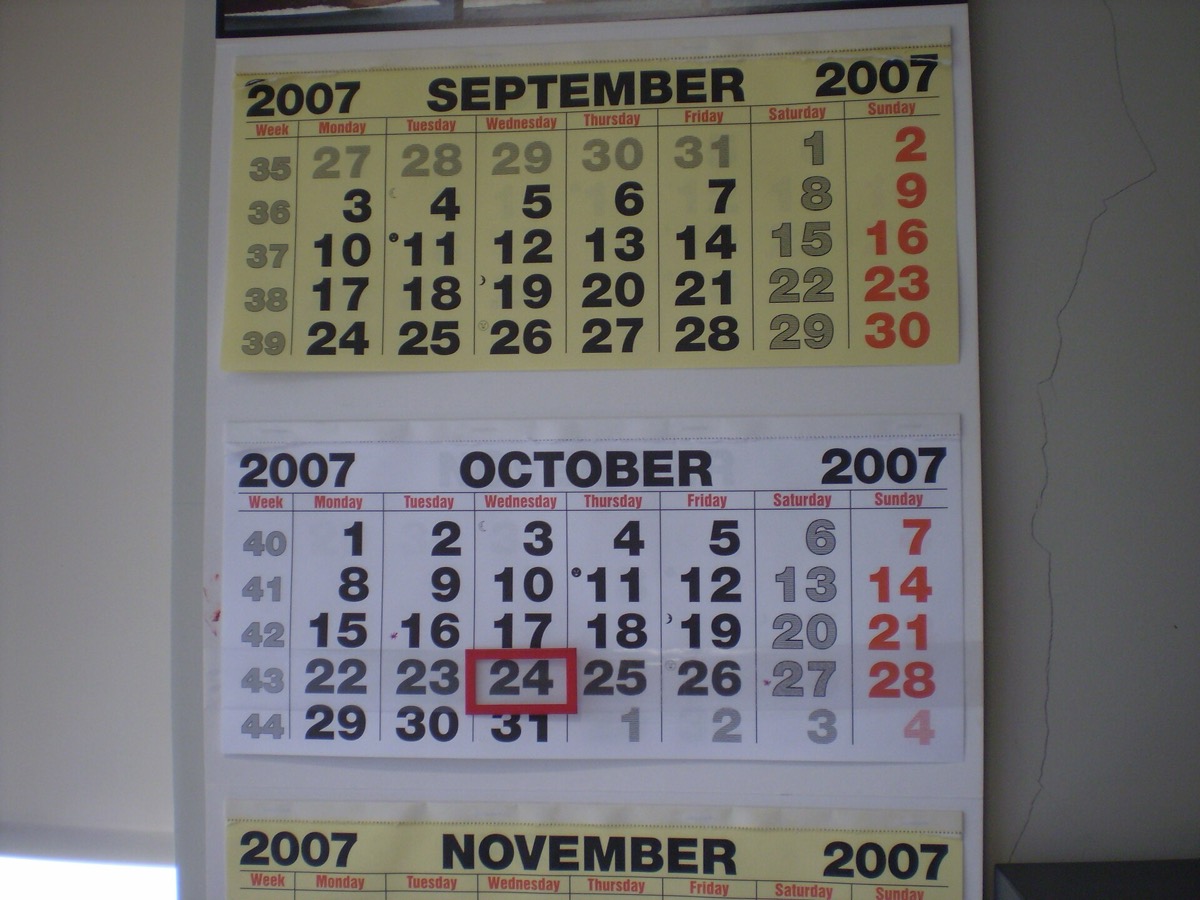
There are 365 days in a year, so it feels like a room would need hundreds of people before two birthdays collide. But the thing being counted is not people, it is , and every pair is its own chance to match. So how big does the room have to be?
Twenty-three people make 253 different pairs, not 23 comparisons, and that is already enough to cross even odds. The clean way to get there is backwards: work out the chance that nobody matches, then subtract it from one. At 70 people the odds are above 99 percent.
The confusion starts with the question, not the arithmetic. Ask what the odds are that somebody in the room shares your birthday and the answer really does need hundreds of people. The question here is a different one: what are the odds that some two people match, any two at all.
That change turns the count over. Twenty-three people do not make 23 comparisons, they make 253, because everyone is checked against everyone else. The number of pairs grows about as the square of the number of people, which is why it climbs so much faster than it feels like it should.
The simple way to compute it runs through the . Work out the chance that nobody matches, where each new arrival has to miss every birthday already in the room, then subtract that from one. The result crosses 50 percent at 23 people, and by 70 it is above 99.
None of this is a party trick, and the is not really a paradox either. In cryptography the same reasoning is called a , and it is why a hash signature has to be about twice as long as a first guess would suggest. The calculation does assume birthdays spread evenly across the year, which is not exactly right, and the real clumping only pushes matches up, so the conclusion survives it.
wat. A room of 23 people holds 253 possible pairs of birthdays, and that is already enough for even odds that two of them match.
wat wat
The same arithmetic sets how long a cryptographic signature has to be before collisions stop being practical to hunt for.
How do we know?
It is a direct probability calculation: multiply the chance that each new person misses everyone already in the room, then subtract the result from one.
What is still unknown
The calculation assumes birthdays fall evenly across the year. Real birth records clump a little by season and weekday, which only makes matches likelier, so the answer holds.
Learn something?
Where to next
 Can three dice each beat the next one around the circle?probability
 How can you estimate pi by dropping needles on a floor?probability
 What if the famous study disproving the hot hand had the maths wrong?probability