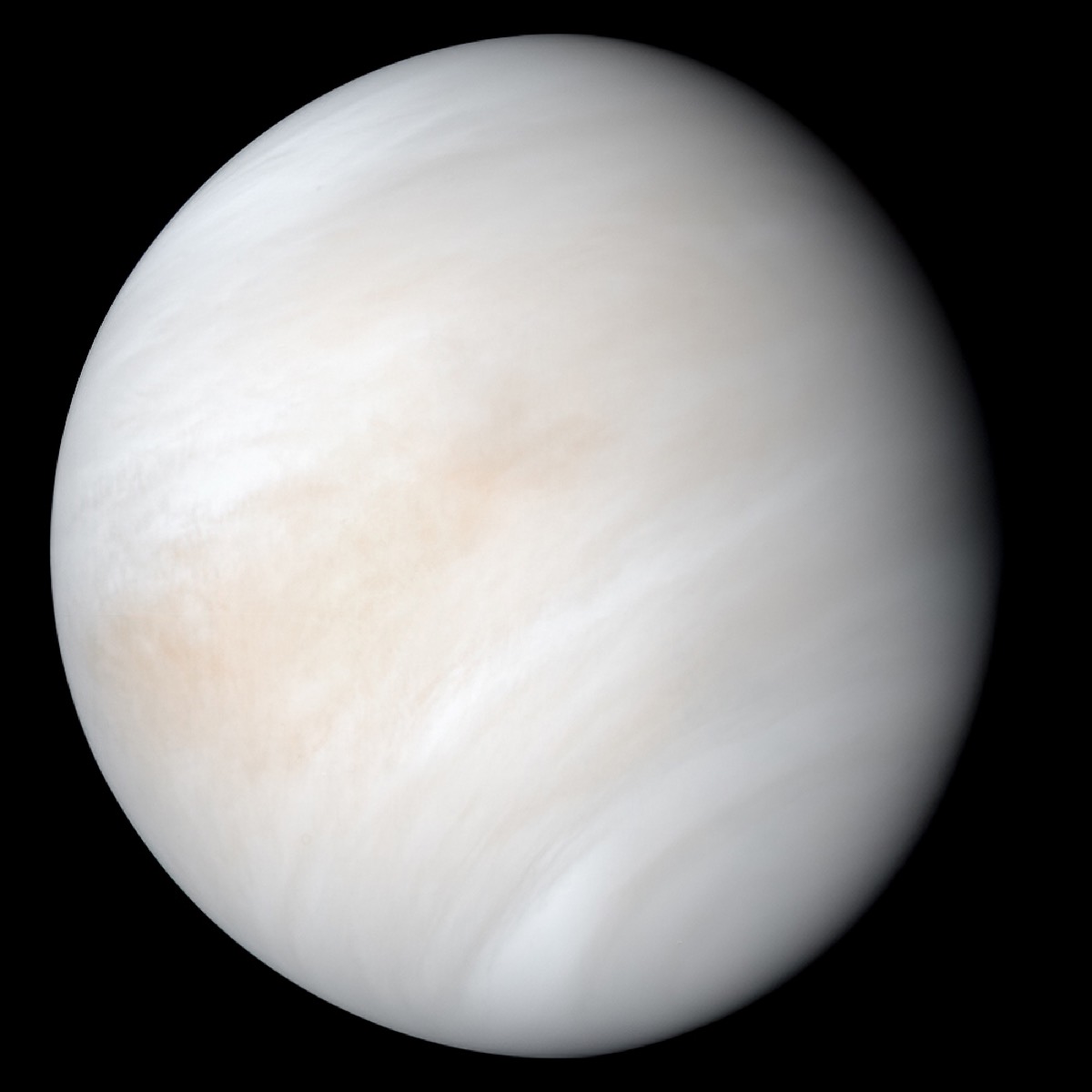
A planet spins while it orbits, and on Earth those two clocks are separated by a factor of 365. Nothing requires them to stay that far apart. The rotational period of one of our neighbors stayed unknown for a long time, because its clouds never let anybody watch the surface turn.
Venus, where a runs 243.0185 Earth days against an orbit of 224.70096. The year is shorter than the day by about 0.924 days. Radar penetrated the clouds in 1962 to measure it, and found the planet turning clockwise seen from the north pole, so the sun there rises in the west.
Venus orbits the Sun in the same direction as every other planet, taking 224.70096 Earth days for a full tour. Its is the lowest of any planet, at 0.007 against 0.0167 for Earth, so its orbit is the most circular, with an inclination to the ecliptic of about three and a half degrees.
Its spin was long a mystery. Astronomers could see small details in the atmosphere implying that the clouds circulated in about four days, opposite to the orbital direction, but the solid planet beneath them stayed hidden.
Radar settled it in 1962 by penetrating the clouds. The planet turns once in 243.0185 Earth days, clockwise as seen from the north pole, which is . The sun there rises in the west, and the sidereal day outlasts the year by roughly 0.924 days.
The two clocks being so close reshapes the experience of a day there. The is a little less than half the sidereal day, about 116 days and 18 hours. Days and nights each last almost two terrestrial months, though the thick atmosphere probably makes dusk and dawn very gradual.
wat. Venus finishes its orbit before it finishes a single turn.
wat wat
Two clocks this close together leave no way to ignore the difference between a solar day and a sidereal day.
How do we know?
The Royal Belgian Institute for Space Aeronomy sets out the measured orbital and rotational periods, including the 1962 radar determination that first pinned the rotation down.
What is still unknown
The cause of the retrograde rotation remains poorly understood.
Learn something?
Where to next
 How long do Saturn’s rings have left?solar system
 What is left behind when a star swallows one of its own worlds?planets
 Has anyone ever seen the Oort Cloud?solar system