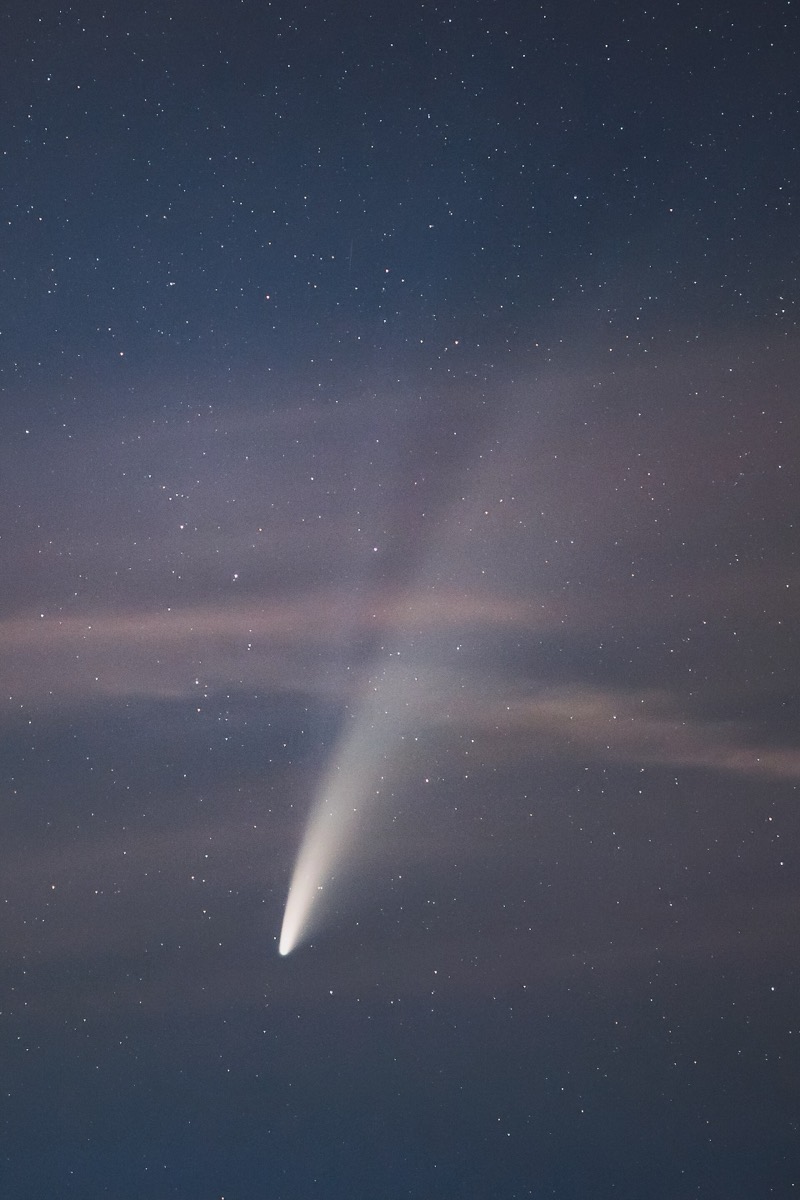
Long-period comets arrive from every direction, on orbits that take them far beyond the planets. In 1950 proposed where they come from: a vast, extremely distant of icy bodies surrounding the solar system. The proposal explains the comets. The shell itself is another matter.
No. NASA describes it as a group of icy objects, and places it between 5,000 and 100,000 from the Sun, perhaps one quarter to halfway to the next star. What we observe are the comets that come in from it, not the cloud they came from.
In 1950, the astronomer Jan Oort proposed that some comets come from a vast, extremely distant spherical shell of icy bodies surrounding the solar system. The giant swarm of objects now carries his name.
NASA places it between 5,000 and 100,000 astronomical units from the Sun. That makes it the most distant region of the solar system, extending perhaps one quarter to halfway from the Sun to the next star.
The crucial word in the description is theorized. NASA calls it a theorized group of icy objects coasting along their orbits, which is a careful way of saying that the evidence is the comets rather than the cloud.
That is not a weakness peculiar to this case. Plenty of astronomy infers a population from what arrives from it, and the honest version of the diagram marks this shell as the explanation it is rather than as a surveyed region.
wat. Nobody has seen the Oort Cloud; what arrives are the comets it would explain.
wat wat
A standard item on every diagram of the solar system turns out to be an inference, which is worth knowing when reading the diagram.
How do we know?
NASA sets out the proposal, its author and its date, the distances involved, and the careful word theorized, in the reference page it maintains for the region.
What is still unknown
This is a reference page stating the hypothesis and the distances, not an observational claim, because there is no direct observation to report.
Learn something?
Where to next
 How long do Saturn’s rings have left?solar system
 On which planet does the year end before the day does?solar system
 What happens when a comet is pulled apart and then swallowed by a planet?comets