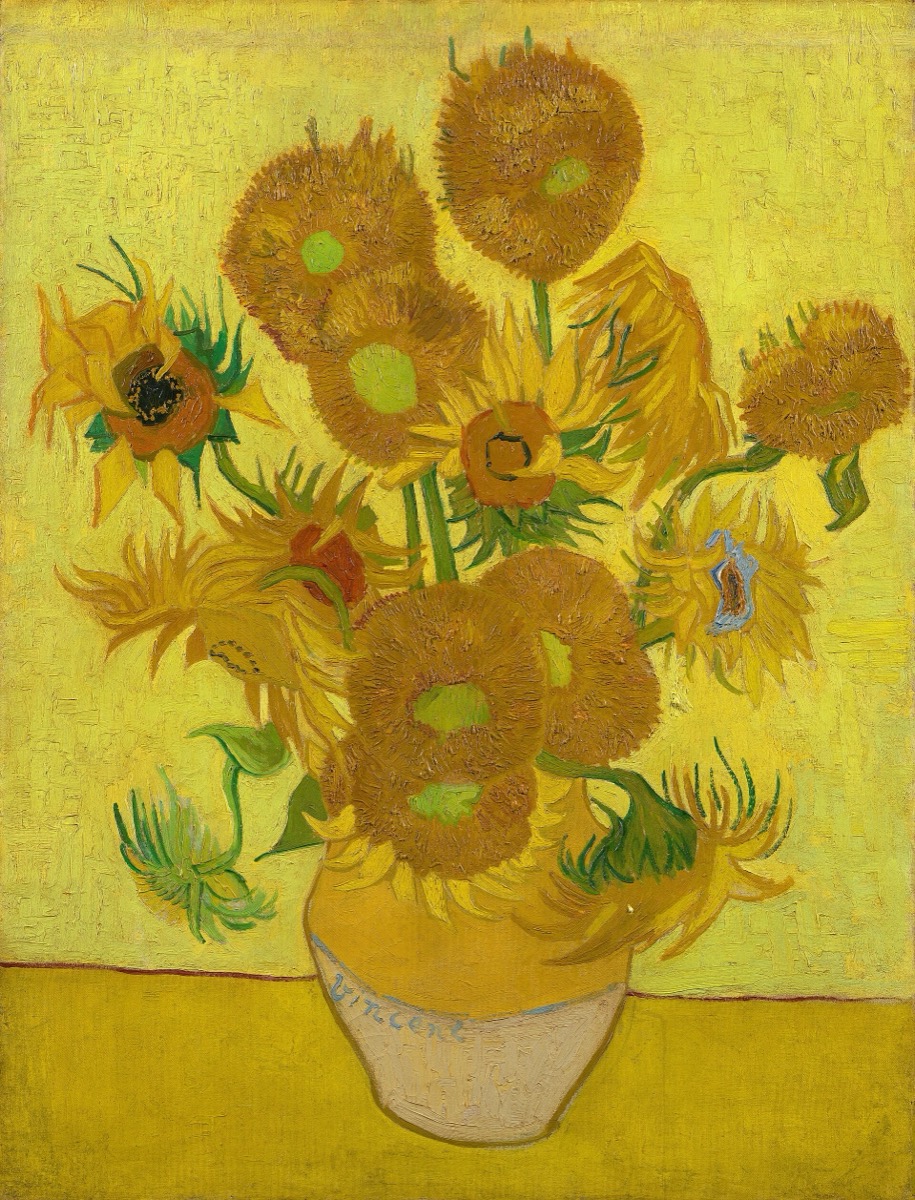
The yellow Van Gogh loved is called , a compound of lead and chromium invented in the 19th century that was cheap and brilliant. Today some of those areas look greenish brown. What is happening to the material, and why can it not be reversed?
Curiosity counts. Here is the answer.
The paint itself. Van Gogh’s yellow is chrome yellow, and inside it are chromium ions that change their oxidation state in response to light and turn brown. X-rays from a particle accelerator mapped the process and showed it is concentrated in the top few microns of the paint layer. That is why it cannot be cleaned or varnish-stripped back to the original shade: there is no foreign layer above the paint, the paint is what changed, and the change is not reversible.
The paint itself changed. Under exposure to light the chromium in the pigment undergoes a reaction that , and the color darkens to a greenish brown. The change happens in a thin layer at the surface only, and that is exactly the layer we see. The process is not reversible, so the original yellow is gone.
The sunflowers we see today are not the color Van Gogh saw. He chose chrome yellow precisely for its brilliance, and the shade that was most brilliant turned out to be the most vulnerable.
Researchers aimed X-rays from a at tiny samples from original paintings, alongside samples in the laboratory under strong light. They mapped the oxidation state of the chromium across a cross-section of the paint layer.
The picture that emerged also explains why it cannot be repaired. The change is concentrated in a few upper microns only, and that is exactly the layer the eye sees, with no dirt or varnish above it to remove. The paint itself is what changed, and the reaction is not reversible.
The caveat is that the rate of darkening depends on the exact composition of the pigment and on display conditions, and varies from painting to painting. So the precise original shade cannot be reconstructed from a sample, and the digital reconstructions shown beside paintings in museums are an informed estimate rather than a measurement. One practical thing does follow: display is an ongoing decision, and every year in front of light exacts a small, irreversible price.
wat. The yellow Van Gogh bought cheap and brilliant is still reacting to light today, and every year on display takes the painting further from the color he painted.
wat wat
A painting is not a frozen object. Part of what looks like an artistic decision is in fact chemistry that went on working a century after the painter put down the brush.
How do we know?
Researchers aimed X-rays from a particle accelerator at tiny samples from original paintings and at samples artificially aged in the laboratory, and mapped the state of the chromium across a cross-section of the paint. The darkening was concentrated in the uppermost microns alone.
What is still unknown
The rate of darkening depends on the exact composition of the pigment and on display conditions, and varies from painting to painting. The precise original shade cannot be reconstructed from a sample alone.
Learn something?
Where to next
 How do you read a sealed letter without opening it?conservation
 How did a blue stone in a nun’s teeth change what we knew about manuscripts?pigment
 What is actually fading The Scream?conservation