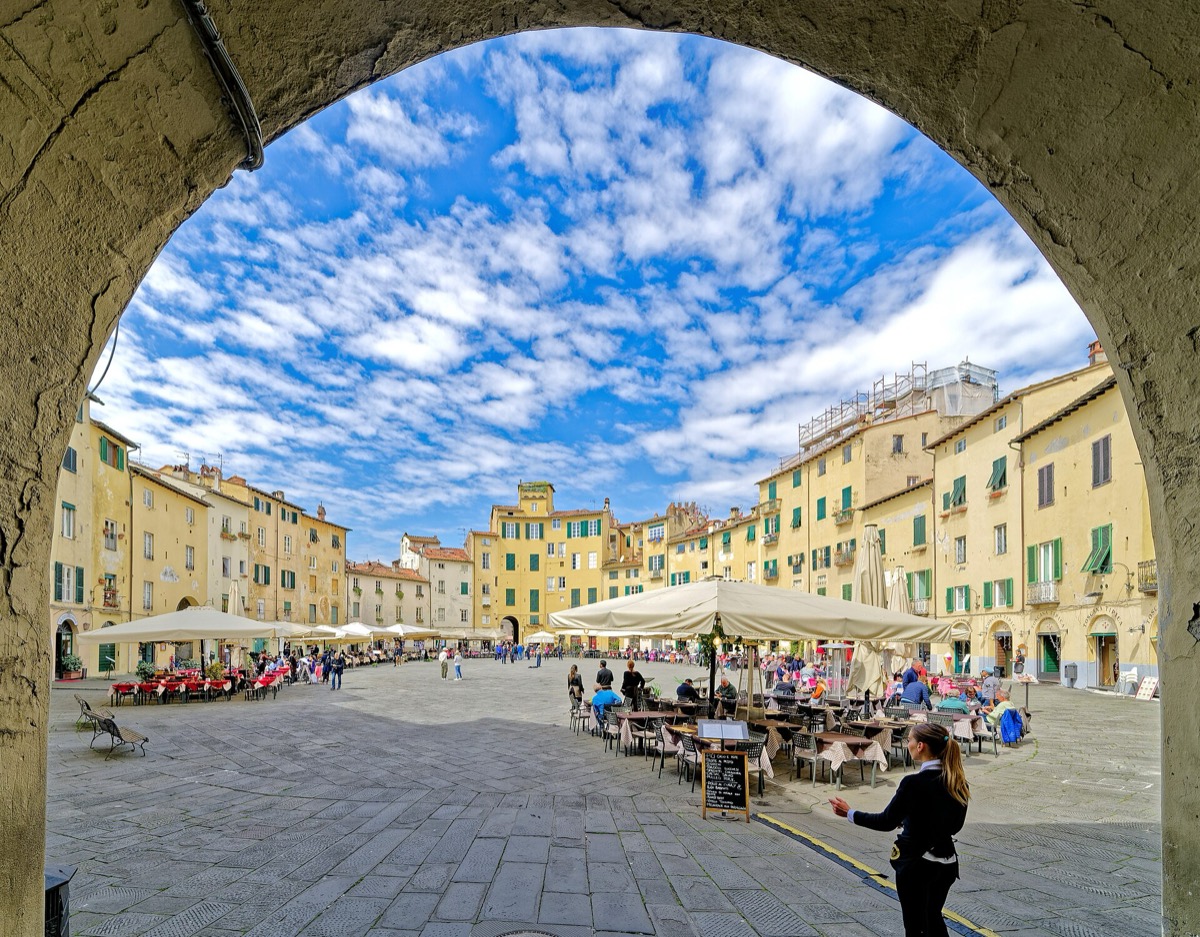
Piazza Anfiteatro in Lucca is an ellipse of pale houses with cafes under them, and no architect of the eighteen thirties would have chosen that shape from nothing. A Roman amphitheatre stood on the spot, built outside the walls in the first or second century. It fell into ruin during the barbarian invasions and was stripped. So how did its outline survive?
The houses kept it. After the amphitheatre was robbed of its entire facing and all its columns, people began building on the ruins that remained, using the surviving structures as foundations and walls, which preserved the shape perfectly. The amphitheatre itself now lies about three meters below ground. What stands above it is a ring of ordinary housing that happens to trace a Roman ellipse.
The Roman amphitheatre at Lucca was built outside the walls in the first or second century, elliptical, with two superimposed orders of fifty-five arches on pillars carrying the . The seating ran to twenty tiers and held ten thousand spectators. Today the structure sits about three meters below the modern ground surface.
It went to ruin during the barbarian invasions, and then became something more useful than a monument: for centuries it served as a kind of for building material. It was stripped of its entire facing and of all its columns. By the Middle Ages it was known not as an amphitheatre but as the , the caves.
What happened next is the part worth noticing. Houses and other buildings began to go up on the remaining ruins, using the surviving structures of the amphitheatre as they stood. Building against what is already there is the cheap option, and the consequence was that the outline of the Roman building was preserved perfectly, in a material that had nothing to do with it.
The square as it looks now dates from eighteen thirty, when the architect had some of the constructions that had risen in the center pulled down and created the street around it, via dell’Anfiteatro. He did not design the ellipse. He cleared the middle of a shape that a thousand years of unsentimental reuse had already kept.
wat. Nobody preserved the amphitheatre. They quarried it, built against what was left, and the shape outlived the building.
wat wat
A city does not usually remember on purpose. Here the memory survived because robbing a ruin and building against what is left is cheaper than clearing the site.
How do we know?
The Lucca tourism office’s description of Piazza Anfiteatro sets out the amphitheatre’s construction and dimensions, its use as a quarry, the houses raised on its remains, and the nineteenth-century work that opened the square.
What is still unknown
A tourism office page rather than an archaeological report. It gives the outline of the sequence and the figures for the original building, without the evidence behind either.
Learn something?
Where to next
 If trees cancel almost half the urban heat effect, why does the thermometer barely move?cities
 How many people in the world can no longer see the Milky Way?cities
 How much does one tree over a sidewalk change a summer afternoon?cities