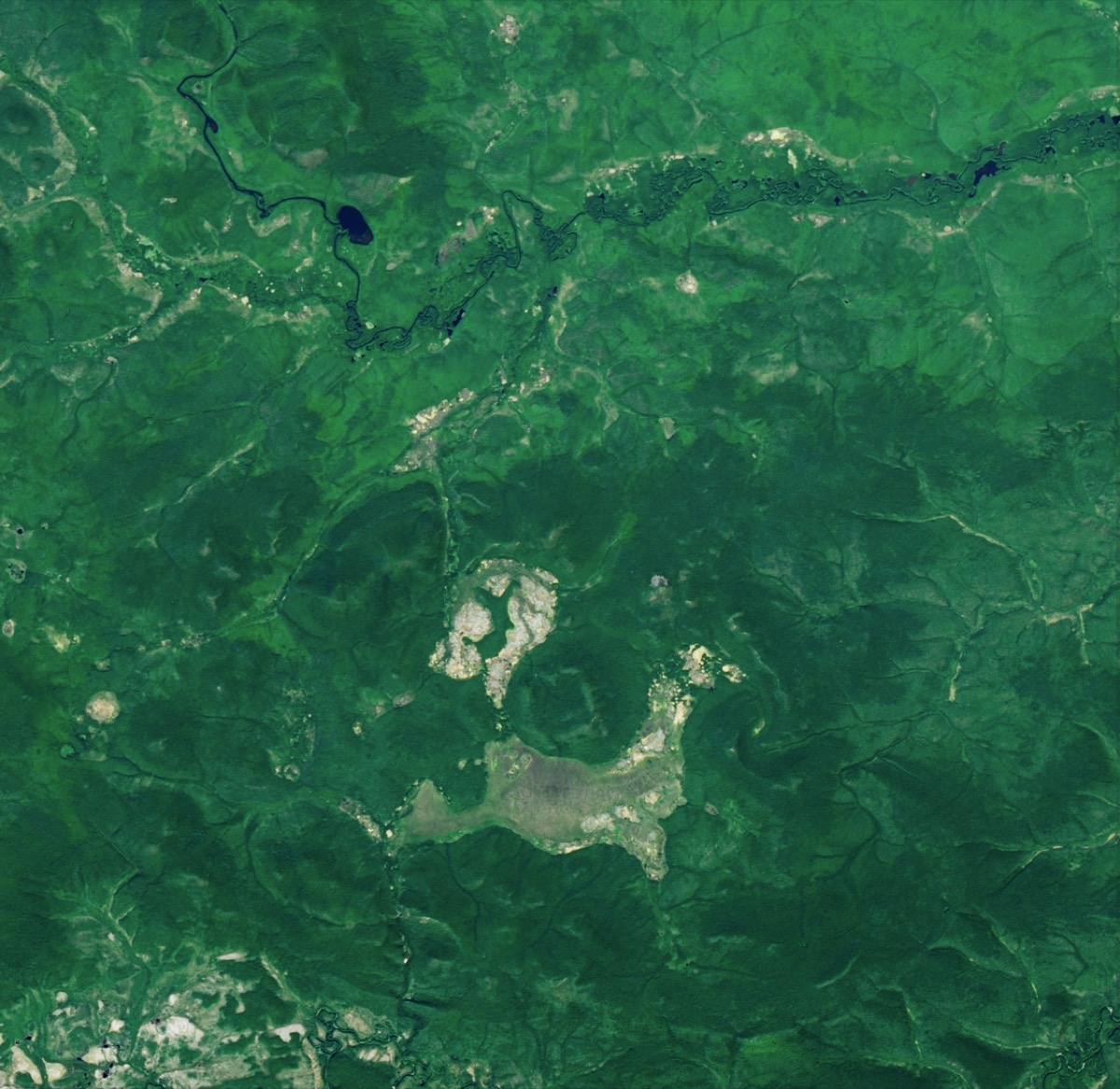
On a June morning in nineteen hundred and eight, something exploded over central Siberia with the force of up to fifteen megatons of TNT, a thousand times the Hiroshima bomb. Seismographs in western Europe picked it up. Trees fell outward for tens of kilometers. The first expedition reached the site nineteen years later and found no crater at all.
An explosion in the air, five to ten kilometers up. The object never reached the ground: it broke apart and vaporized at altitude, producing a and a but no impact crater. The only likely remains ever found are a few fragments less than a millimeter across. The was easy to locate anyway, because every felled tree pointed away from it.
The numbers set the scale. The explosion is estimated to have happened at about a quarter past seven in the morning on the thirtieth of June, nineteen hundred and eight. It burst at an altitude of five to ten kilometers above the Podkamennaya Tunguska River in central Siberia. It flattened some two thousand square kilometers of pine forest and charred more than a hundred, with energy put at as much as fifteen megatons of TNT, a thousand times the bomb dropped on Hiroshima.
What hit is still open. One camp reads the records of bright over Europe afterward as evidence of a comet, whose rapid vaporization would have flooded the upper atmosphere with ice crystals. Another holds that it was an asteroid perhaps fifty to a hundred meters across, of stony or carbonaceous composition. Objects that size are estimated to strike Earth once every few hundred years.
The absence of a crater follows from where the explosion happened. Because the object exploded high in the atmosphere, it created a fireball and a blast wave but left no impact crater. The only likely remains ever found are a few fragments, each less than a millimeter across. The radiant energy was enough to ignite the forest, but the blast wave overtook the fires and put them out, which is why the trees were charred rather than burned.
Leonid Kulik led the first expeditions to the remote site, from nineteen twenty-seven to nineteen thirty. Around the epicentre he found splintered trees lying radially for fifteen to thirty kilometers, all pointing away, which made the spot easy to pinpoint; there he found a marshy bog. Eyewitnesses farther off had described a fireball on the horizon, then trembling ground and hot winds that threw people down. Soviet scientists returned from nineteen fifty-eight to nineteen sixty-one, and an Italian-Russian expedition followed in nineteen ninety-nine.
wat. No crater, because nothing landed. The air above the forest knocked it flat.
wat wat
An object fifty to a hundred meters across is thought to hit Earth once every few hundred years, and this is what one does. The damage was done entirely by air.
How do we know?
Britannica’s account of the event, drawing on eyewitness reports, European seismograph records and the expeditions to the site. Soviet scientist Leonid Kulik led the first of them between nineteen twenty-seven and nineteen thirty.
What is still unknown
The identity of the object is still argued. Some scientists read the bright skies afterward as the signature of a comet, others hold it was a stony or carbonaceous asteroid, and almost nothing survived to settle it.
Learn something?
Where to next
 Water bears were fired from a laboratory gun. Which crash did they survive?impact
 What was waiting inside a sample from an asteroid that was never opened on Earth?asteroids
 What does it take to move an asteroid off its course?asteroids