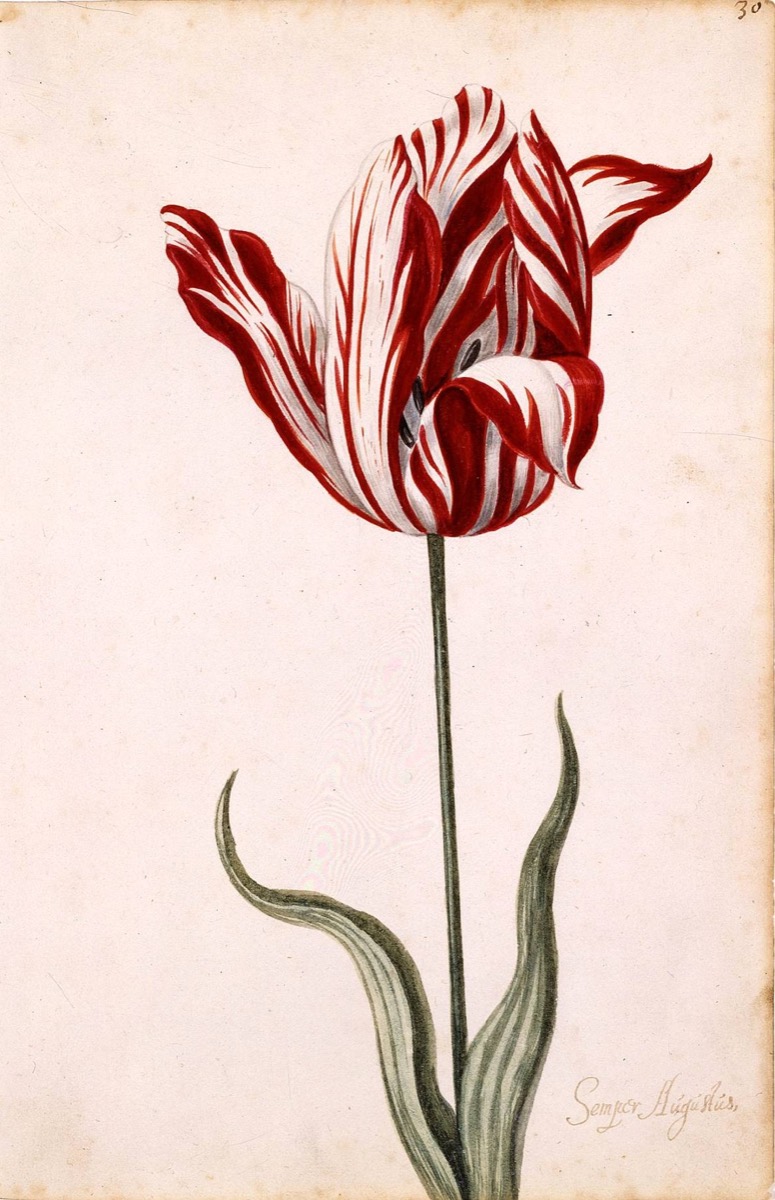
The familiar story of the Dutch tulip mania comes almost entirely from a 19th-century book rather than from the data. What is known: the bulbs were traded while buried in the ground, and nobody could see what would grow from them. What happened in the week the prices collapsed?
Curiosity counts. Here is the answer.
The bulbs lay buried all winter, so nobody knew how many had been planted. The sprouting at the end of winter exposed the quantity, and the price crashed within days. What strengthens the explanation is that the collapse began in Haarlem, where conditions brought the sprouting forward.
The sprouts came up. The rise in prices began in mid-November 1636, exactly at planting season, when the information vanished from sight. The collapse arrived in the first week of February 1637, exactly as the shoots broke through the soil and revealed the quantities and the varieties had streaked. The strongest support for the explanation is the place: the collapse began in , where conditions brought the sprouting forward.
To understand the collapse you have to see the agricultural calendar. A tulip bulb is planted in autumn, lies in the ground all winter, sprouts at the end of winter and flowers in spring. Between planting and sprouting it is entirely invisible, and even the buyer cannot know what they bought.
In exactly that window the trading boiled. The rise in prices began in mid-November 1636, straight after planting season, when all that remained to the traders was paper. These are : an undertaking to buy in summer a bulb nobody can see, at a price set by guessing at a quantity nobody knows.
In the first week of February 1637 the shoots broke through the soil, and the quantity became visible. The price crashed within days. The detail that turns this from a nice story into an argument is the place: the collapse began in Haarlem, where conditions brought the sprouting forward, and only then spread. The information traveled at the speed the plants came out of the ground.
That reorders the whole parable. No madness of crowds is needed to inflate a price; it is enough that basic information is hidden for a few months and then revealed at once. And this is a historical explanation resting on a match between dates rather than an experiment. Historians point to further causes, from a decree of the authorities to the plague raging in those years. Most of the familiar anecdotes, meanwhile, trace back to writing two centuries later.
wat. The rise began as the bulbs went into the ground and the collapse came with the sprouting, when the real quantity became visible.
wat wat
A bubble needs no madness of crowds. It is enough that basic information is hidden, and that it is revealed all at once.
How do we know?
A historical analysis cross-referencing the price curve of 1636–1637 with the planting and sprouting calendar of tulip bulbs and with the place where the collapse began.
What is still unknown
This is a historical explanation resting on a match between dates, not an experiment. Other sources propose further reasons for the collapse.
Learn something?
Where to next
 What is a visit to a protected natural area worth to mental health?economics
 What does the color of a soap bubble know about its own thickness?bubbles
 Is a whale blowing a ring of bubbles making a tool?bubbles