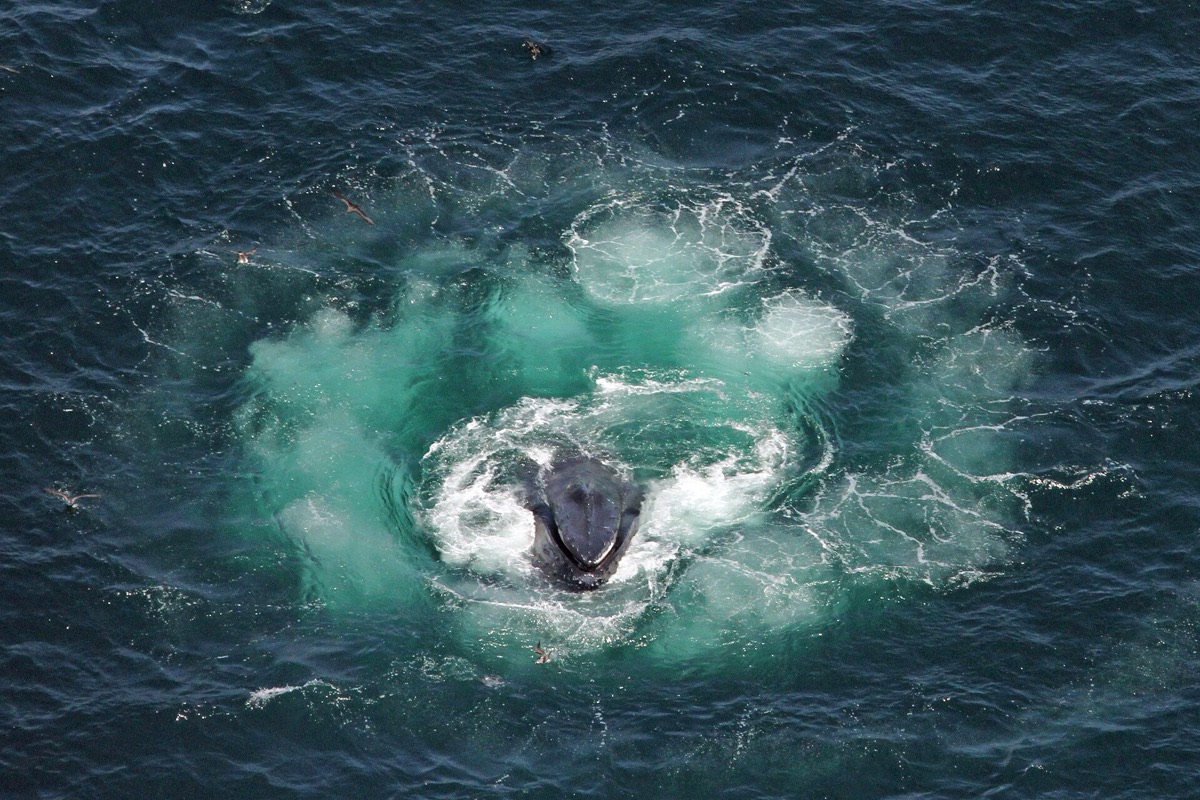
Plenty of animals use tools and very few build them, which is the line that separates picking up a stick from making one. Humpback whales blow rings of bubbles around prey, and the group version is famous. Szabo and colleagues went after the solitary version in Southeast Alaska, with tags on the whales and drones overhead, and measured the geometry of each net. Is the whale shaping it, or just blowing?
Shaping it, in several dimensions at once. The nets are built from , and the whales appear to control how many rings go into one, how big and how deep it is, and how far apart neighboring bubbles sit. Regulating those elements raises prey intake per by about sevenfold on average. Breath rate and swimming kinematics show the denser mouthful costs no extra energy.
Using a tool is common across the animal world. To one is not, and the gap between the two is a large part of why tool behavior gets studied at all. A whale that blows a structure out of its own breath sits awkwardly on that line.
feeding is best known as a group behavior, several whales circling and spiralling together. Szabo and colleagues looked at solitary humpbacks feeding on krill in Southeast Alaska, using tags carried by the animals and drones flying above them. That lets one net be seen from inside and from overhead.
The nets turn out to have a describable form: internally tangential rings, with the whales apparently controlling the number of rings, the size and depth of the net, and the horizontal spacing between neighboring bubbles. These are separate variables, and a whale adjusting them is doing something more than exhaling in a circle.
Regulating the structure raises prey intake per lunge by about sevenfold on average. The authors measured breath rate and the kinematics of swimming and lunging to check the obvious objection, and the denser mouthful does not cost more energy to obtain. More krill per lunge, for the same expenditure, out of a tool made of air.
wat. Seven times the mouthful for the same effort, out of a structure the whale builds from nothing but its own breath.
wat wat
Manufacturing a tool out of air, and tuning its dimensions to the job, puts humpbacks in a very small group of animals that make rather than merely use.
How do we know?
Szabo and colleagues combined animal-borne tags with drone footage of solitary humpbacks feeding on krill, measured net geometry, and logged breath rate and lunge kinematics.
What is still unknown
Control over the net is inferred from the regularities in its structure, not shown by asking a whale to build one differently, and the work covers krill feeding in one region.
Learn something?
Where to next
 Why does living near water seem to be good for you?sea
 Is an octopus throwing silt at a neighbor, or just tidying up?sea
 How does a sponge keep its own filter from clogging?sea