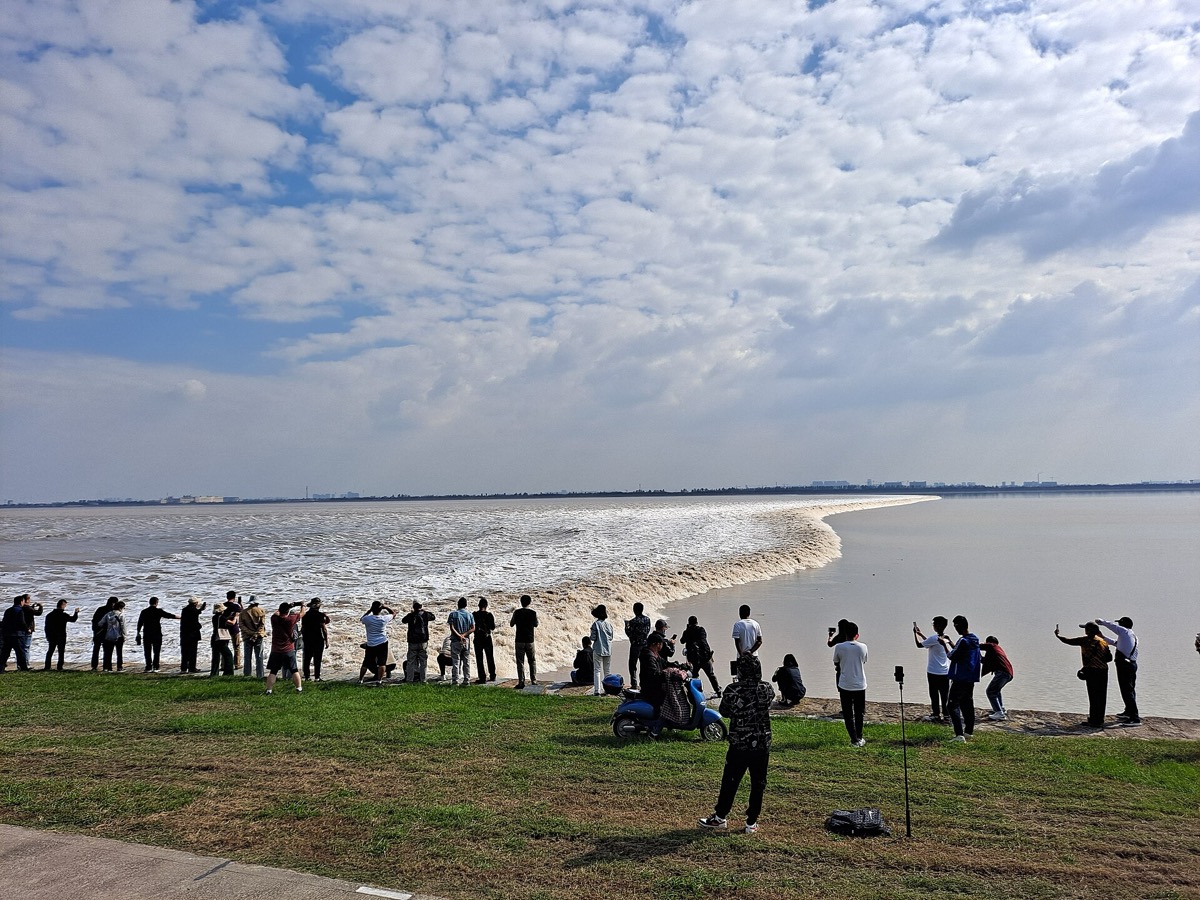
In most rivers the tide raises the water quietly, over hours. In a few places it arrives as a single steep front that travels upstream, while the current under it still runs out to sea. Researchers modeled the conditions that produce one. What makes it?
A wave that catches up with itself. A is a positive wave traveling upstream, generated when the tide rises fast and the estuary funnels it, so the swell grows and its front steepens as the flood advances inland. In shallow water the front of a wave moves slower than the water piling in behind it, and the slope sharpens until it breaks. The water below can still be flowing seaward.
A rising tide normally lifts a river gradually. In a few estuaries it does something else. The tide arrives as one sharp front that runs inland at the speed of a bicycle, while the water beneath it is still draining toward the sea.
The conditions are geometric, and is the word for all of them together. A large tidal range, a wide mouth that narrows, and a bed that shallows. Each of these concentrates the same volume of water into less room, so what cannot spread sideways or downward goes upward instead.
Then the physics does the rest. A slows as the depth falls, so the leading edge is held back while the water behind keeps pushing. The front compresses and steepens until it breaks, into a bore or into a train of waves.
Because so many factors interact, predicting whether a bore will form at all is genuinely hard. The study reduced the problem to a rectangular channel with a steadily rising downstream level. The simulations produced three outcomes: a bore, no bore, and a weak bore that forms with a gentle front and then quickly vanishes. The criteria drawn from that comparison were then checked against data from real estuaries.
wat. A tidal bore forms where the tide is squeezed into an estuary that narrows and shallows, until it breaks into a wave running upstream against the current.
wat wat
A bore mixes water and sediment violently along tens of kilometers of river, which reaches navigation, banks and habitats alike.
How do we know?
Viero and Defina stripped the problem to a rectangular channel of constant width with uniform flow, raised the downstream water level at a constant rate, and ran numerical simulations to see when a bore forms.
What is still unknown
Height and speed vary enormously with the shape of the river, the depth, the discharge and the tidal cycle, so no two events match. The modeling also used an idealized channel rather than a real estuary, and the criteria were checked against real data afterwards.
Learn something?
Where to next
 What makes a whirlpool in the open sea?tides
 Why do ducklings swim in a tight line behind their mother?waves
 How fast did salmon return to a river after the dams were taken out?rivers