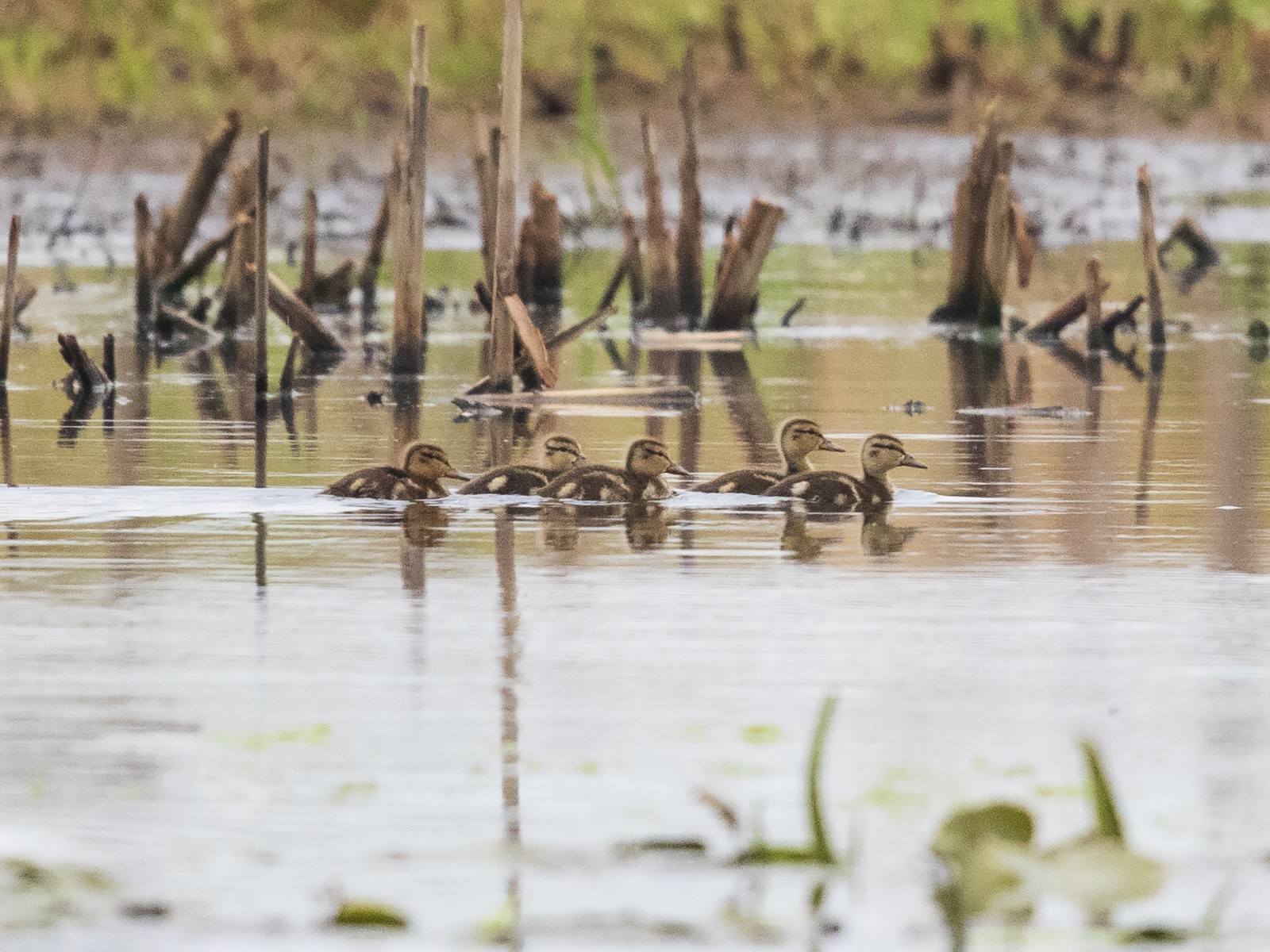
Ducklings swim in a tight line behind their mother, and keeping the group together explains it easily enough. Except that a swimming duck leaves behind her, and a wake is usually a hindrance. So what are they getting back there?
A push. , a calculation of how the water moves and what forces it exerts, found a point behind her where the slope of the wave drives a duckling forward instead of holding it back. That is . Then comes the : each duckling hands the wave onward rather than absorbing it, and from the third onward the wave resistance approached zero in the model.
Ducklings swim in a tight line behind their mother, and it looks like family behavior. The model suggests it is also an efficient formation.
When a duck swims she leaves a wake of waves, and making those waves is a substantial part of the effort. A hydrodynamic calculation found a point behind her where the slope of the wave actually pushes forward, like a surfer sliding down.
From there the chain continues. Further ducklings in the line can pass the wave energy to one another instead of absorbing it, so the single-file arrangement is not incidental.
From the third duckling onward the wave resistance approached zero in the model, which is to say the advantage turns from individual into collective. The work rests on a simplified model rather than on measuring the energy live ducklings spend in natural conditions.
wat. In a line of ducklings, a wave passed from the mother through the first few can cut the wave resistance of those behind almost to nothing.
wat wat
The familiar family arrangement may also be an efficient solution for passing energy along inside a moving group.
How do we know?
The researchers built a mathematical and numerical model of a duck and her ducklings and calculated the wave resistance at every position in the line.
What is still unknown
The work rests on a simplified model rather than on measuring the energy a live duckling spends in natural conditions.
Learn something?
Where to next
 Which way does a sleeping duck point its open eye?ducks
 What exactly does a wave do to make the sea glow?waves
 Why does a swimmer work less behind another swimmer?swimming