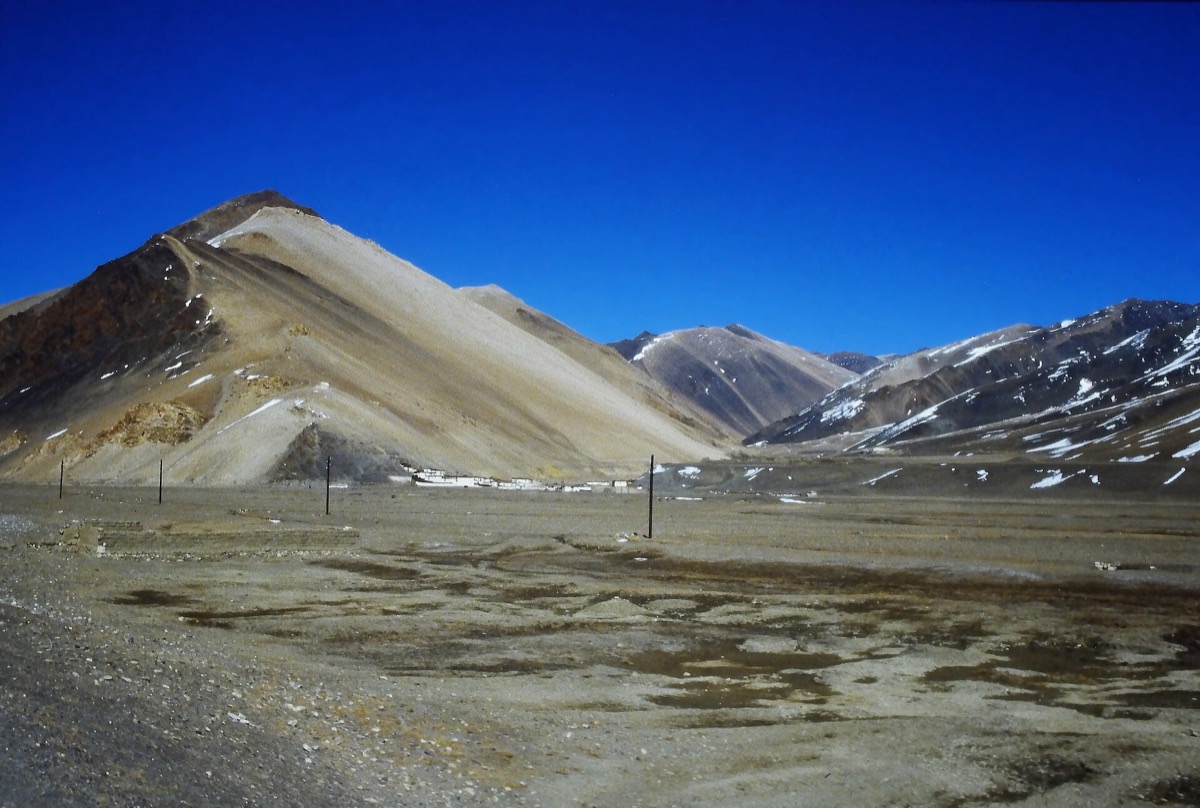
Tibetan adaptation to the low oxygen of the plateau is among the clearest cases of recent human natural selection. One gene in the hypoxia pathway, , carries the most extreme signature of positive selection found in Tibetans, and tracks differences in hemoglobin concentration at altitude. Which left the question of where the beneficial version came from. Re-sequencing it in 40 Tibetans and 40 Han gave an odd answer.
It came from another kind of human. The structure around EPAS1 is so unusual that the authors conclude it can only convincingly be explained by of DNA from Denisovans or Denisovan-related individuals. Scanning worldwide populations, the selected haplotype appears only in Denisovans and in Tibetans, at very low frequency among Han Chinese. Its length rules out shared ancestry as the explanation.
Migrating out of Africa put modern humans into greater temperature extremes, new pathogens and higher altitudes, all of which would have acted as agents of natural selection. Tibetan adaptation to the hypoxic environment of the high plateau is among the most celebrated examples of the local adaptations that followed.
Earlier work had picked out EPAS1, a hypoxia pathway gene, as carrying the most extreme signature of positive selection in Tibetans, and had tied it to differences in hemoglobin concentration at high altitude. What that does not answer is where the favored version of the gene came from.
Re-sequencing the region around EPAS1 in 40 Tibetan and 40 Han individuals turned up a highly unusual haplotype structure. The authors conclude it can only convincingly be explained by introgression of DNA from Denisovan or Denisovan-related individuals. Scanning a wider set of worldwide populations, the selected haplotype appears only in Denisovans and in Tibetans, and at very low frequency among Han Chinese.
The alternative had to be ruled out, and the length of the haplotype does it. A variant shared through , meaning simple common ancestry, would not survive as a long intact block confined to two groups. The authors draw the general lesson: admixture with other hominin species supplied genetic variation that helped humans adapt to new environments. Note that introgression is inferred from structure rather than observed directly.
wat. The gene variant that lets Tibetans live at altitude is found in Denisovans and almost nowhere else, which is how it got there.
wat wat
Interbreeding with an extinct hominin turns out not to be a genetic footnote. It supplied a variant that let modern humans occupy a plateau that would otherwise have been close to uninhabitable.
How do we know?
Huerta-Sánchez and colleagues re-sequenced the region around EPAS1 in 40 Tibetan and 40 Han individuals, then scanned a larger set of worldwide populations for the selected haplotype.
What is still unknown
Forty individuals per group for the re-sequencing, and introgression is inferred from haplotype structure rather than observed. The argument rests on ruling out the alternative explanation, which is strong here and still an inference.
Learn something?
Where to next
 Why is a harmful blood mutation common exactly where malaria is worst?evolution
 Why does a cat walk past a bowl of sugar?genetics
 What is the appendix actually for?evolution