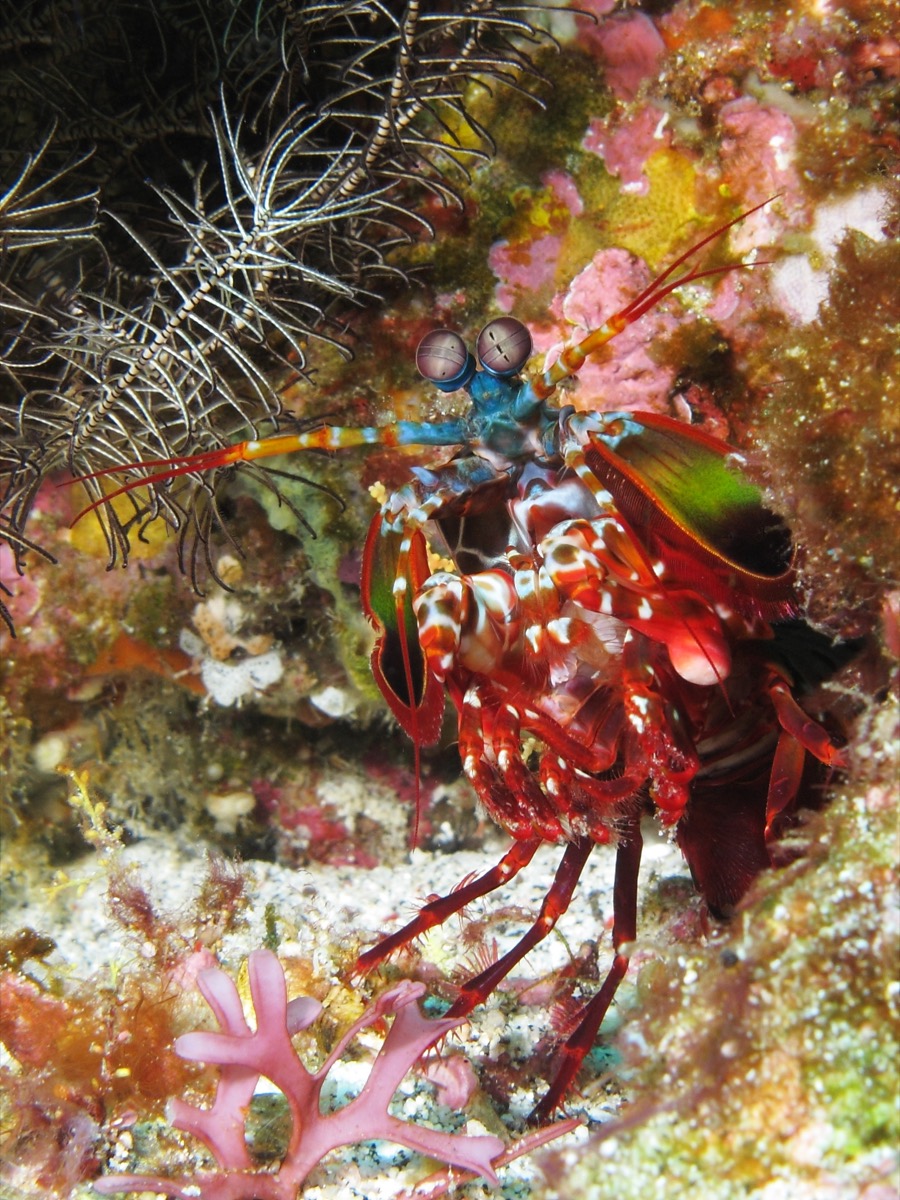
Mantis shrimp break shells with brief, powerful strikes of their , and the speeds involved are extreme enough that occurs in the gap between limb and prey. That raises a question about bookkeeping: how much of the damage is the limb, and how much is the water?
Both, in that order, microseconds apart. Each strike generates two brief high-amplitude , typically 390 to 480 microseconds apart: the first from the limb’s impact, the second from collapsing cavitation bubbles. Impact forces ran from 400 to 1501 and cavitation peaks reached 504.
Mantis shrimp are renowned for breaking shells with brief, powerful strikes of their raptorial appendages. Because the strikes are so fast underwater, cavitation occurs between the appendage and the hard-shelled prey, which means the water itself joins the attack.
This study set out to measure the magnitude and the relative contribution of the two. High-speed imaging, force measurements and acoustic analyses were applied together to the peacock mantis shrimp Odontodactylus scyllarus.
The surprising finding is that each strike generates two brief high-amplitude force peaks, typically 390 to 480 microseconds apart. The first is caused by the limb’s impact and the second by the collapse of cavitation bubbles.
The numbers set the scale. Peak limb impact forces range from 400 to 1501 newtons and peak cavitation forces reach 504, so despite their small size these animals generate impact forces thousands of times their body weight. On average cavitation peaks are 50 percent of the limb impact, and they may exceed it by up to 280 percent.
wat. The limb lands, and half a millisecond later the collapsing bubbles land too.
wat wat
An animal that gets a second free hit from the water it is punching through is doing something no engineered hammer does.
How do we know?
Patek and Caldwell combined high-speed imaging, force measurements and acoustic analyses on the peacock mantis shrimp Odontodactylus scyllarus to separate the two peaks and assign each to its cause.
What is still unknown
One species under laboratory measurement, and the relative size of the cavitation contribution varies a great deal between strikes.
Learn something?
Where to next
 How does a small beetle fire liquid at boiling point?biomechanics
 What is hagfish slime actually for?biomechanics
 What is a cat's tongue actually doing when it grooms?biomechanics