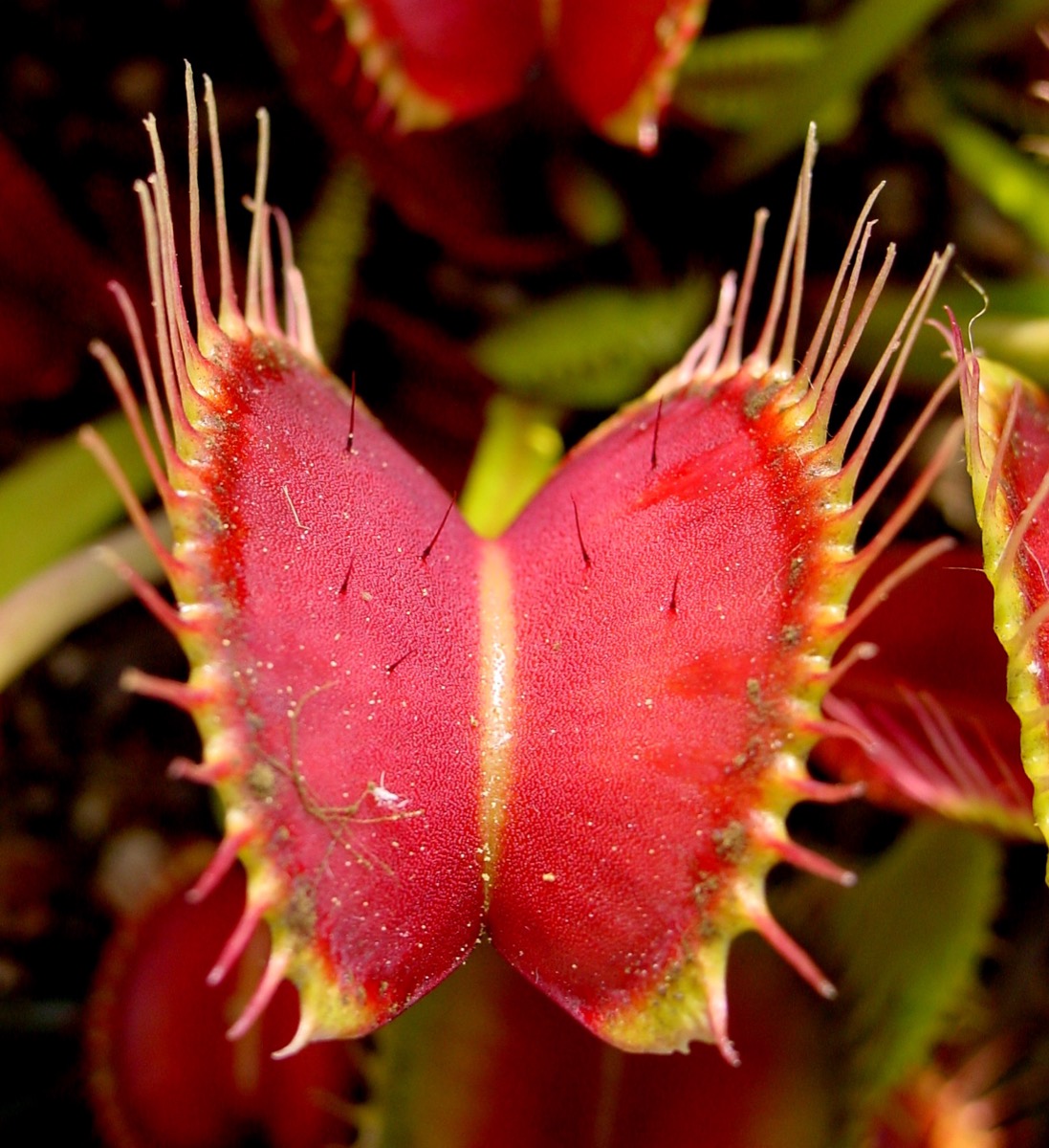
A Venus flytrap shuts after two touches on its , which is a cheap decision. Digesting is not: the sealed trap has to be flooded with acid and a cocktail of enzymes, and that costs the plant real resources. A raindrop is not food. So between the snap and the enzymes, something has to be checked. Bohm and colleagues looked for the check.
It counts. Each touch on a trigger hair fires an all-or-nothing , and the plant uses how many it gets. Two switch on the pathway. More than three turn on the genes for prey-degrading enzymes, and the level of that expression rises with the number of stimulations. A trapped insect struggling to escape keeps touching the hairs, which is exactly the signal.
Carnivorous plants in nutrient-poor soil depend on an animal diet, and the Venus flytrap has the most theatrical apparatus for getting one. Darwin was fascinated by it. The leaf tip is a bilobed snap trap lined with mechanosensitive hairs and a dense array of glands, and starving traps even emit a fruity volatile blend that draws insects in.
Closing is the easy part. A visitor bends a trigger hair, the mechanical stimulus becomes an all-or-nothing action potential, and two pulses within fifteen to twenty seconds snap the lobes shut. The prey then spends hours touching the hairs as it tries to break out, and the trap seals hermetically into what the authors call a green stomach, flooded with acid and digestive enzymes.
Bohm and colleagues asked how many stimulations it takes before the plant treats the encaged object as food worth processing. Applying measured series of touches, they found the jasmonic acid signaling pathway activates after the second stimulus, while more than three action potentials are needed before genes encoding prey-degrading hydrolases are switched on. That expression then scales with the number of stimulations.
Prey also brings , and the trap takes it up through the glands. The authors identified the channel responsible, DmHKT1, whose transcript numbers likewise depend on the count of mechano-electrical events. So the number of pulses a struggling victim triggers is what identifies it as a sodium-rich animal, and the plant spends on digestion in proportion.
wat. Two touches close the trap. Three or more say the thing inside is still fighting, which means it was alive, which means it is food.
wat wat
A plant with no nervous system is running a threshold rule on a count of electrical events, and the output of that rule is a graded commitment of resources.
How do we know?
Bohm and colleagues applied controlled series of trigger-hair stimulations to flytraps and tracked what each count produced: hormone signaling, expression of genes for digestive hydrolases, and transport of sodium into the trap.
What is still unknown
The stimulations come from an experimenter rather than an insect, so the counts are clean in a way a real struggle is not. The sodium channel is identified by its expression pattern and transport role, not by a knockout plant.
Learn something?
Where to next
 Where exactly does an ant lose its footing on a pitcher plant?plants
 Can an ape treat its own injury with a plant?plants
 Does a plant under stress make any sound you could pick up?plants