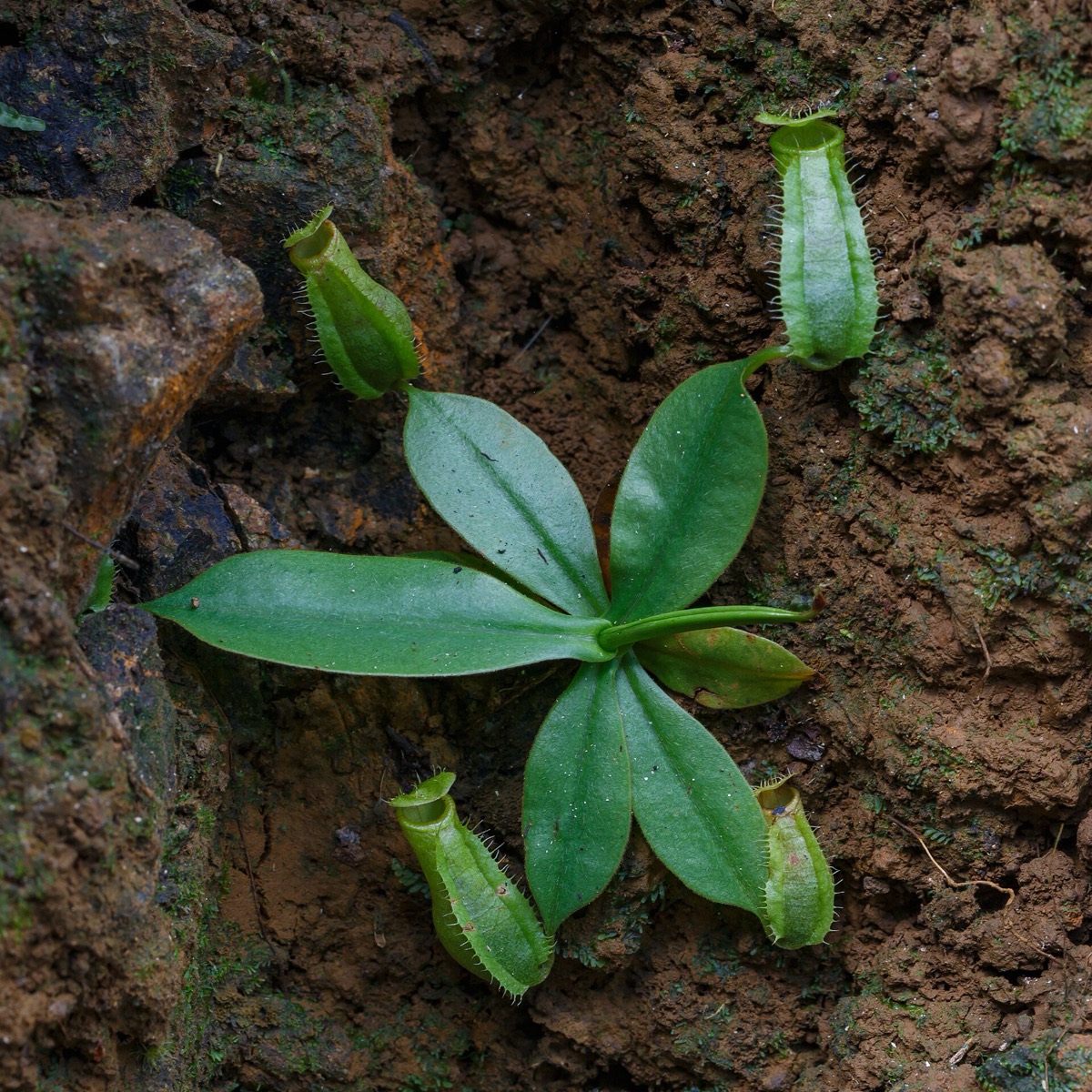
A Nepenthes pitcher has been credited with slippery wax crystals, downward-pointing cells and nectar laced with alkaloids, all of them inside the jar. Bohn and Federle went outside it and measured the friction of weaver ants walking on the rim, first dry and then wet. Is the rim doing the catching?
Almost all of it. The is covered in regular radial ridges of smooth overlapping cells, and nectar or rain wets it completely, laying down a continuous liquid film. Ants stepping onto a wet rim start : the film cancels the grip of their soft , while the ridges make their claws hold or slide depending on which way they face. Dry, the same rim is walkable.
Nepenthes pitchers catch insects, and the explanations on offer all pointed inside the jar: wax crystals that flake under a foot, cells that point downward, nectar laced with alkaloids. Each is real. None of them explains why a visiting ant steps in at all.
Bohn and Federle looked instead at the peristome, the curled rim around the mouth. Under a microscope it carries regular radial ridges built from smooth overlapping epidermal cells, arranged as a series of steps leading inward. Nectar seeps from the inner margin, and in humid weather rain and nectar together wet the whole surface.
Dry, the rim holds an ant fine. Wet, it does not. The team measured friction forces for weaver ants and found two separate failures. The liquid film kills the grip of the soft adhesive pads, and the stepped topography produces for the claws. One surface defeats both of an insect’s attachment systems at once.
Aquaplaning also explains the plant’s timing. A trap that depends on a water film works in humid weather and rests in dry, which suits a plant of the wet tropics. The same mechanism turned up in a species with waxy inner walls too, so the rim is not a backup for the wax. It is the main event.
wat. The trap is not the jar but its rim, and it only works for as long as the rim stays wet.
wat wat
A trap with no moving part catches an insect by exploiting water and geometry, which is why the surface keeps being copied in work on anti-adhesive materials.
How do we know?
Bohn and Federle measured friction forces for weaver ants on the peristome of Nepenthes bicalcarata, wet and dry, and examined the surface under a microscope.
What is still unknown
The friction measurements cover one ant species on two pitcher species, and the trap only works in humid weather, so the mechanism is a seasonal one rather than a constant.
Learn something?
Where to next
 How do ants find a short route when none of them has the map?ants
 Why do infected ants die in the same place and at the same hour?ants
 What does an ant colony do with a nestmate whose leg is infected?ants