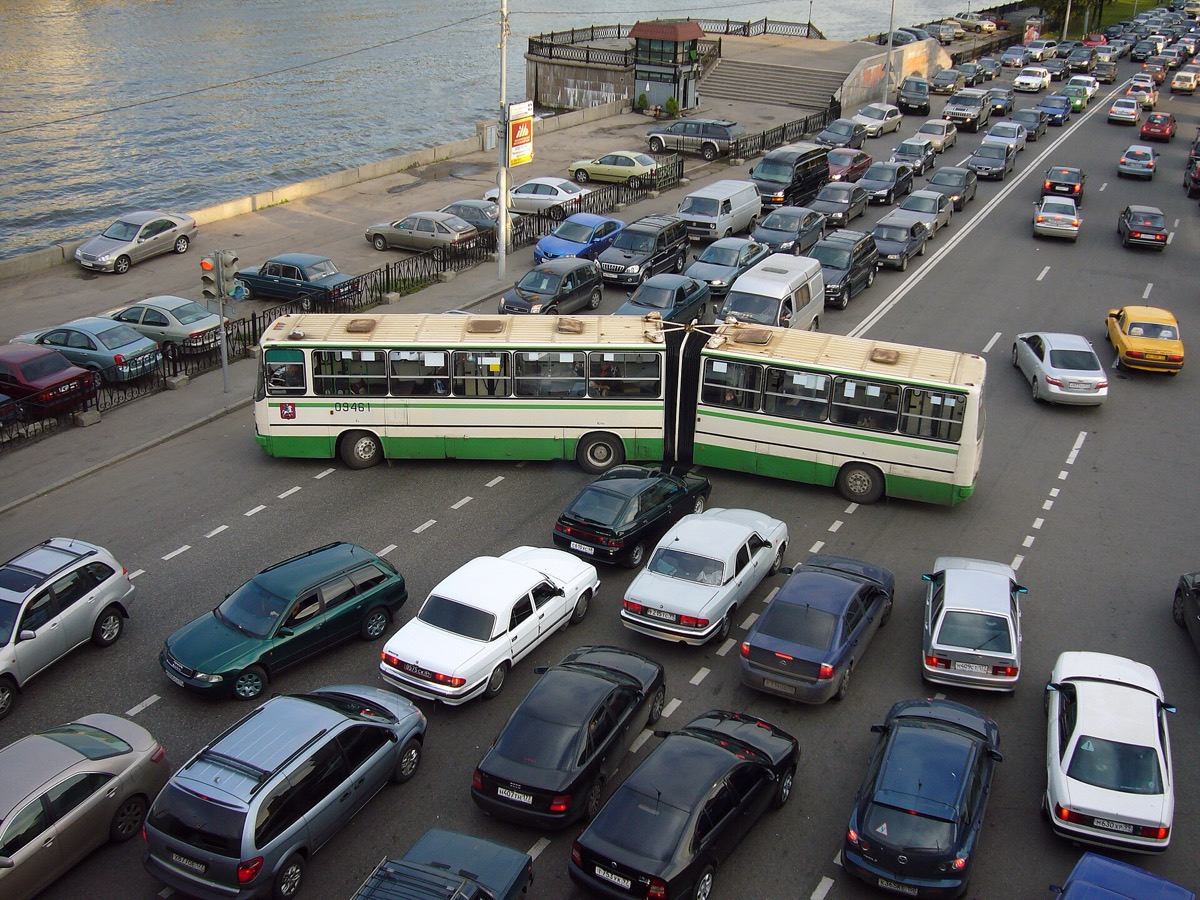
Sugiyama and colleagues put cars on a circular track with no at all, spaced evenly, all moving at the same speed, at a density chosen to sit at the edge of instability. Even a tiny fluctuation grew. The even spacing could not hold, and a jam cluster appeared and traveled backward around the circuit like a .
The physics treats traffic as a of interacting particles. Above a critical average density, the free-flowing state is unstable, because fluctuations get amplified rather than damped, and the transition to a jam happens spontaneously. On that view a bottleneck is only a trigger, and not the essential origin of a traffic jam at all.
A traffic jam on a highway is a familiar enough phenomenon that the usual explanation goes unexamined: something up ahead is in the way. From a physical viewpoint, vehicular flow is a non-equilibrium system of interacting particles, and the collective effect of many such particles makes the free-flow state unstable once fluctuations are amplified.
On that account, the transition to a jamming state occurs spontaneously if the average vehicle density exceeds a certain . Which makes a bottleneck only a trigger, and not the essential origin of a jam. That is a theoretical claim, and the paper sets out to show it experimentally.
The experiment is elegantly plain. Vehicles were run on a circuit with no bottleneck anywhere on it. In the initial condition all of them were moving, homogeneously distributed around the circular road, at the same velocity, with the average density prepared for the onset of the instability.
What followed is the result. Even a tiny fluctuation grew larger, the homogeneous movement could not be maintained, and finally a jam cluster appeared and propagated backward like a solitary wave. The authors present this as the first experimental evidence that a traffic jam is a collective phenomenon, in the same family as dynamical phase transitions and pattern formation. One caution: a circular track has no entrances, exits or destinations, so this shows the mechanism exists rather than how much congestion it accounts for.
wat. Pack the cars close enough and the jam makes itself, with nothing in the way.
wat wat
It separates the trigger from the cause. Drivers look for the accident at the front of a jam, and above a certain density no accident is needed, because the jam is a property of the flow.
How do we know?
The experiment ran vehicles on a circular road with no obstruction. All of them started evenly distributed at the same velocity, with the average density set for the onset of the instability, and the resulting behavior was recorded.
What is still unknown
A controlled experiment on a circular track, which removes entrances, exits, lane changes and destinations. Those are real features of highways, so the experiment shows the mechanism rather than measuring how much of real congestion it explains.
Learn something?
Where to next
 Why does a reactor that has already been shut down still need cooling?physics
 Why does the cheese in a cacio e pepe sometimes seize into one lump?physics
 Why does a drop of water flee a very hot pan in particular?physics