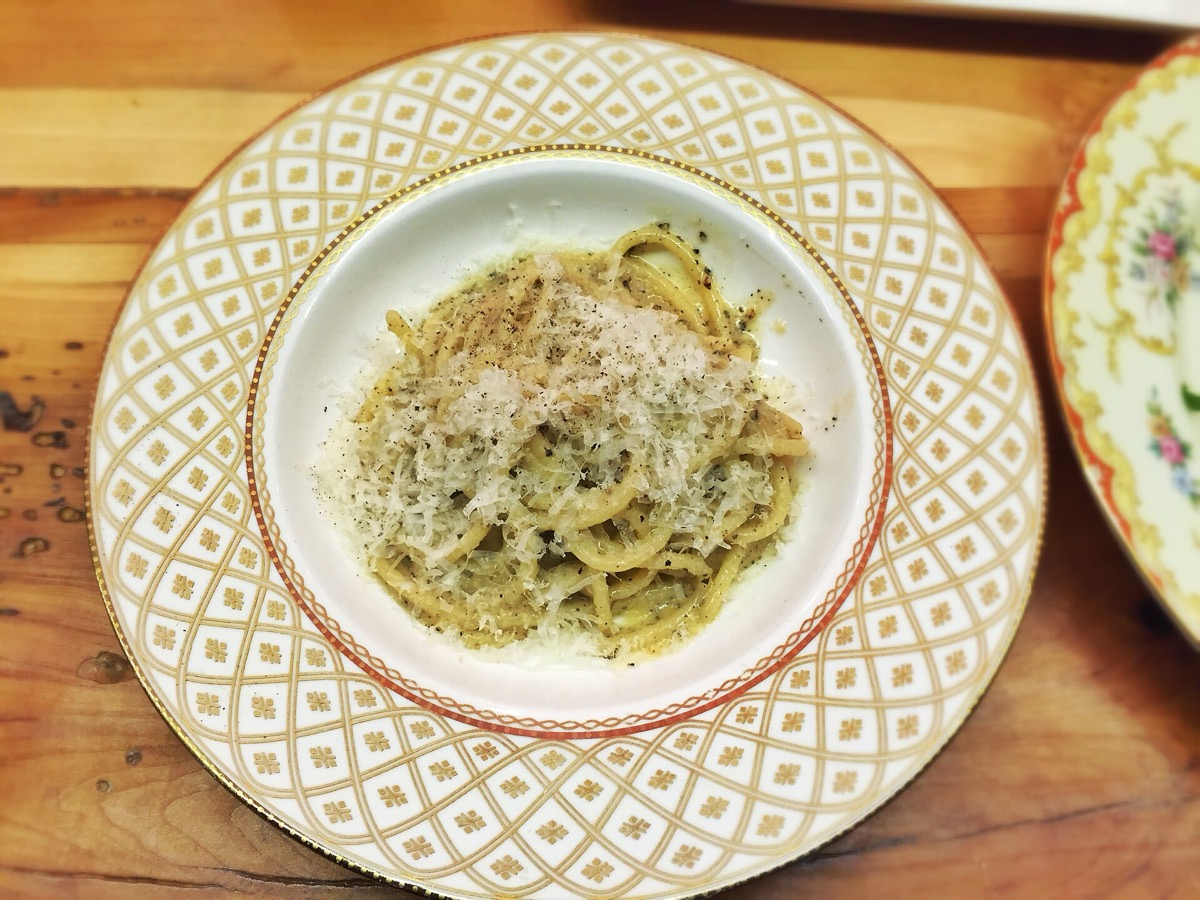
Cacio e pepe is supposed to hold nothing but pasta, pecorino, pepper and water, and that is the whole secret. Except that heating the cheese brings on , and the proteins clamp together into a single lump. The researchers mapped the conditions and varied them systematically. What prevents it?
Starch, above . Below one percent starch relative to the weight of the cheese, lumps formed in every mixture; above it the sauce stayed smooth even as the temperature moved. That is a sharp threshold and not a slope, which explains why the same recipe either works or fails outright, with no middle stage. In home cooking the starch comes from the pasta water.
The recipe is supposed to hold nothing but pasta, cheese, pepper and water, so when the sauce turns into a lump there is nothing to blame but the conditions.
In heat the protein unfolds and exposes the sticky parts that had been folded inside it, and they catch on one another. The very same process sets an egg in a pan.
meant varying the quantity of starch, the heat and the water systematically, and measuring viscosity at each point. Below one percent starch relative to the weight of the cheese, lumps formed in every mixture, which is to say this is a sharp threshold and not a slope.
More starch stabilized the sauce and helped keep it smooth even as the temperature moved. works simply: the chains get in between the proteins and stop them meeting. In home cooking the source of that starch is the pasta water. The experiment examined a controlled recipe and particular ingredients, and the kind of cheese, its age and the cooking temperature may move the exact boundary.
wat. In a cacio e pepe sauce a low threshold decided it: under one percent starch by weight of cheese was enough to produce lumps.
wat wat
The kitchen shows how a small change in the composition of a material decides whether a mixture holds together or separates.
How do we know?
The researchers prepared controlled mixtures, measured their viscosity, and mapped which concentrations and temperatures kept the sauce uniform.
What is still unknown
The experiment examined a controlled recipe and particular ingredients; the kind of cheese, its age and the cooking temperature at home may move the exact boundary.
Learn something?
Where to next
 Why does a reactor that has already been shut down still need cooling?physics
 Why does a drop of water flee a very hot pan in particular?physics
 A chain pours from a cup to the floor. Why does it rise into the air first?physics