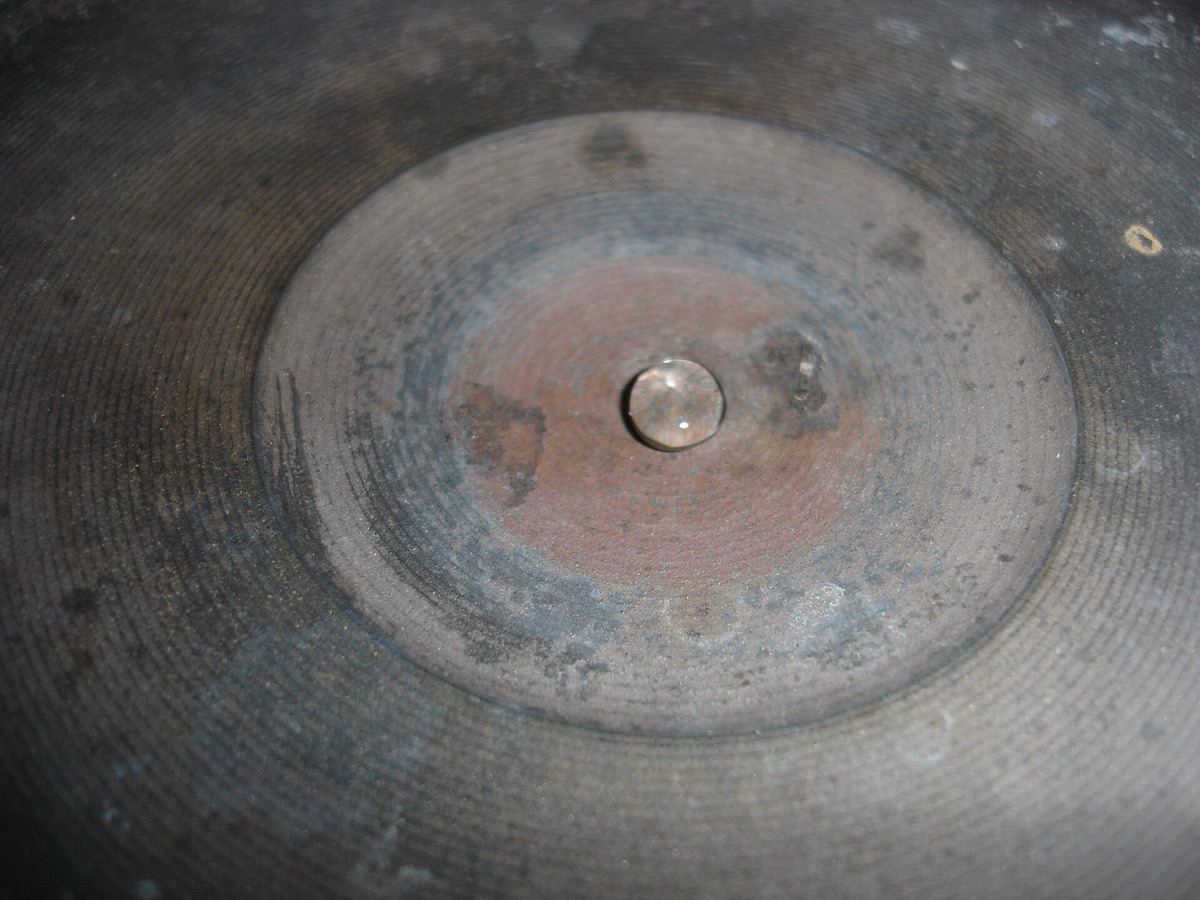
In a moderately hot pan, water touches the metal and boils quickly. Logic says that the hotter the pan, the faster the drop should evaporate. Above a certain temperature exactly the opposite happens. Why?
It rides on its own steam. Above a certain temperature the evaporation underneath is so fast that a continuous layer of vapor forms, . The drop hovers on it almost , rolls and even bounces. Surprisingly, the vapor layer also the water, so a drop on a hotter surface can survive longer than a drop on a slightly cooler one.
In a moderately hot pan water touches the metal and boils quickly. Above a certain temperature the behavior flips sharply, and the drop starts to flee.
The reason is that evaporation at the bottom of the drop becomes so fast that a continuous layer of vapor forms. The drop hovers on it, almost without contact and without friction, so a tiny tilt is enough to send it sliding, and it rolls and even bounces.
The surprising detail is what that layer does to heat. A gas conducts heat far worse than a liquid in direct contact, so the layer insulates, and a drop on a hotter surface can survive longer than a drop on a slightly cooler one.
This reaches well beyond the kitchen: in cooling metals, engines and reactors the same vapor layer can slow heat removal exactly when it is needed. The threshold : the liquid, the roughness, the pressure and the impact speed. No single number fits every surface.
wat. A drop of water on a scorching surface can live longer because it slides on a cushion of vapor that insulates it from the metal.
wat wat
The same effect bears on the cooling of metals, engines and reactors, where a layer of vapor can slow the removal of heat.
How do we know?
A review of flow and heat research combined measurements of the drop’s shape, the vapor layer, its motion and its lifetime on surfaces at different temperatures.
What is still unknown
Everything here depends on conditions: the threshold temperature depends on the liquid, the roughness, the pressure and the impact speed. Everything depends on conditions, and no single number fits every pan or surface.
Learn something?
Where to next
 Is there a best angle for skipping a stone?water
 Why does a reactor that has already been shut down still need cooling?physics
 Why does the cheese in a cacio e pepe sometimes seize into one lump?physics