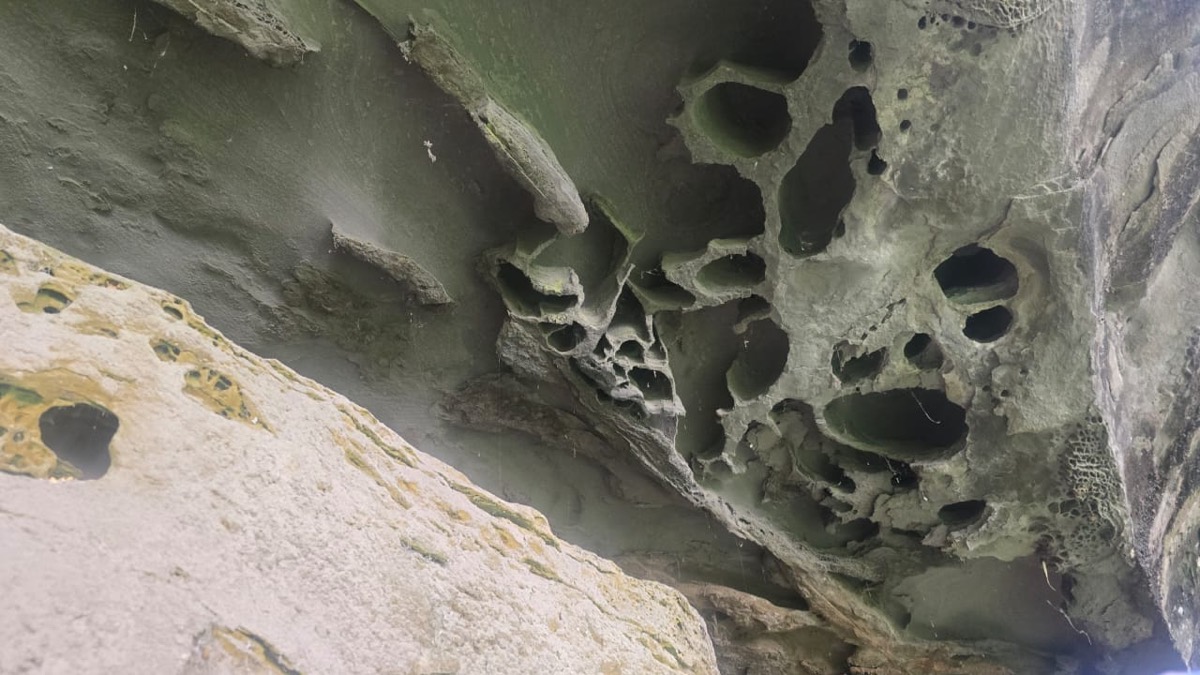
are the pits that form by non-uniform weathering in rock that looks perfectly uniform, leaving a honeycombed face. Two equations had been proposed for how fast they grow, both calibrated on outcrops from the coast of Japan around two thousand years old. That is a short baseline for a slow process. So measurements were taken at Meteor Crater and across the Colorado Plateau.
The old equations do not hold over fifty thousand years. Measurements extending the record back at least 50,000 years showed clearly that tafoni enlarge significantly over tens of thousands of years, with the most useful parameter. The 1991 equation did not fit the data and the 1996 equation fitted better, so the authors propose a sigmoidal equation whose constants vary with the rock.
Tafoni are pits formed by non-uniform weathering in otherwise uniform rock, which is what makes them interesting rather than merely decorative. Two equations had been proposed for the rate at which they develop, and both rested on outcrops from the coast of Japan roughly two thousand years old.
Two thousand years is a short lever for dating a feature that may be far older. This study took tafoni measurements from Meteor Crater, Arizona and its vicinity, in the Moenkopi and Kaibab formations, extending the equations back at least 50,000 years.
As earlier studies had reported, pit depth proved the best parameter to measure. Pit size decreases significantly with increasing of the rock surface, and it also varies greatly for other reasons. In some cases measurements differed significantly between two stations taken from contiguous areas of similar inclination and aspect within an apparently homogeneous bed.
What is clear is that over tens of thousands of years tafoni enlarge significantly. The data are generally log-normal and all are markedly , which matters for fitting. The 1991 equation proposed by Matsukura and Matsuoka does not fit, and the 1996 equation proposed by Sunamura fits better. The authors propose a sigmoidal equation relating depth to age, with constants that vary with lithology, and report that it fits far better than the earlier published ones.
wat. Rock pits keep enlarging over tens of thousands of years, on a curve that neither equation calibrated on two-thousand-year-old outcrops could describe.
wat wat
Rock weathering rates are how a landscape gets dated, and an equation calibrated on two thousand years was being applied to features far older. Extending the baseline by a factor of twenty-five changes which curve fits.
How do we know?
Norwick and Dexter measured tafoni in the Moenkopi and Kaibab formations at Meteor Crater, Arizona and across the Colorado Plateau. That extended the existing growth equations back at least 50,000 years and tested them against the data.
What is still unknown
Pit size varies greatly for reasons the measurements cannot capture. In some cases two stations in contiguous areas of similar inclination and aspect, in an apparently homogeneous bed, differed significantly from each other.
Learn something?
Where to next
 Does climbing chalk really help you hold on to rock?rock
 A salt flat cracks into polygons of almost equal size. What marks their borders?salt
 Can swapping the salt in the kitchen prevent a stroke?salt