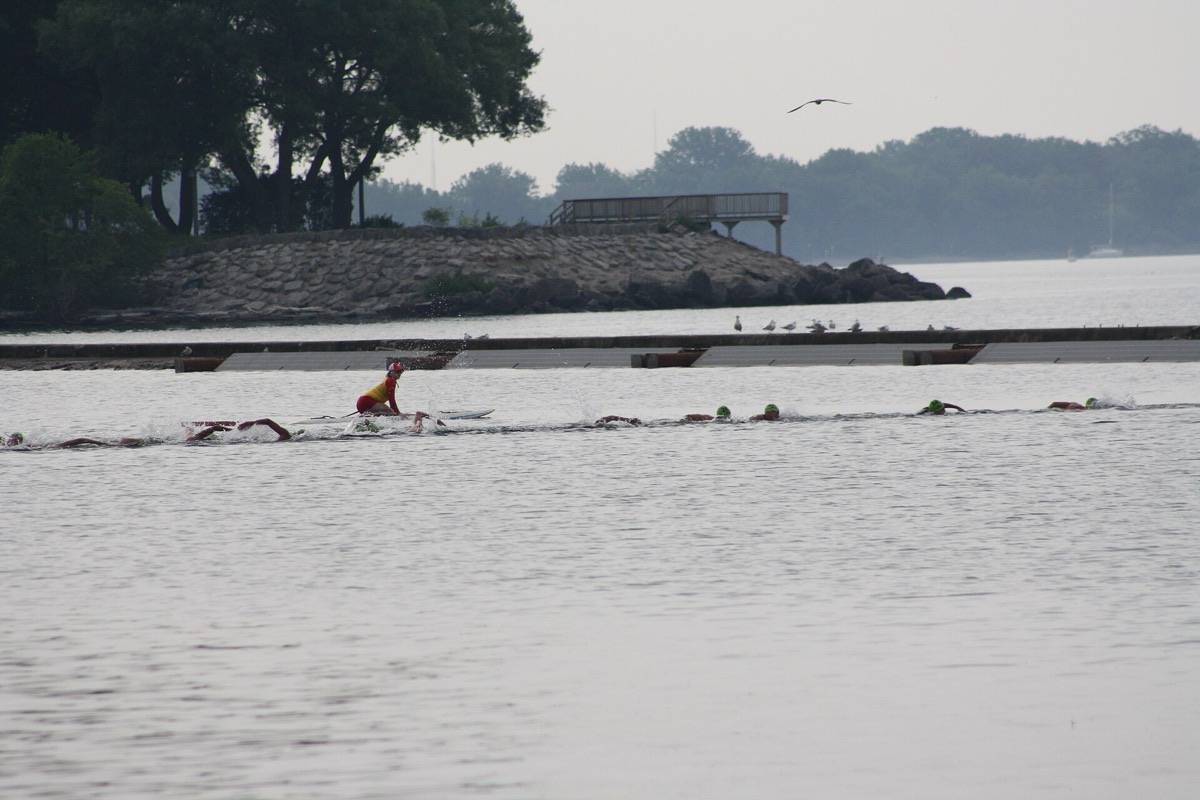
Whoever swims behind another swimmer enters water that has already been moved by them, which sounds like a clear advantage. To measure it, swimmers did three trials at the same pace: alone, beside , or behind one. What was measured in the muscles?
Less muscular fatigue behind. Fifteen swimmers did 200-meter trials while the researchers measured muscle activity on video and with sensors. changed less from behind, about 5 per cent against about 11 per cent swimming alone; was higher too. This comes from short, controlled trials, not a promise of victory in any open-water race.
A leading swimmer moves water and creates a different flow region behind them. Cyclists know a similar effect in air, and in water there are also waves and a more complex resistance.
Fifteen swimmers performed three 200-meter trials at a submaximal pace: alone, beside a leader and behind one. Sensors on the surface of the muscles and video recording allowed comparison of changes in muscle activity and in stroke length.
The fall in the frequency index of the muscle signal was smaller behind a leader, about 5.1 per cent on average against 11.1 per cent swimming alone. The swimming efficiency index was higher in that position too; swimming beside the leader was an intermediate option.
The numbers are not equivalent to a precise saving in oxygen or to a time difference in competition. They came from a short trial at a controlled pace, so in open water you also have to consider waves, distance, timing and safety between swimmers.
wat. In a trial with 15 swimmers, swimming behind a leader reduced fatigue measures compared with swimming alone.
wat wat
In water sports, position relative to others can change energy expenditure even when a swimmer’s fitness has not improved.
How do we know?
The same 15 swimmers swam in three positions at a controlled pace; muscle sensors and video recording served to compare fatigue and efficiency.
What is still unknown
The tests ran over 200 meters at a controlled submaximal pace. Open water, waves and a long race can all change the advantage.
Learn something?
Where to next
 Does the color of a competitor’s kit affect who wins?competition
 What exactly was swimming’s governing body trying to ban?swimming
 Why does swimming time to a hundredth and no further?swimming