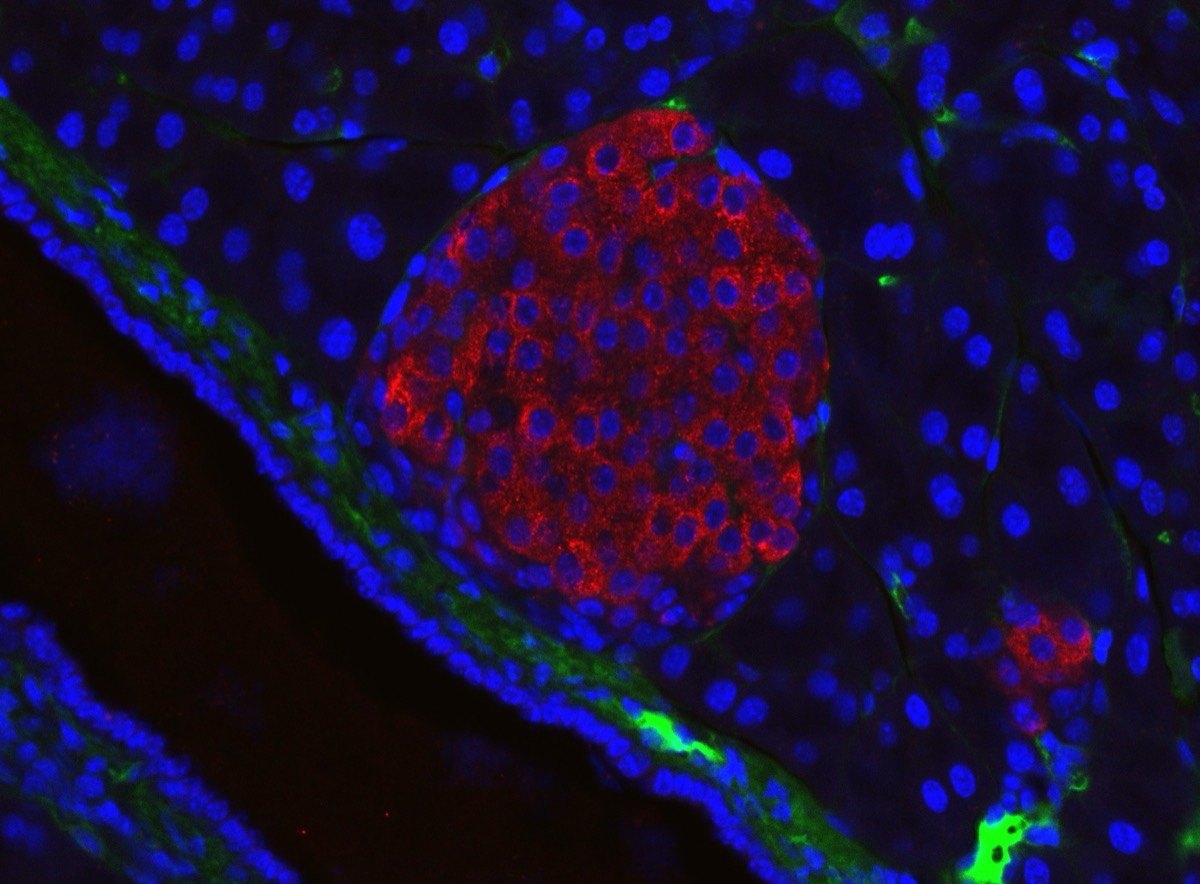
Type 1 diabetes destroys the insulin-producing islets, and donor islet transplants are limited by supply and by the immune suppression they require. Growing islets from a patient’s own reprogrammed cells would answer both. A first-in-human phase I trial transplanted such islets beneath the abdominal anterior rectus sheath, an unusual site chosen for access. This is the one-year result from the first patient. What did the glucose data show?
from day 75, and it held. Time in the target glucose range rose from 43.18 percent at baseline to 96.21 percent by month four, with falling to a non-diabetic level. After that the patient stayed stable, above 98 percent time in range with glycated hemoglobin around 5 percent. At one year all study endpoints were met with no sign of transplant-related abnormalities.
Type 1 diabetes destroys the pancreatic islets that make insulin. Transplanting islets from deceased donors does work, and it has stayed a niche treatment because donors are scarce and recipients need lifelong immune suppression to keep the graft. Islets grown from the patient’s own cells would remove both obstacles at once.
This is the preliminary analysis of a first-in-human phase I trial testing exactly that. , derived from the patient, were differentiated into islets and transplanted beneath the abdominal anterior rectus sheath. The site is unusual and deliberate, since it can be imaged and reached again if something goes wrong.
The patient achieved sustained insulin independence starting 75 days after transplantation. climbed from a baseline of 43.18 percent to 96.21 percent by month four, with glycated hemoglobin falling to a non-diabetic level. From then on control was stable, with time in range above 98 percent and glycated hemoglobin near 5 percent.
At one year the clinical data met all study endpoints, with no indication of transplant-related abnormalities. The authors conclude that further clinical studies are warranted, which is the right conclusion and the ceiling on what one case can support. Nothing here speaks to how often this succeeds, how long the graft lasts, or whether the autoimmune process that destroyed the original islets will eventually find these ones.
wat. Seventy-five days after the transplant one patient stopped needing insulin, and a year on was still above ninety-eight percent time in range.
wat wat
Autologous is the word carrying the weight. Islets grown from the patient’s own cells sidestep both the donor shortage and the rejection problem that have kept islet transplantation a niche procedure for decades.
How do we know?
Wang and colleagues reported the one-year outcome for the first patient in a phase I trial of autologous chemically induced pluripotent stem-cell-derived islets, transplanted beneath the abdominal anterior rectus sheath.
What is still unknown
One patient. A single uncontrolled case at one year cannot establish durability, safety or how often this works, and type 1 diabetes is autoimmune, so whether the new islets eventually get attacked too is unanswered here.
Learn something?
Where to next
 What else does the tiny muscle that gives you goosebumps do?stem cells
 Is there an animal that can start its life over?stem cells
 Can an adult cell be sent back to the beginning?stem cells