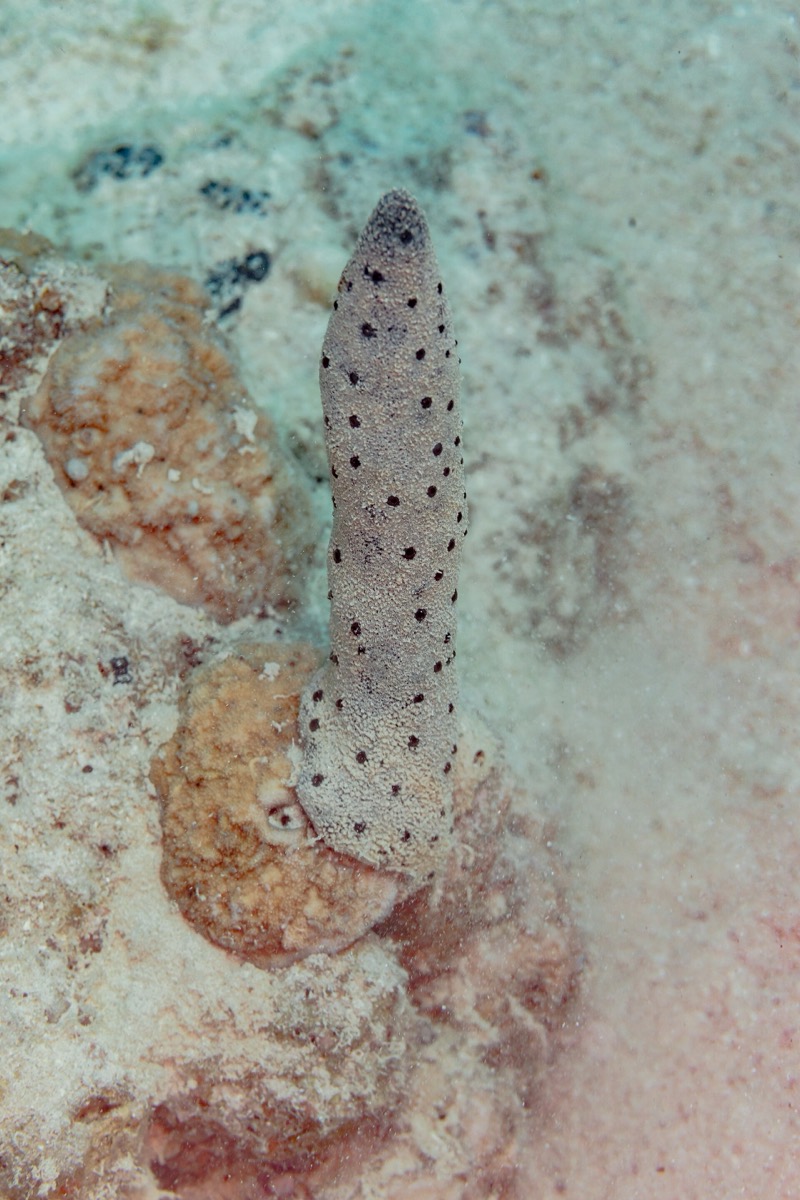
A sponge is a filter with almost nothing that moves, pulling seawater in through thousands of tiny inlet pores and pushing it out through a few large openings. Solid waste ought to leave the way the water does, by the outflow. Kornder and colleagues ran time-lapse video on a Caribbean tube sponge and analyzed what it was shedding. Which way does the rubbish actually go?
Backwards, and out of the inlets. The sponge moves particle-trapping against the direction of its own internal water flow and ejects it from the seawater inlet pores, the , through periodic surface contractions that earlier work called sneezing. The result is a steady stream of mucus-wrapped particles leaving the animal, and a notable flux of that sponge-associated fauna eat.
Sponges are among the oldest multicellular animals still with us, and they move an enormous volume of water. Seawater enters through thousands of small inlet pores, the ostia, gets filtered inside, and leaves through a few large openings called . A filter that size has a clogging problem, and how sponges avoid it was largely unknown.
The natural assumption is that solid waste leaves with the outflowing water through the oscula, since that is where everything else goes. Kornder and colleagues filmed the Caribbean tube sponge Aplysina archeri in time-lapse and analyzed what it shed, and the footage shows the opposite.
Particles get trapped in mucus, and the mucus travels across the surface against the direction of the internal water flow. It gathers at the inlet pores and gets ejected there, during the periodic surface contractions earlier observers had already named sneezing. Watched at speed, the animal looks like it is continuously streaming debris off itself.
None of that detritus goes to waste. The flux coming off an abundant reef sponge is large enough to put a number on, and sponge-associated fauna actively consume it, which puts the cleaning mechanism inside the way a reef moves nutrients around. The authors note that mucus transport of this kind has close counterparts in other animals, humans included.
wat. The waste leaves by the intake and not the exhaust, carried on mucus crawling upstream across the surface.
wat wat
A filter feeder that sheds waste from its intake rather than its exhaust turns a self-cleaning problem into a food supply for everything living on and around it.
How do we know?
Kornder and colleagues recorded time-lapse video of the Caribbean tube sponge Aplysina archeri and analyzed the waste it released, tracking where on the surface the material left.
What is still unknown
One sponge species on Caribbean reefs. The authors argue the mechanism may be common among sponges, but that is an argument from plausibility rather than a survey.
Learn something?
Where to next
 Why does living near water seem to be good for you?sea
 Is an octopus throwing silt at a neighbor, or just tidying up?sea
 What is a sea turtle actually sensing when it finds its way home?sea