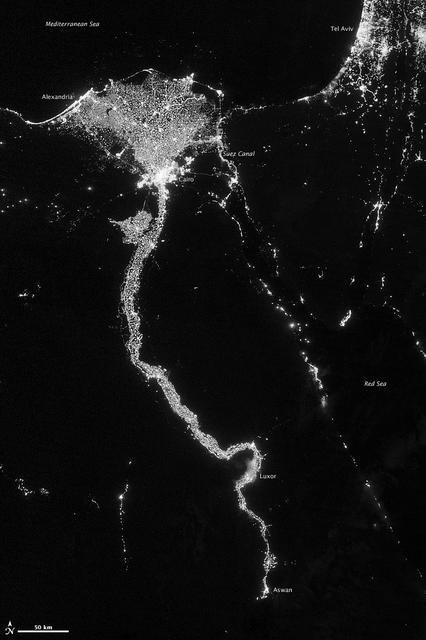
The two records disagree sharply. The radiance of nighttime artificial lights measured from orbit by the instrument on Suomi-NPP increases at an average of about 2.2 percent a year worldwide. The artificial radiance of the night sky, inferred from counts of stars visible to the unaided eye, rises at about 9.6 percent a year.
Bará and Castro-Torres ask whether changing light can reconcile the two. Their model shows that spectral change alone could explain the gap, if the visual observations are made with scotopic or mesopic adaptation at particular times under particular transition conditions. For adapted observers, however, reconciling the two sets requires light sources that affect the naked-eye counts without showing up in the satellite data.
Two independent records track how fast the night is brightening, and they do not agree. The radiance of nighttime artificial lights measured by the VIIRS-DNB instrument aboard Suomi-NPP increases at an average rate of about 2.2 percent a year worldwide. The artificial radiance of the night sky deduced from Globe at Night unaided-eye observations of the number of visible stars rises at about 9.6 percent a year.
The paper calls the difference between these two estimates remarkable, and asks whether it could be an artifact rather than a contradiction. Outdoor lighting technology is being replaced, which changes the of the light. A satellite sensor and a human eye weight wavelengths differently, so a shift in the spectrum can move the two indicators apart without either being wrong.
To test this the authors present a model for evaluating the temporal rate of change of different light pollution indicators and apply it to the VIIRS-DNB and Globe at Night data. The result is conditional on how the observers’ eyes were adapted. The reported difference could be explained by spectral changes alone, if the visual observations are made with scotopic or mesopic adaptation at definite times under some particular transition conditions.
For photopic adapted observers the explanation fails, and something else has to exist. Reconciling the two measurement sets then requires light sources that affect the Globe at Night observations but do not show up in the VIIRS-DNB data. The lumen emissions of those sources would have to increase at a rate larger than nine percent a year worldwide. One caution: this is a modeling study about two datasets, not a new measurement of the night sky.
wat. From orbit the night brightens by two percent a year; from the ground, nearer ten.
wat wat
Both numbers are measurements of the same thing by different means. That they differ by a factor of four is a problem about what an instrument in orbit can see, not about which group is careless.
How do we know?
The authors built a model for the temporal rate of change of different light pollution indicators and applied it to the satellite and naked-eye datasets. The question was whether the ongoing replacement of lighting technologies could account for the divergence.
What is still unknown
A modeling study resolving a discrepancy between two datasets rather than new measurement of either. Its conclusions depend on assumptions about observers’ visual adaptation, which is exactly the quantity hardest to pin down in citizen-science data.
Learn something?
Where to next
 How many people in the world can no longer see the Milky Way?light pollution
 Does a streetlight reach a moth that flies outside its circle of light?light pollution
 Has the Earth been getting greener, and if so why?satellites