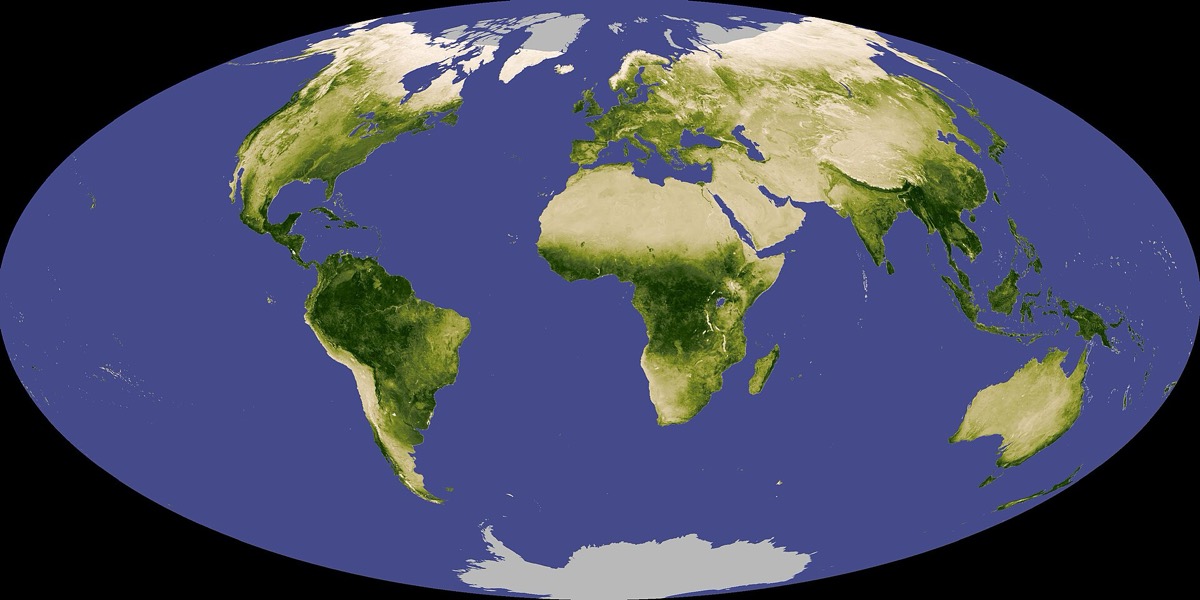
Zhu and colleagues put three long satellite leaf area records next to ten global ecosystem models. Between 1982 and 2009, growing-season leaf area rose persistently over a quarter to a half of the vegetated land surface, while less than four percent of the globe showed a decline. The models point to one dominant cause, and it is not a comfortable one.
attribute about seventy percent of the trend to carbon dioxide fertilization. accounts for roughly nine percent, climate change eight percent and land cover change four percent. The pattern is regional. Carbon dioxide explains most of the tropical greening, climate change explains greening in the high latitudes and on the Tibetan Plateau, and land cover change dominates in southeast China and the eastern United States.
Vegetation is changing fast, and until this work it was not well established how the world’s plants were responding overall. Zhu and colleagues approached it from two directions. Three long-term satellite records give the observed trend, and ten global ecosystem models give a way to ask what caused it, over the years from 1982 to 2009.
The observed trend is large and lopsided. Growing-season integrated leaf area increased persistently and widely over twenty-five to fifty percent of the global vegetated area. Less than four percent of the globe showed decreasing leaf area. Whatever is happening, it is pushing in one direction nearly everywhere plants grow.
The attribution is where the comfort drains out. Factorial simulations with the models suggest that carbon dioxide fertilization effects explain about seventy percent of the observed greening trend. Nitrogen deposition follows at roughly nine percent, climate change at eight percent, and land cover change at four percent. The dominant cause of a greener planet is the gas at the heart of the climate problem.
Geography sharpens the picture. Carbon dioxide fertilization explains most of the greening in the tropics. Climate change accounts for greening of the high latitudes and the Tibetan Plateau. Land cover change contributed most to the regional greening in southeast China and the eastern United States. The authors are candid about limits. Unexplained regional effects mean the next generation of models will need forest demography, management intensities for cropland and pasture, and constraints such as phosphorus availability.
wat. The planet grew more leaves, and most of the credit goes to the carbon dioxide we added.
wat wat
More leaves is not a reassurance. The main driver of the greening is the same rise in carbon dioxide driving the climate problem, so the effect is a symptom rather than an offset.
How do we know?
Three long-term satellite leaf area index records establish the trend, and ten global ecosystem models run in factorial simulations separate the contributions of four candidate drivers over the period from 1982 to 2009.
What is still unknown
The attribution rests on ecosystem models rather than measurement, and the authors list what those models omit: forest demography, regional differences in cropland and pasture management, and constraints such as phosphorus availability.
Learn something?
Where to next
 Can a lake suffocate the valley below it?carbon dioxide
 How does anyone know how thick Arctic sea ice is?satellites
 Is the night sky getting brighter faster than satellites say?satellites