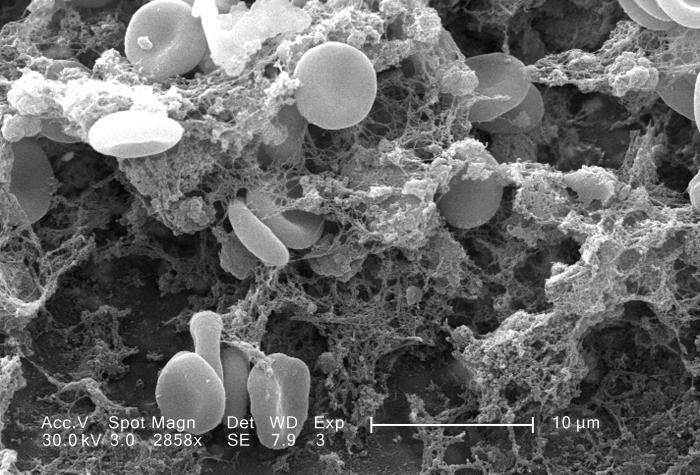
The nucleus is a cell’s control center, and without it there is no repairing, no manufacturing and no dividing. A starts out with a nucleus and, in the last stages of maturing, pushes it out and sheds the rest of its organelles too. Why would anything do that?
For room and for flexibility. What is left is a flexible, disc-shaped bag that can carry an enormous quantity of through narrow capillaries. The price is paid at the end: with no nucleus there is no repair, so the cell wears out, stiffens, and the spleen clears it after about four months. Which is why the bone marrow has to make some two million new ones every second, without pause.
This is one of the more extreme trades in biology. The nucleus is the cell’s control center: the DNA is there, and all the instructions for every protein come from it. A cell that throws it out gives up any capacity to repair itself or to divide.
happens in the last stage of maturing, in the bone marrow. The cell pushes it to one end and releases it, and other cells collect and break it down. The mitochondria and the other organelles go as well.
What it gets in return is a bag: an empty space filled almost entirely with haemoglobin, inside an unusually flexible membrane. The sunken shape increases the surface area, and the flexibility lets the cell compress and pass through a capillary narrower than itself.
The price is paid at the end. With no nucleus there is no repair, so the cell gradually wears out, loses its give, and the spleen clears it after about four months. That is the whole . From which it follows that the bone marrow has to make some two million new cells every second, without a break. And this is a rule about mammals: in many other vertebrates the mature red cells keep a nucleus.
wat. A human red blood cell trades its nucleus for more room for haemoglobin and more give in a capillary.
wat wat
The structure explains how blood carries oxygen efficiently, and why the body has to keep producing red cells continuously.
How do we know?
Blood and bone-marrow smears show the stages of maturing, and labeling cells makes it possible to follow the ejection of the nucleus and the lifespan of cells in circulation.
What is still unknown
The rule applies to mammals; in many other vertebrates the mature red blood cells keep a nucleus.
Learn something?
Where to next
 If bone is replaced continuously, why does the skeleton keep its shape?cells
 Which organ grows back to exactly the size the body needs?cells
 Do Sherpas carry more oxygen, or just use it better?oxygen