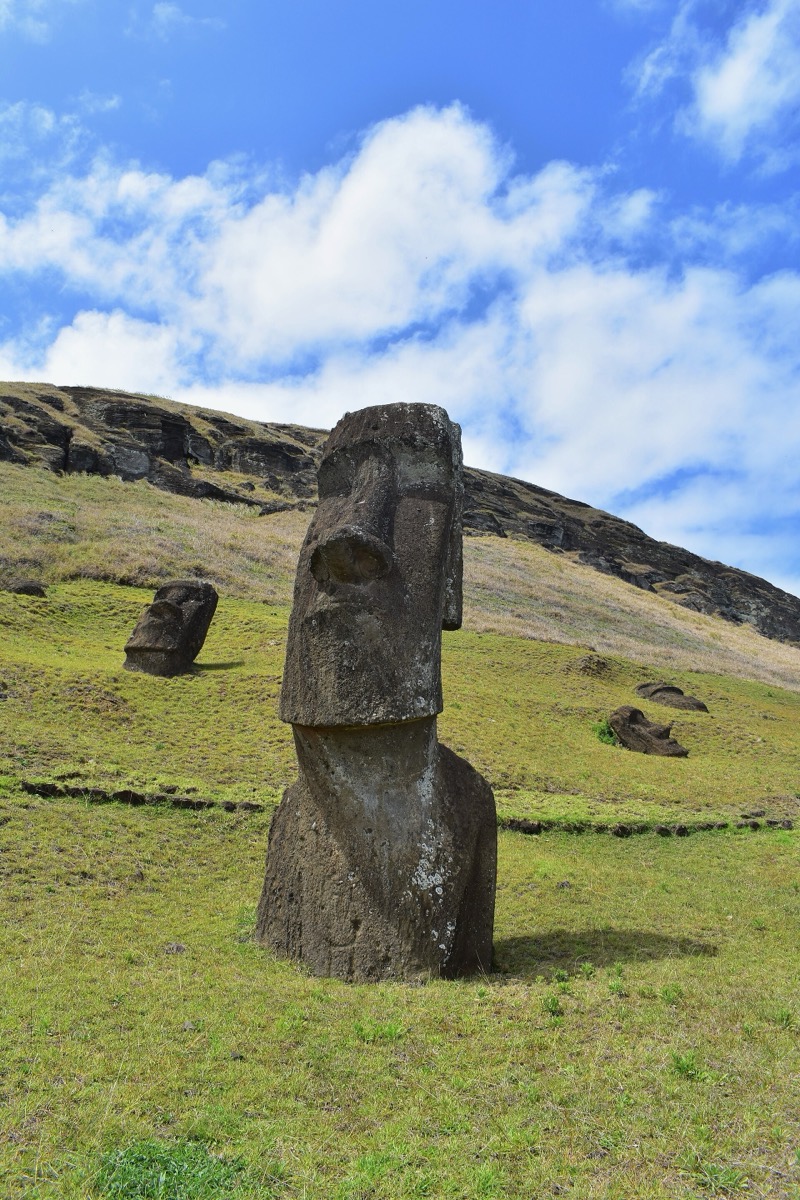
Rapa Nui gets told as a parable, a society that felled its forests and collapsed before it ever met Europe. A crash that severe should leave a signature in the genome, because a shrinking population loses genetic variety and the loss stays visible for generations. Researchers sequenced 15 ancient islanders. What did they find?
No sign of the collapse, plus a voyage nobody had proved. Reconstructing population size from the genomes rules out a severe during the 1600s, which is the sharp version of the story. The same genomes carry about 10 percent Native American ancestry, dated to roughly 1250 to 1430, centuries before any European ship reached the island.
Rapa Nui is one of the most isolated inhabited places on Earth, and it is usually introduced as a cautionary tale. Forests cut down, a society that ate through its own resources, a collapse that happened before Europe showed up. The tale is tidy, which is a reason for suspicion rather than for confidence.
A sharp crash is testable. When a population contracts, genetic variety contracts with it, and the signature persists. So the researchers radiocarbon dated 15 ancient Rapanui individuals, sequenced their whole genomes, and asked which population histories could generate what they measured.
The reconstructions and the simulations reject a severe bottleneck in the 1600s. The individuals are Polynesian in origin and most closely related to Rapanui living today, which also matters for repatriating the remains.
Then there is the other half. Ancient and present-day Rapanui carry about 10 percent Native American , dated to roughly 1250 to 1430, well before European contact. Fifteen people is a thin sample, and they lived between 1670 and 1950, so the result rejects one sharp story rather than proving an easy life.
wat. Fifteen ancient genomes showed no sharp population crash on Rapa Nui before the Europeans came.
wat wat
A historical story that reads as a tidy warning can come apart when somebody tests it directly in the genes, and the islanders also turn out to have done something more remarkable than collapsing.
How do we know?
Moreno-Mayar and colleagues radiocarbon dated 15 ancient Rapanui individuals and sequenced their whole genomes at 0.4 to 25.6 times coverage, then ran population simulations to see which histories could produce the pattern.
What is still unknown
Fifteen individuals is a small sample, and they date from 1670 to 1950, so most of them lived close to European contact or after it. Rejecting a severe crash is not the same as denying hardship or environmental change.
Learn something?
Where to next
 Do the black and white stripes really cool a zebra down?myth
 The food hit the floor and you grabbed it. Do five seconds really save it?myth
 Is a nautilus shell really built on the golden ratio?myth