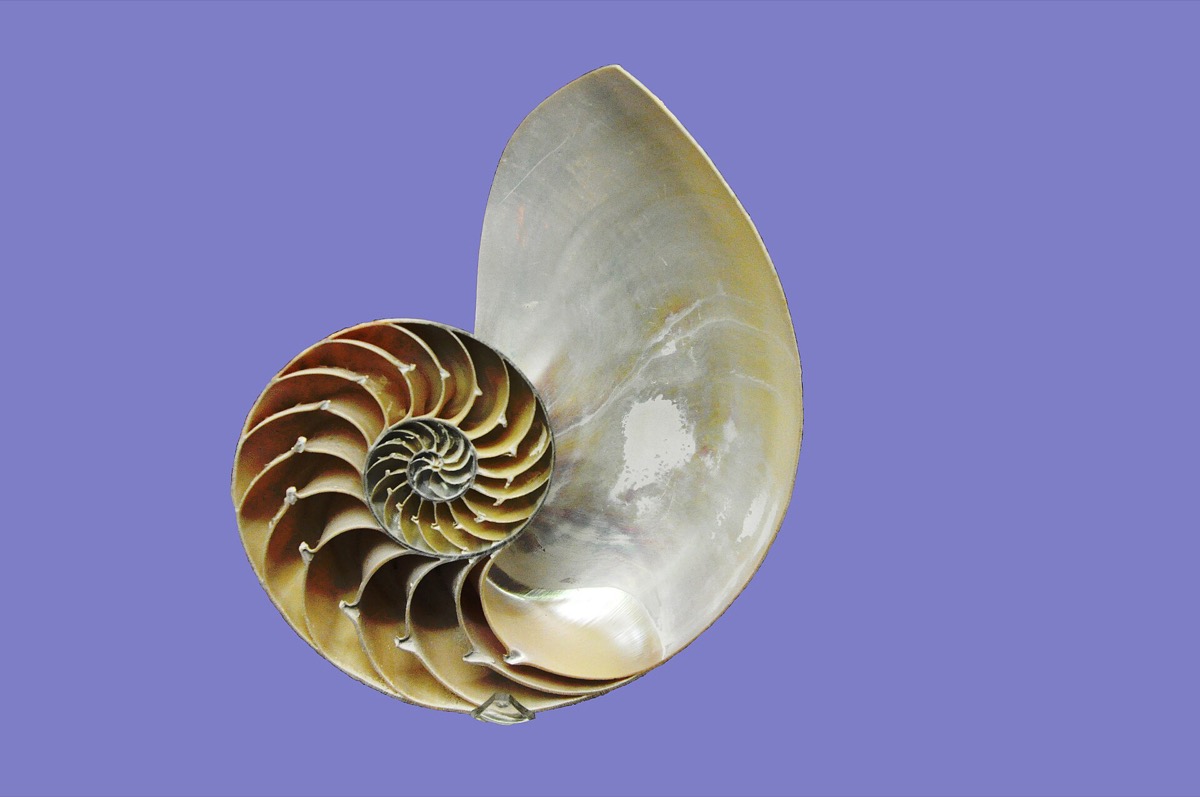
The is the standard illustration of the in nature, and part of the claim is true. The shell does grow as a , each chamber larger than the last by a fixed proportion. That makes the claim testable, because a fixed proportion is a number somebody can measure. So what is the number?
Not 1.618. Measured on real shells the ratio comes out closer to 4:3, about 1.333, and when 80 shells from the Smithsonian collections were examined the average came to 1.310. The shells also differ from one another, which is the part the myth cannot absorb, since a claim that every nautilus shares one ratio requires every nautilus to be identical.
The claim is everywhere, in design books, slide decks and classrooms: the nautilus shell proves that nature is built on the golden ratio. It makes a particularly good example because a large part of it is correct.
The correct part is the logarithmic spiral. Each chamber is larger than the one before it by the same proportion, which lets the animal grow without changing shape. The regularity has a job too, since the sealed chambers work as a buoyancy device.
The faulty step is the jump from there to the golden ratio, roughly 1.618 times per turn. Infinitely many logarithmic spirals exist, one for every growth ratio, and only one of them involves that number. Saying the nautilus is built on it is a claim about a specific number, so the way to settle it is to measure shells.
settles it. They come out closer to a ratio of about 4 to 3, and a sample of 80 shells from the Smithsonian collections averages about 1.310 per turn. They also vary from shell to shell, which a universal constant would not. The myth survived partly because the Smithsonian and a bestselling novel repeated it, which is a better lesson than the arithmetic: a claim can be beautiful, widely repeated, and never once checked.
wat. The golden ratio is 1.618, and nautilus shells measured in a collection average about 1.31.
wat wat
A claim that looks right is not the same as a claim that was checked, and this one spread through design books, museums and a bestselling novel without anybody reaching for a ruler.
How do we know?
Researchers measured the aspect ratio directly on shells from scientific collections, including a sample of 80 from the Smithsonian, rather than overlaying a spiral on a photograph.
What is still unknown
Individual shells vary and measurement methods differ, so no single number represents the species. That variation is itself the argument against the myth rather than a weakness in the refutation.
Learn something?
Where to next
 How long is the coast of Britain?measurement
 How is the distance to the Moon known to the millimeter?measurement
 Did the people of Easter Island really destroy themselves before Europeans arrived?myth