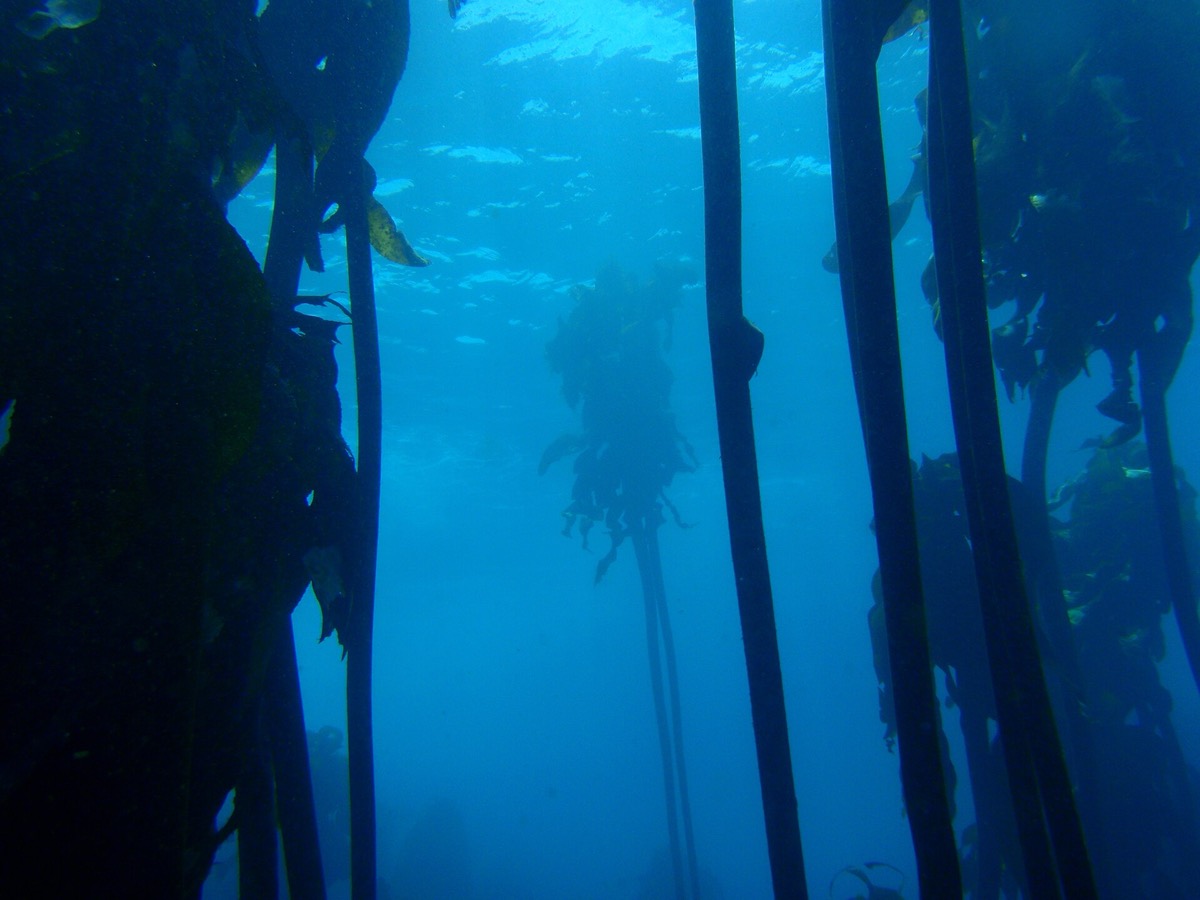
A kelp forest is not a forest of trees but a dense stand of large seaweeds under water, which makes any comparison with land awkward. Off northern Portugal a team measured how far the forests extend, how much seaweed they hold, and how fast that seaweed grows. How much carbon is sitting there?
About 16.48 thousand tonnes, above the seabed. That is the carbon held in the bodies of the seaweed across 5,189 , dominated by two species. The rate came to roughly 1,903 tonnes of carbon a year, below the 3,717 tonnes credited to the saltmarshes and seagrasses of mainland Portugal, and equal or better once you divide by area. Carbon in a living frond is not yet carbon buried.
begins with uptake, and large seaweeds take up carbon as they grow, which is the easy part of the claim. The climate question is harder: how much of that carbon stays in the seaweed, and how much reaches a place where it will be kept out of the air for a long time.
The researchers surveyed subtidal kelp forests in northern Portugal, dominated by two species, Laminaria hyperborea and Saccorhiza polyschides. They measured the extent of the forests, the biomass, the growth and the carbon content of the tissue, all in the water rather than by remote estimate.
The arithmetic gave about 16.48 thousand tonnes of carbon standing in the seaweed above the seabed, across 5,189 hectares. The annual sequestration estimate came to roughly 1,903 tonnes, less than the 3,717 tonnes attributed to mainland saltmarshes and seagrasses, and matching or exceeding them per unit of area.
The difference between a growing frond and buried carbon is where the honesty of the number lives. Part of the forest detaches and drifts to places nobody has measured, and the assumptions about move the total substantially. So these figures describe a regional potential rather than a carbon credit anybody should be selling.
wat. Off northern Portugal, kelp forests covering some 5,189 hectares held about 16.5 thousand tonnes of carbon.
wat wat
Protecting underwater forests may matter for the climate as well as for the fish, and the case has to distinguish carbon sitting in a seaweed from carbon buried for the long term.
How do we know?
The team combined in-situ measurements of forest extent, biomass, growth and carbon content to estimate both the standing stock and the annual flux.
What is still unknown
The annual estimate is sensitive to assumptions about kelp that breaks loose and drifts away, and about what becomes of it. Large stretches of the Portuguese coast have never been surveyed this way.
Learn something?
Where to next
 Why does an ice shelf already floating in the sea still matter for sea level?ocean
 Where is most of the carbon a mangrove forest stores?blue carbon
 Are the world’s kelp forests disappearing?kelp