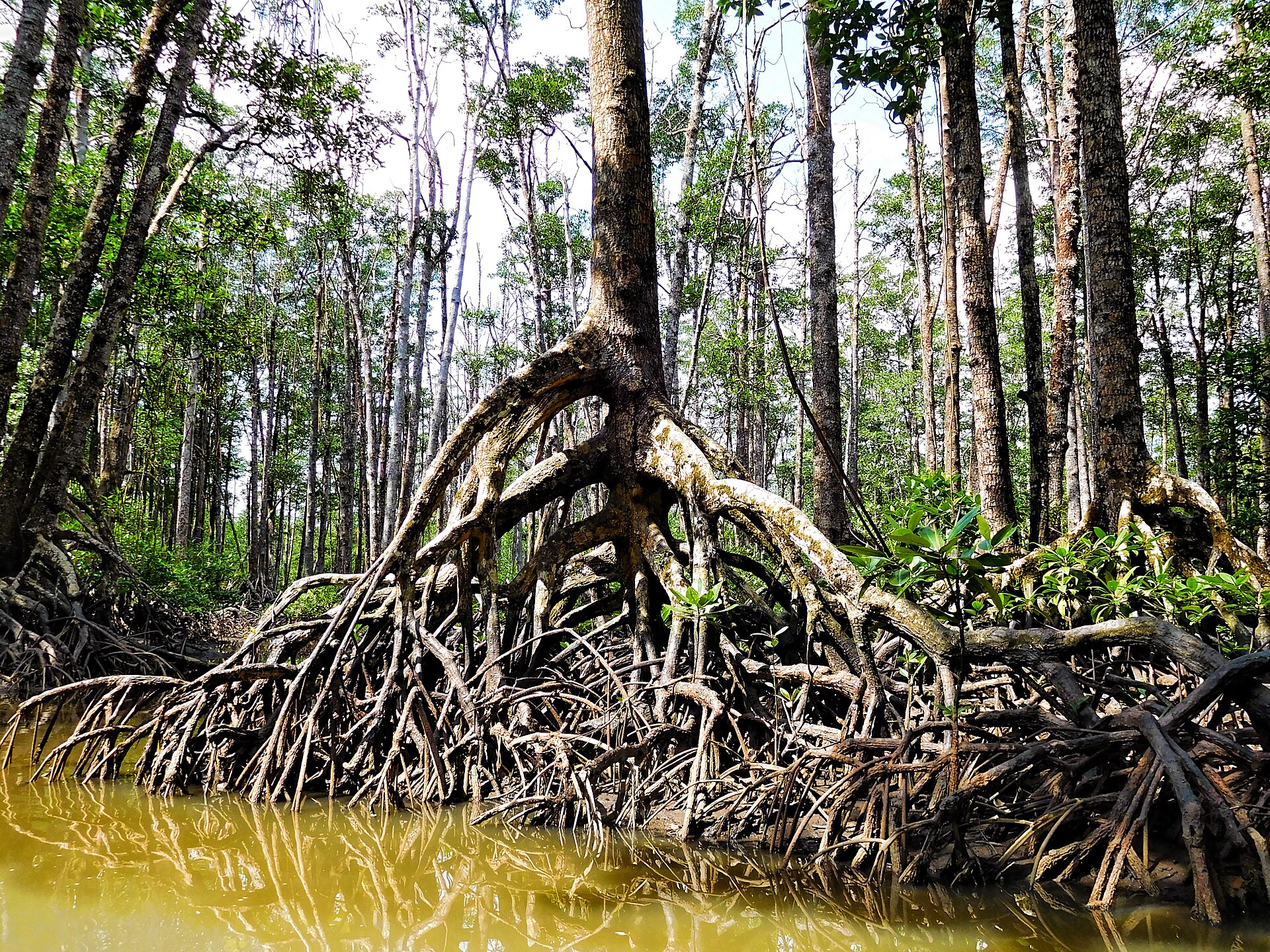
roots slow the water and trap mud and organic matter, and the salty ground beneath them holds almost no oxygen, so decay is extremely slow. Which means the carbon is not sitting only in the trunks and the leaves. So where is it?
Underfoot, in the mud. like this can keep for hundreds and thousands of years, and the store below ground is sometimes larger than the carbon in the trunks and leaves together. Which is also the danger: cut or drain a mangrove, usually for shrimp ponds or coastal development, and the sediment meets oxygen and decay restarts. A stock that took thousands of years to build is released within years.
Intuition says a forest stores carbon in its trees, and in a mangrove that is true of only a small part of the picture. Most of the store is under your feet, in the mud.
The mechanism starts with the structure. Mangrove roots stick up and branch out, and they slow the flow of water at every tide. Particles of mud and organic matter settle among them and are trapped, and the layer piles up slowly over hundreds and thousands of years.
What keeps that is the same thing that keeps it in a peat bog. The ground is saturated and salty and almost without oxygen, so the bacteria that break organic matter down barely work. What is buried stays.
Hence the danger of . Cut or drain a mangrove, usually for shrimp ponds or coastal development, and the sediment meets oxygen and decay restarts. A stock built over thousands of years is released within years. The measurement is done in sediment cores by depth, the rate varies enormously between sites, and a new planting does not immediately reconstitute an old system.
wat. Most of a mangrove’s carbon vault is in the mud under the roots, not in the canopy.
wat wat
Protecting mangroves supports the climate, fisheries, and the defense of coasts against waves and storms.
How do we know?
Researchers take sediment cores, measure carbon by depth and date the layers, and combine that with area mapping and remote sensing.
What is still unknown
The rate of accumulation varies enormously between sites, and a new planting does not immediately reconstitute an old mangrove system.
Learn something?
Where to next
 How much carbon sits in the kelp forests off northern Portugal?blue carbon
 Is sea level rising by the same amount everywhere?coasts
 What is the foam piling up along the tide line made of?coasts