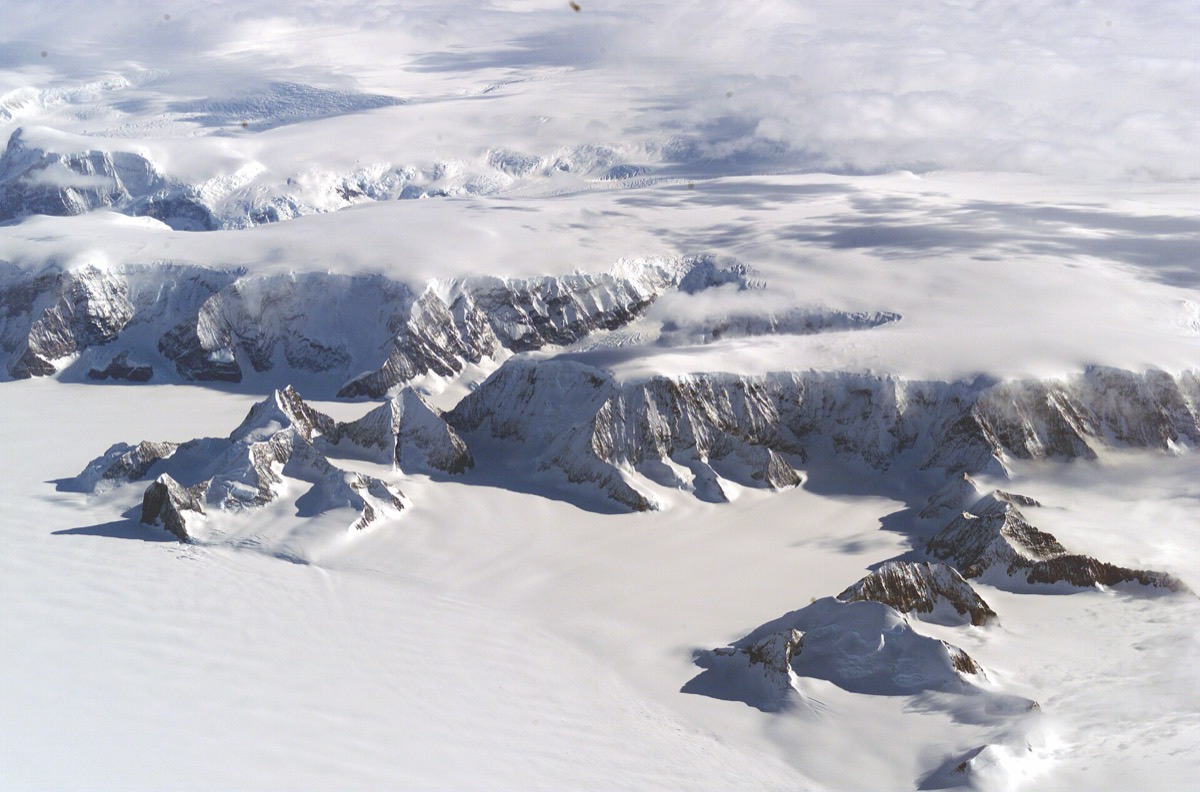
An is a tongue of floating ice reaching out from the land into the sea. Since it is already floating, melting it adds nothing at all to , exactly like an ice cube melting in a full glass. So why does it matter whether it breaks up?
Because its importance is mechanical, not a matter of its mass. A shelf wedges between coasts and islands and buttresses them, resisting and slowing the flow of land ice into the sea. It is a plug, not a cargo. When a shelf breaks up the glaciers behind it speed up, sometimes several times over, and that ice is on land today and does add water to the ocean when it arrives.
The confusion here is common and understandable, and it starts from a thought experiment that is perfectly correct. An ice cube melting in a full glass does not spill it, because the ice was already displacing a volume of water equal to its own weight. That is , and an ice shelf floating on the sea obeys it too.
So the importance of a shelf lies not in its mass but in its mechanical role. It is squeezed between the walls of valleys and snags on submerged islands, so it resists movement and pushes back against the land ice feeding it. That is what makes it a plug and not a cargo.
When a shelf breaks up, the glaciers behind it accelerate, sometimes several times over. That ice is on land today, and when it reaches the sea it does add water to the ocean. The break-up itself barely changes the level, and what follows it changes a great deal.
The measurement comes from space: satellites track the speed of ice flow and its thickness over years, and after shelves broke up the glaciers that fed them were seen to accelerate measurably. The remaining uncertainty is mostly about what happens under the ice, where warm water eats at the shelf from below and direct measurement is hard. So the range of estimates for future rise is still wide, and that is precisely the number coastal engineers need.
wat. After shelves broke up, the glaciers behind them sped up at a rate measured from orbit.
wat wat
It sets how fast sea level could rise, which bears directly on how cities plan their coastal defenses.
How do we know?
Satellites measure the speed of ice flow and its thickness over years. After shelves broke up, the glaciers that fed them were seen to accelerate measurably.
What is still unknown
The projections depend on models of processes beneath the ice, which are hard to measure directly. The range of estimates for future rise is still wide.
Learn something?
Where to next
 If trees cancel almost half the urban heat effect, why does the thermometer barely move?climate
 Does the Amazon still absorb more carbon than it releases?climate
 What comes out of the frozen ground of the north when it thaws?climate