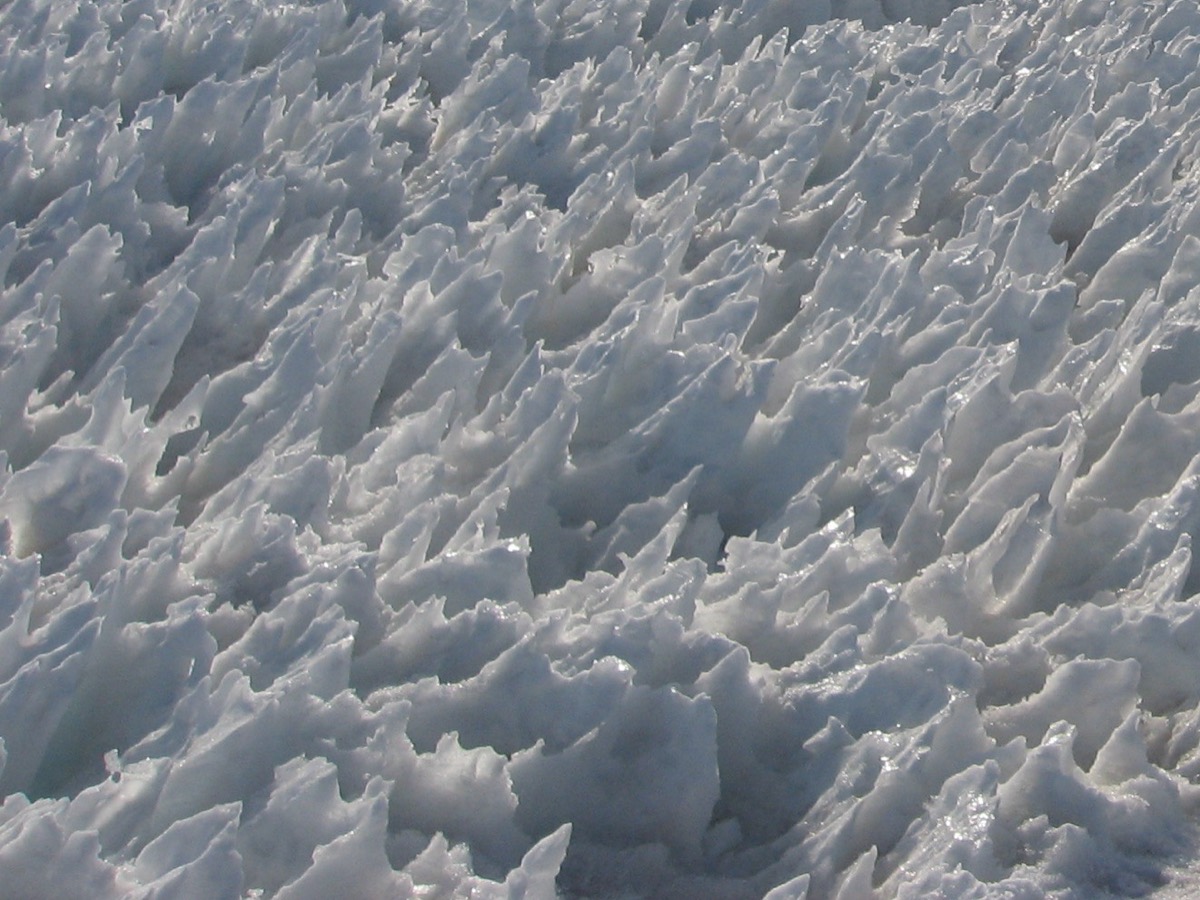
are blades of snow and ice that grow in dry air at altitude, and they all face the same way. They do not pile upward: they are what remains when the snow around them vanishes. What sets the spacing between them?
How vapor and heat move near the surface. The blades remain where the snow around them and vanishes straight into vapor. catch reflected light and lose material at different rates. A physical model showed the spacing between the blades is set not only by trapped light but mainly by the way water vapor and heat disperse close to the surface and mix into the air.
Blades of snow all facing the sun look like a pattern somebody arranged, and the explanation starts with a tiny difference between a hollow and a peak.
The first condition is dry air at altitude. There the snow does not melt but passes straight into vapor, so the bumps stay standing instead of being washed flat by running water. The blades do not pile up; they remain as the snow around them vanishes.
Feedback does the rest. A tiny hollow catches both direct light and light reflected from its walls, so it loses material faster and deepens, and the difference compounds until the surface sharpens.
What the model added is the spacing. A asked which small disturbance grows fastest. It showed the distance between the blades is set not only by trapped light but mainly by the way water vapor and heat disperse near the surface. The model focuses on the initial stage, and wind, melting and varying radiation across the terrain affect mature blades.
wat. Penitente blades are the remains of snow that vanished unevenly into water vapor in dry mountain air.
wat wat
An enormous shape in a landscape can grow from a tiny difference in the rate at which material disappears, with no external template.
How do we know?
The researchers built a stability analysis of a snow surface under solar radiation and calculated which spacing between bumps grows fastest.
What is still unknown
The model focuses on the initial stage. Wind, melting and radiation vary across the terrain and affect mature blades.
Learn something?
Where to next
 How old is the sunlight falling on your face?physics
 Why does a reactor that has already been shut down still need cooling?physics
 Why does the cheese in a cacio e pepe sometimes seize into one lump?physics