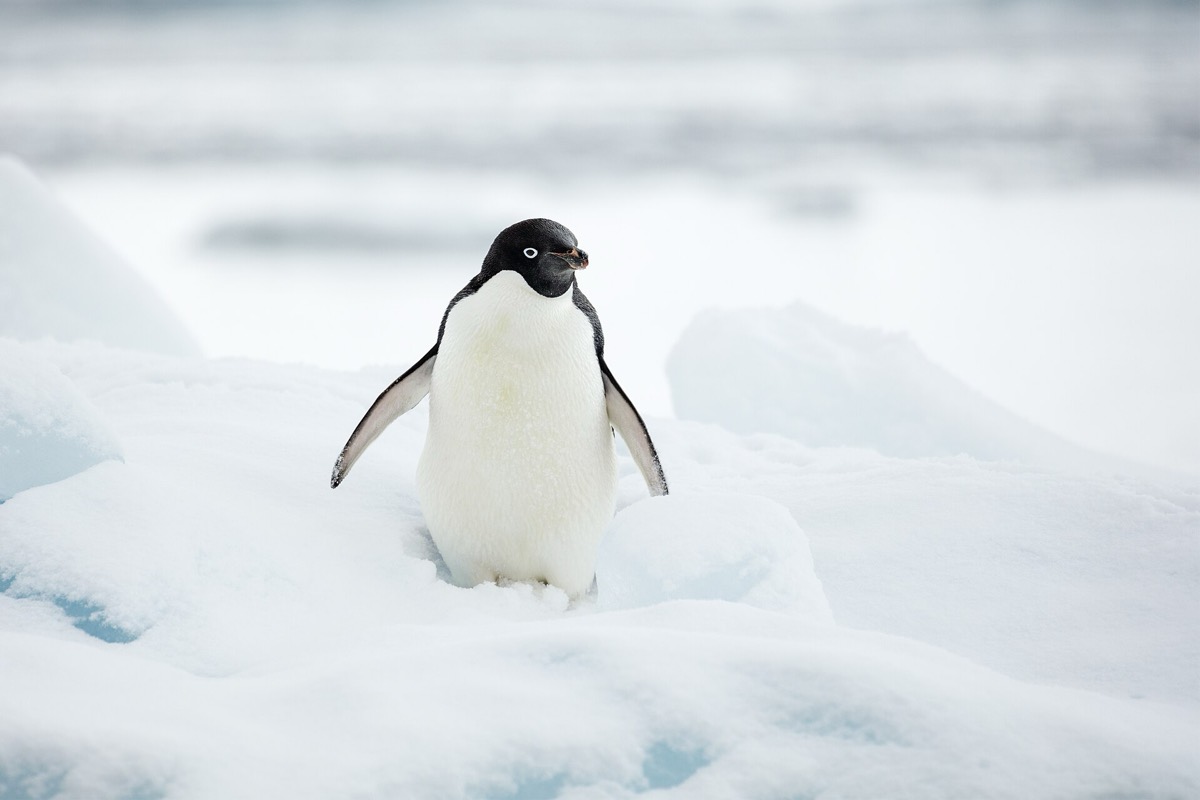
A penguin on a nest does not get up to relieve itself. It stays put and projects the material clear of the rim, which leaves a tidy nest and a ring of marks on the ice at a measurable distance. That distance is a clue, because getting material to travel it takes pressure. Meyer-Rochow and Gal decided to work out how much. What does the arithmetic give?
Around ten for watery material, and about sixty kilopascals for thicker material with a like olive oil, which is roughly seventy-seven and four hundred and fifty millimeters of mercury. Those forces lie well above anything known for humans. They are high, but the authors note the flow still does not become , so none of the effort is wasted on churning.
and Adelie penguins generate considerable pressures to propel material away from the edge of the nest. The question Meyer-Rochow and Gal set is how much pressure that takes, and the useful feature of the problem is that it can be approached entirely from outside the bird.
Four quantities suffice. The distance the material travels before it hits the ground. Its density and its viscosity. And the shape, the aperture and the height above ground of the vent. With all of those measured, the pressure follows.
The answer splits by consistency. Fully grown penguins generate about ten kilopascals, or seventy-seven millimeters of mercury, to expel watery material, and about sixty kilopascals, or four hundred and fifty millimeters of mercury, for material whose viscosity resembles olive oil. The forces lie well above those known for humans.
High pressure is not the same as wasted pressure. The authors point out that the flow does not become turbulent, which would have cost energy without added range. What the calculation cannot settle is the part that looks most like a decision: whether a bird chooses the direction it fires in, and what role the wind plays, both remain unknown.
wat. A nesting penguin generates more pressure than a person can, and does it without getting up.
wat wat
It is an estimate built entirely out of quantities you can measure from outside the animal, which is how physics gets at a body nobody is going to instrument.
How do we know?
Meyer-Rochow and Gal measured the distance the material travels before landing, its density and viscosity, and the shape, aperture and height above the ground of the vent. From those they calculated the pressure needed to account for the result.
What is still unknown
A calculation from measured parameters, not a pressure recorded inside a penguin. The authors state plainly that whether a bird chooses its direction, and what part the wind plays, remain unknown.
Learn something?
Where to next
 Can sleep be useful if it only lasts four seconds at a time?penguins
 How do penguins decide who has to stand on the cold outside?penguins
 How does a small beetle fire liquid at boiling point?biomechanics