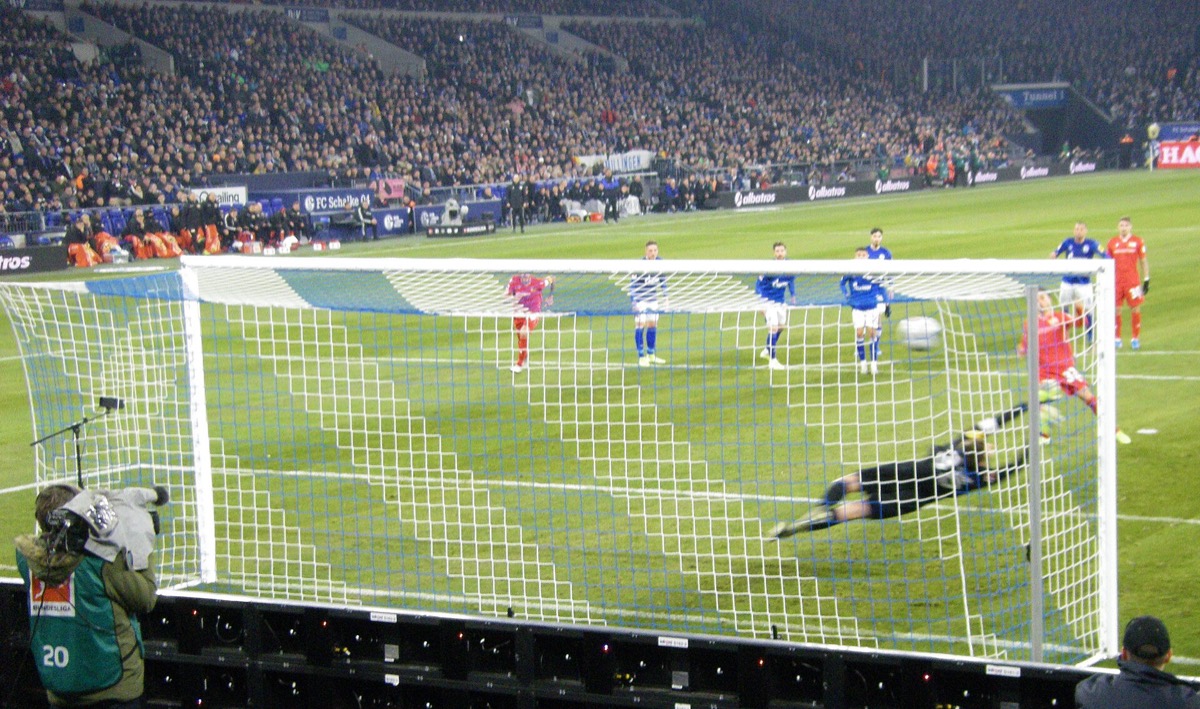
A player taking a is trying to watch the goal and the goalkeeper, and right behind the goal an advertising screen slides across their field of view. To test whether that does anything, players took kicks with no advertisement, with a still one, and with one traveling left or right. What happened to the gaze and to the kick?
The aim traveled with the advertisement. The moving screen caught the gaze of the kickers, above all those who watched the goalkeeper before choosing a side. When the two directions of travel were set against each other, the aim shifted systematically with the direction. Kicks were also a little less variable with no advertisement at all. Nobody showed that a billboard costs a goal here.
In a penalty kick the goal and the keeper hold the attention, and the background does not disappear from sight. The question was whether a behind the goal merely distracts in general, or shifts the aim in a direction you can predict in advance.
Players of intermediate skill kicked against four backgrounds: nothing, a stationary advertisement, and an advertisement traveling left or traveling right. Eye movements were recorded along with where each kicker aimed and where the ball went.
The traveling background caught the eyes of the players using a , tracking the keeper to decide their side. Comparing the two directions showed systematic differences in aim according to which way the display moved, which is the signature of rather than of a general lapse in concentration.
Performance was also somewhat steadier from kick to kick with no advertisement present. None of this says that a sign in a stadium decides a match, and it does show that motion with no relevance to the kick can reach a trained movement. What is still open is how much of it survives real expertise and real pressure.
wat. An advertisement sliding behind the goal pulled the eyes of penalty takers, and moved where their kicks went.
wat wat
Visual information with nothing to do with the task can still bend a precise movement, even while the player is concentrating on the goal.
How do we know?
Paterson, van der Kamp and Savelsbergh compared eye movements and ball placement across four backgrounds, including an advertisement moving in each of two opposite directions.
What is still unknown
The kickers were of intermediate skill and the setting was controlled. The study does not show the same effect on a professional in a full stadium under competitive pressure.
Learn something?
Where to next
 Should a goalkeeper facing a penalty really just stay in the middle?soccer
 What does it cost to change your mind at the last instant of a penalty kick?soccer
 Where do the eyes go when you take a penalty under pressure?penalty