In nineteen ninety-three three astronomers found a comet beside Jupiter that looked wrong: at least a dozen nuclei strung out like , eventually twenty-one of them. Working out the orbit revealed what had happened to it, and what was going to. Every telescope that could point at Jupiter was waiting the following July. What did they see?
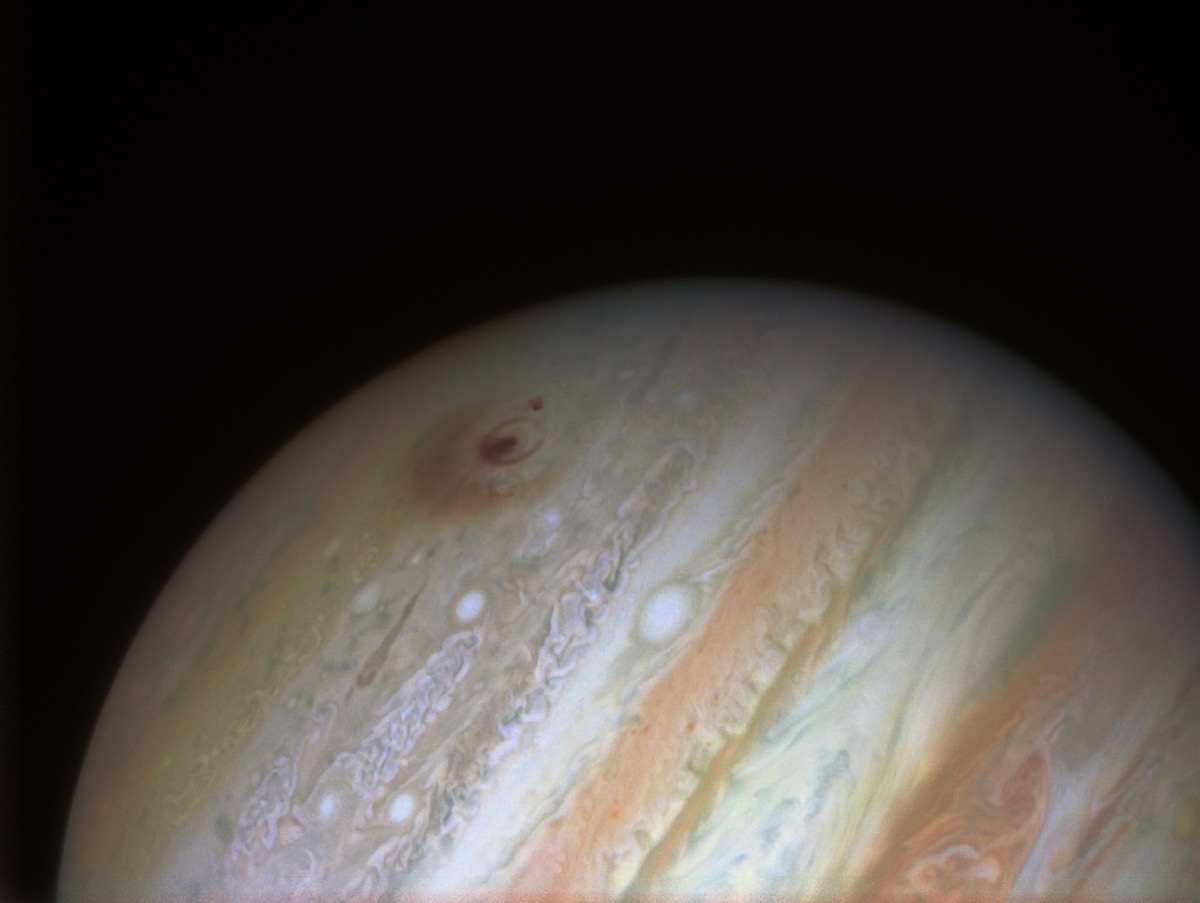
Fragments plunging in, and scars larger than Earth. The pieces hit between the sixteenth and twenty-second of July nineteen ninety-four, at two hundred and twenty-one thousand kilometers per hour. Each exploded deep in the atmosphere into a fireball, which rose back out and laid dark on the cloud tops. Fragment G left a multiringed black cloud wider than Earth.
The discovery came first and the explanation second. On the twenty-fifth of March nineteen ninety-three, Eugene and Carolyn Shoemaker and David Levy found a previously unknown comet close to Jupiter in photographs from the eighteen inch Schmidt telescope at Palomar. Its appearance was very unusual: at least a dozen active cometary nuclei lined up like glowing pearls, and as they spread, twenty-one fragments in all.
Analysis of their common orbit reconstructed the history. The comet had been orbiting the Sun before being captured into orbit around Jupiter, most probably around nineteen twenty-nine. On the eighth of July nineteen ninety-two it passed about twenty-two thousand one hundred kilometers above the cloud tops. At that range broke the single nucleus, about one and a half kilometers in diameter, into many pieces. Solar perturbations then lowered the to less than the planet’s radius.
The impacts ran from the sixteenth to the twenty-second of July nineteen ninety-four, at two hundred and twenty-one thousand kilometers per hour, separated on average by seven to eight hours. All of them struck the night side, hidden beyond the limb as seen from Earth, which left Galileo, then en route to Jupiter, as the only instrument positioned to watch them directly. The planet’s nine hour and fifty-five minute rotation brought each site into view for everyone else. Each fragment plunged deep in and exploded into a bubble of super-hot gas.
What the scars looked like depended on the fragment. About a third produced little or no observable effect, which suggests nuclei smaller than a hundred meters across. Fragment G, perhaps three hundred and fifty to six hundred meters across, was the largest. It left a multiringed black cloud wider than Earth’s diameter, and delivered energy equivalent to at least forty-eight billion tons of TNT, many times the yield of the world’s nuclear arsenal. The dark clouds glowed in infrared, cooled over days, and remained visible for weeks before fading away.
wat. Jupiter pulled the comet into twenty-one pieces two years before it ate them, and the bruises were bigger than our planet.
wat wat
It was the first collision between two solar system bodies ever predicted and then observed, which is a different thing from finding the aftermath of one.
How do we know?
Britannica’s account of the comet, its discovery, its orbital history and the impacts. Observers monitored those from telescopes worldwide, from the Hubble Space Telescope and other orbiting instruments, and from the Galileo spacecraft then on its way to Jupiter.
What is still unknown
The fragments all struck the night side, hidden from Earth. Only Galileo saw the impacts themselves, and Earth-based observers worked from the sites as Jupiter’s rotation brought them around.
Learn something?
Where to next
 How much smaller is Jupiter’s Great Red Spot than it used to be?jupiter
 Has anyone ever seen the Oort Cloud?comets