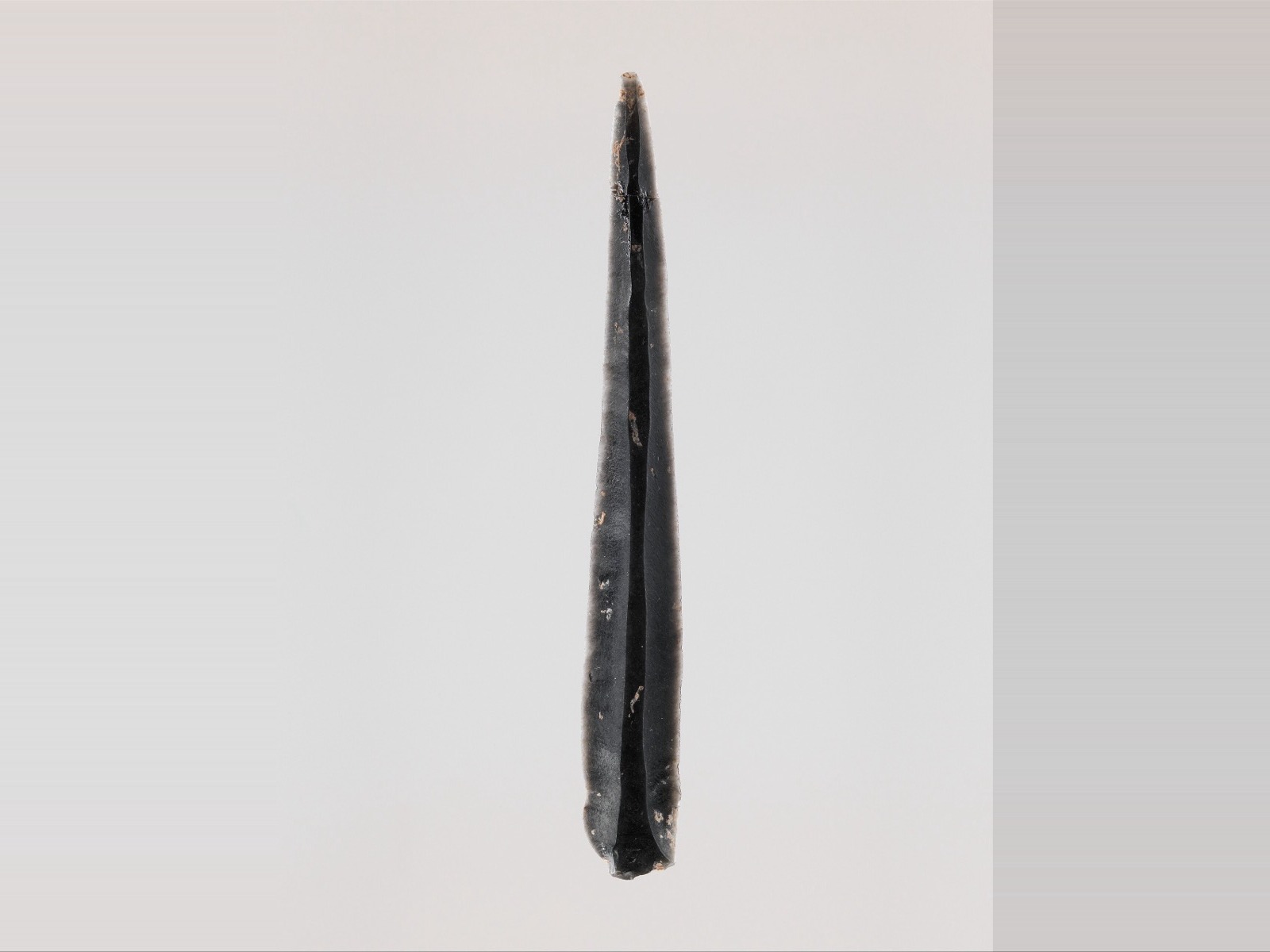
can be flaked to an edge far finer than ground steel, and a run of clinical articles claimed wound healing and scar superiority from obsidian scalpels. All of it was anecdotal. Disa and colleagues put the two blades side by side in the same animal, so each wound had its own control, and then followed the wounds for six weeks.
Better at first, the same in the end. was significantly narrower in the obsidian wounds at seven, ten and fourteen days. By twenty-one days the two groups no longer differed, and by forty-two days every wound was barely detectable. never differed at any time point, so the advantage was in appearance and early only.
The claim being tested came from the clinic rather than the laboratory. Several anecdotal clinical articles had asserted wound healing and scar superiority for obsidian, the volcanic glass whose fracture produces an edge finer than any ground steel blade. Nobody had put the two against each other under controlled conditions.
The design handles the obvious confound. Forty adult male Sprague-Dawley rats each received two parallel eight centimeter incisions on the back, one made with an obsidian scalpel and the other with a standard number fifteen surgical steel blade. Each animal therefore carried its own control, and the outcomes measured were wound tensile strength, scar width and histology, analyzed by ANOVA.
Two results point in different directions. Tensile strength of the two wound types was not different at seven, fourteen, twenty-one or forty-two days, so the obsidian wounds were never stronger. Scar width, though, was significantly less in the obsidian wounds at seven, ten and fourteen days, with a p value below point zero zero five.
Then the difference closed. At twenty-one days scar width no longer differed between the groups, and at forty-two days all the wounds were barely detectable, which precluded analyzing width any further. A blinded histologic review suggested the obsidian wounds contained fewer inflammatory cells and less at seven days. So the finer edge buys a tidier early wound, and nothing that lasts.
wat. The obsidian wounds looked better for two weeks. By three weeks you could not tell them apart, and the strength was never different at all.
wat wat
The paired design is the whole value. Two wounds in the same animal remove the between-animal variation that anecdote cannot control for.
How do we know?
Forty adult male Sprague-Dawley rats each received two parallel eight centimeter incisions on the back, one cut with an obsidian scalpel and one with a number fifteen surgical steel blade. The team assessed tensile strength, scar width and histology, and analyzed the data by ANOVA.
What is still unknown
Rats, not people, and forty-two days is not long enough to say anything about a mature human scar. The paper offers the histologic difference as a suggestion from a blinded review rather than a measured count.
Learn something?
Where to next
 Does knee surgery for arthritis beat a fake operation?surgery
 Which organ grows back to exactly the size the body needs?surgery
 Can reading a list out loud before surgery keep people alive?surgery