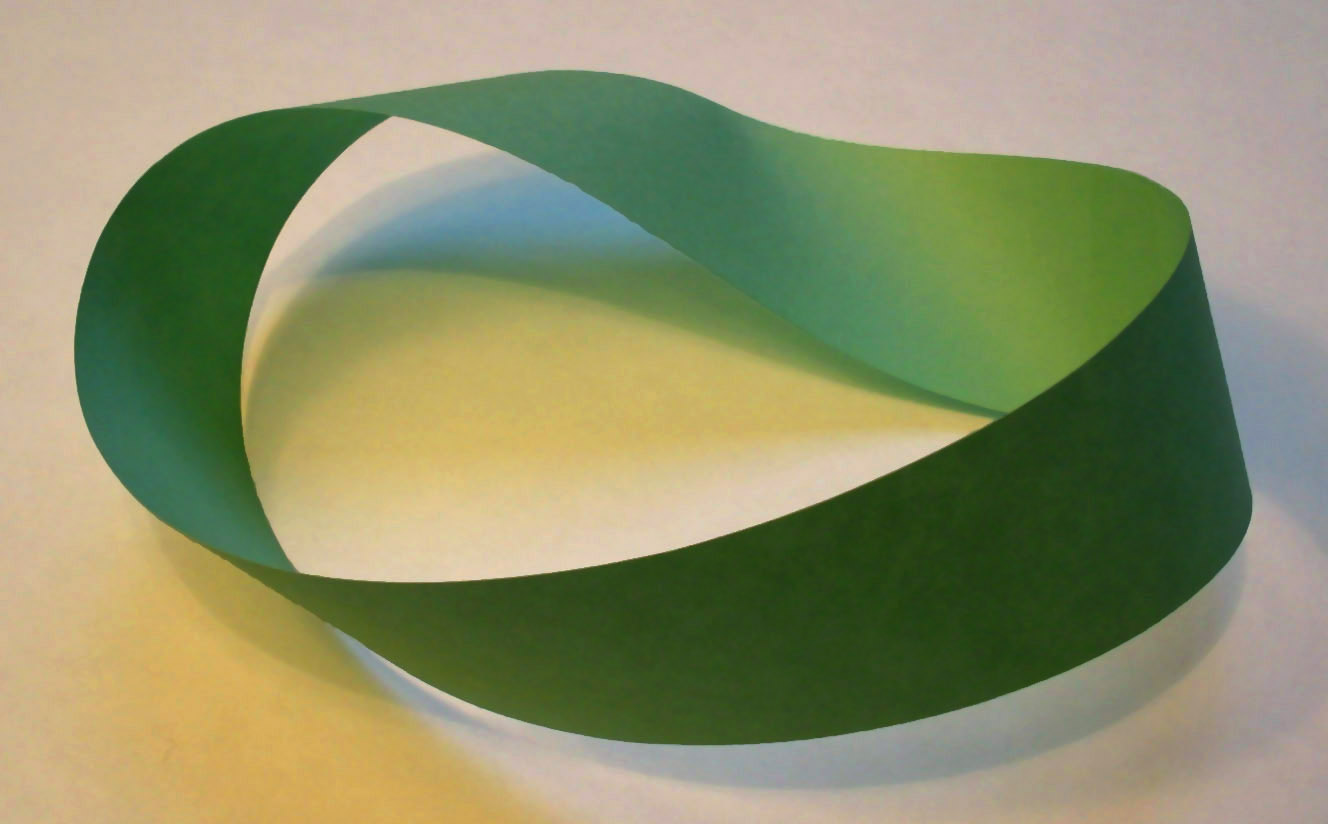
Take a paper band, give one end a half twist, reattach the ends, and the result has a single side and a single edge. It is the standard demonstration of a . What happens when you start cutting it, and how many twists you add first, is where the predictions stop being obvious.
One band of twice the length. Cutting a Möbius strip along its middle yields a single band rather than two, while cutting it in three divisions yields one band of double length plus one Möbius strip. The figures that come out of these cuts are called , and they depend on both the number of half-twists and the number of cuts.
The Möbius strip, also called the twisted cylinder, is a one-sided nonorientable surface. You obtain it by cutting a closed band into a single strip, giving one of the two ends a half twist, and reattaching the ends.
The naming is not quite fair. Möbius invented the strip bearing his name in 1858, but Listing discovered it independently and published it, which Möbius did not.
Cutting it produces the surprises. Adding extra twists and reconnecting the ends gives paradromic rings. One half-twist with one cut yields a single band of double length, while one half-twist across three divisions yields that band plus a Möbius strip of the original length.
The strip also connects to other surfaces. Its sits alongside a parametric description of it as a cubic surface. A torus can be cut into one with an even number of half-twists, attaching one to a disk along its boundary produces a , and a Klein bottle splits lengthwise into two of them. The B. F. Goodrich Company once patented a conveyor belt in this shape that lasts twice as long as a conventional belt.
wat. Cut it down the middle and you still have one band, only longer.
wat wat
A surface where an intuition as basic as having two sides fails is a cheap way to see why topology needs its own vocabulary.
How do we know?
Wolfram MathWorld tabulates the results of cutting strips with one or two half-twists across several divisions, drawing on the classical treatments by Listing and Tait and by Ball and Coxeter.
What is still unknown
A reference entry rather than a proof, pointing to the literature for each result.
Learn something?
Where to next
 Why can nobody actually make a Klein bottle?topology
 How does a thin film solve a geometry problem without calculating?geometry
 Why were geometry problems hung in temples in Japan?geometry