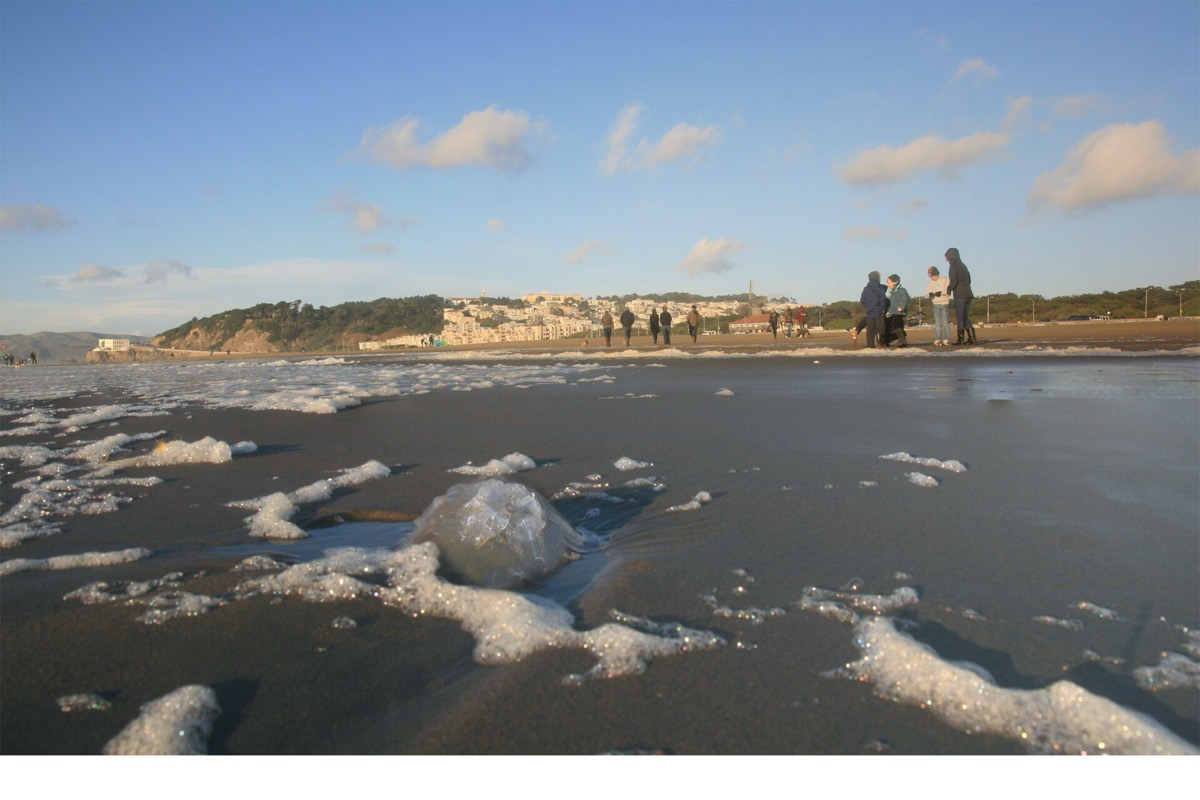
Scoop up seawater in a clear glass and look closely and it is full of tiny particles: dissolved salts, proteins, fats, dead algae, detergents and other pollutants, and assorted bits of organic and artificial matter. Shake the glass and small bubbles form on the surface. The same thing happens along a coast on a far grander scale. What is it?
, churned up. Sea foam forms when the ocean is agitated by wind and waves, with each coastal region having its own conditions governing it. are one common source of the thick foams: when large blooms decay offshore, great amounts of decaying algal matter wash ashore, and foam forms as the surf churns it. Most of it is harmless.
Seawater is not clean in the way a glass of tap water is. It carries dissolved salts, proteins, fats, dead algae, detergents and other pollutants, and a quantity of other organic and artificial matter. Shake a glass of it and small bubbles form on the surface, which is the whole mechanism in miniature.
Sea foam is that process at the scale of a coast, with wind and waves doing the shaking. Each coastal region has its own conditions governing how foam forms, so the same mechanism produces very different results from one shoreline to another.
Algal blooms supply the material for the thickest foams. When large blooms decay offshore, great amounts of decaying algal matter wash ashore, and the surf churns that dissolved organic matter into foam. Most sea foam is not harmful to humans, and its presence is often an indication of a productive ocean ecosystem.
The exceptions are specific. Large harmful blooms decaying near shore carry potential impacts on health and environment. Along Gulf coast beaches during blooms, popping foam bubbles are one route by which algal toxins become airborne, irritating eyes and endangering people with asthma. Then there were the seabird die-offs, off California in two thousand seven and in the Pacific Northwest in two thousand nine. Scientists found a soap-like foam from decaying Akashiwo sanguinea had stripped the from feathers, leading to fatal hypothermia.
wat. It is the sea shaken hard enough to froth, and what froths is everything dissolved in it.
wat wat
Thick foam usually means a productive ocean ecosystem rather than pollution, which is the opposite of what most people on a beach assume when they see it.
How do we know?
NOAA’s National Ocean Service explains what sea foam is, where the material comes from, and the circumstances under which it stops being harmless.
What is still unknown
A short public explainer. It gives the mechanism and the main exceptions without going into how much foam a given bloom produces or how long the toxins persist.
Learn something?
Where to next
 How do sea otters save kelp forests without touching them?ocean
 Is the water at the bottom of the deepest trench on earth standing still?ocean
 Why does an ice shelf already floating in the sea still matter for sea level?ocean