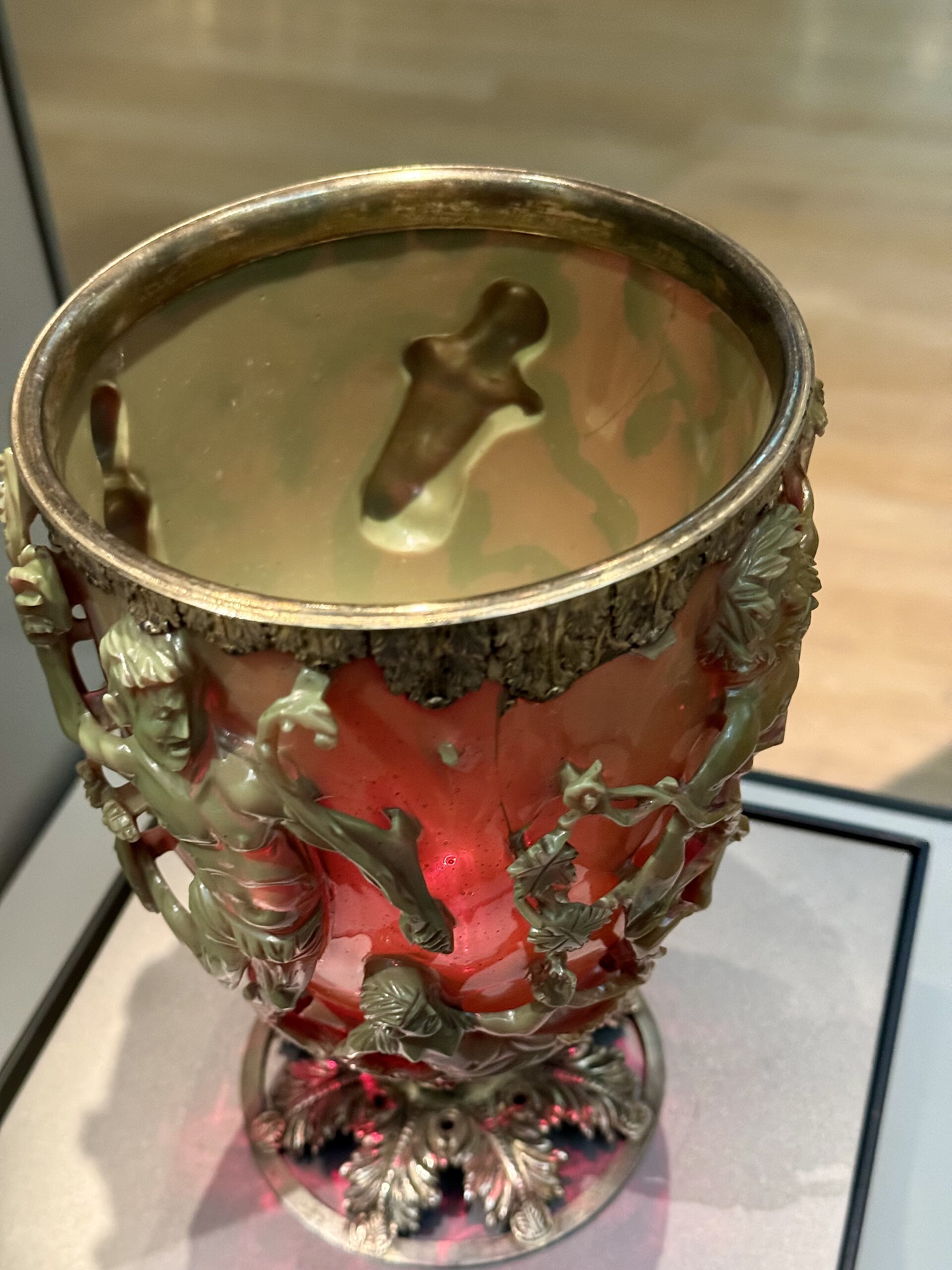
Because the glass contains metal nanoparticles. The British Museum catalogues the fourth-century as green and red, which is the whole oddity: it is both. nanoparticles show different colors when illuminated from the front, by scattering, or from the back, by transmission, and that effect is unique to nanoparticles and nanostructures.
The color does not come from a dye. are particles under a hundred nanometers across, and the color of a solution of them is set by rather than by simple absorbance. Such particles were used in antiquity to make colored glass, and many medieval cathedral windows are red because they hold gold nanoparticles.
The British Museum’s record for the Lycurgus Cup lists it simply. A late Roman drinking-cup, fourth century, glass, green and red, covered with scenes representing the death of King Lycurgus, with a silver-gilt rim and foot. The colors are the puzzle. One object described as two colors is either badly catalogued or doing something unusual.
It is doing something unusual, and the mechanism is nanoscale. Metallic nanoparticles are small particles with dimensions of less than a hundred nanometers, and they have unique optical characteristics. The color of a nanoparticle solution is given by surface plasmon resonance, in contrast to the simple absorbance of a molecule, so the hue depends on the particles rather than on any dye.
Dichroism is the specific effect here. Dichroic nanoparticles show different colors when illuminated from the front, where the eye receives scattered light, or from the back, where it receives transmitted light. The chemistry paper is blunt that this is the point. The effect is unique to nanoparticles and nanostructures in general, which is why it can generate what the authors call the "wow" effect in a classroom.
The practice is far older than the explanation. Metallic nanoparticles were used in antiquity for the production of colored glass, and many medieval cathedral red windows are stained with gold nanoparticles. Two cautions about this card. The optics come from a chemistry-education paper on synthesizing dichroic gold and silver particles, not from analysis of the cup. The museum record states the colors without explaining them.
wat. Light it from the front and it is green; light it from behind and it turns red.
wat wat
Showing someone a red solution and saying it holds gold nanoparticles proves little, since red is easy. A liquid or a glass that changes color depending on which side the light comes from cannot be done any other way.
How do we know?
A paper in Chemistry Teacher International sets out the optics of dichroic gold and silver nanoparticles with reference to the Lycurgus Cup’s colors, alongside the British Museum’s catalogue record of the cup itself.
What is still unknown
The optics come from a chemistry-education paper about synthesizing such particles, not from analysis of the cup, and the museum record describes the glass as green and red without explaining why. Neither source is a study of the Roman glass itself.
Learn something?
Where to next
 Why does a toughened window crumble into thousands of small pieces instead of long blades?glass
 Lightning strikes sand and is gone in an instant. What does it leave below the surface?glass
 How can shards of Roman glass hint at ancient recycling?glass