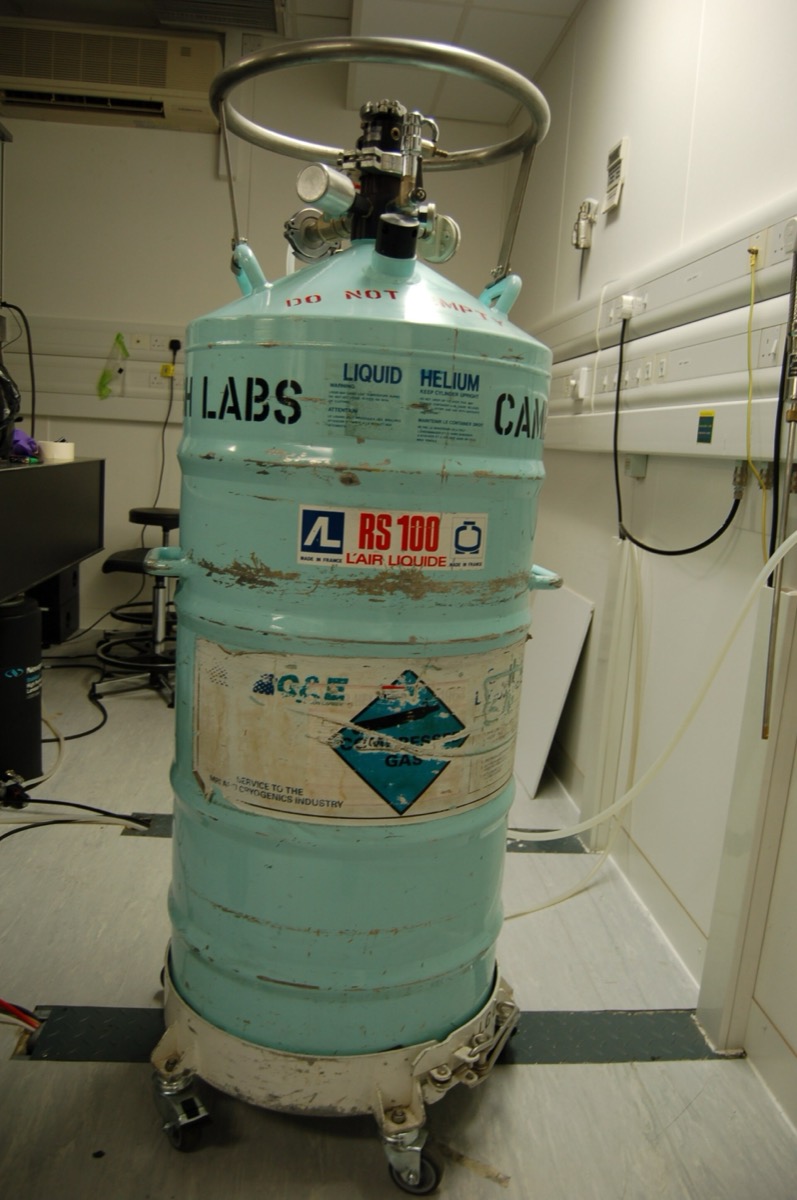
Its internal friction disappears. In 1938 Pyotr Kapitza discovered the of helium, meaning that below about 2.2 the viscosity of the liquid vanishes. Allen and Misener made the same discovery independently at the in Cambridge. Kapitza shared the 1978 Nobel Prize in Physics for his inventions and discoveries in low-temperature physics.
Getting there took thirty years of cold. Kamerlingh-Onnes first liquefied helium around 1908, which opened a run of unexpected phenomena, including superconductivity in mercury in 1911. Kapitza’s own earlier contribution was an ingenious device for liquefying helium in large quantities, which the award ceremony speech calls a prerequisite for the progress that followed.
Low temperatures here mean just above absolute zero, at minus 273 degrees Celsius, where all heat motion ceases and no gases can exist. The convenient scale counts up from there in kelvin, so that 3 kelvin is the same as minus 270 Celsius. Seventy years before the 1978 prize, Kamerlingh-Onnes succeeded in liquefying helium, which started a run of new and unexpected phenomena.
The first of them was superconductivity. In 1911 Kamerlingh-Onnes found that the electrical resistance of mercury disappeared completely at about 4 kelvin, and in 1913 he received the Nobel Prize for his discoveries. His laboratory in Leiden ranked for years as the destination for anyone working in low-temperature physics.
In the late nineteen twenties the young Russian physicist Kapitza, then working with Rutherford in Cambridge, became a serious competitor. His achievements made enough of an impression that the Royal Society created the Mond Laboratory for him, where he stayed until 1934. Foremost among that period’s work was an ingenious device for liquefying helium in large quantities, which was a prerequisite for the progress of the following decades.
Back in his own country Kapitza had to build an institute from nothing. In 1938 he surprised the physics community with the superfluidity of helium: the internal friction of the liquid disappears below 2.2 kelvin, the . The same discovery was made independently by Allen and Misener at the Mond Laboratory. Two cautions. This is an award ceremony speech, so dates and temperatures are rounded for an audience, and the other half of that year’s prize went to Penzias and Wilson for something entirely unrelated.
wat. Below the lambda point, helium simply stops resisting its own motion.
wat wat
Zero viscosity is not a small quantity, it is a different kind of liquid. A fluid with no internal friction creeps up walls and flows through gaps that should stop it.
How do we know?
The presentation speech for the 1978 physics prize, given by Professor Lamek Hulthén, sets out the sequence. It runs from the liquefaction of helium through superconductivity and Kapitza’s liquefier to superfluidity below the lambda point.
What is still unknown
An award ceremony speech, which is a public account rather than a technical one. It gives round figures and compresses a long history, and the prize went half to Kapitza and half to an unrelated discovery in astronomy.
Learn something?
Where to next
 Why does a reactor that has already been shut down still need cooling?physics
 Why does the cheese in a cacio e pepe sometimes seize into one lump?physics
 They had an alligator bellow in helium. Which part of its voice changed?helium