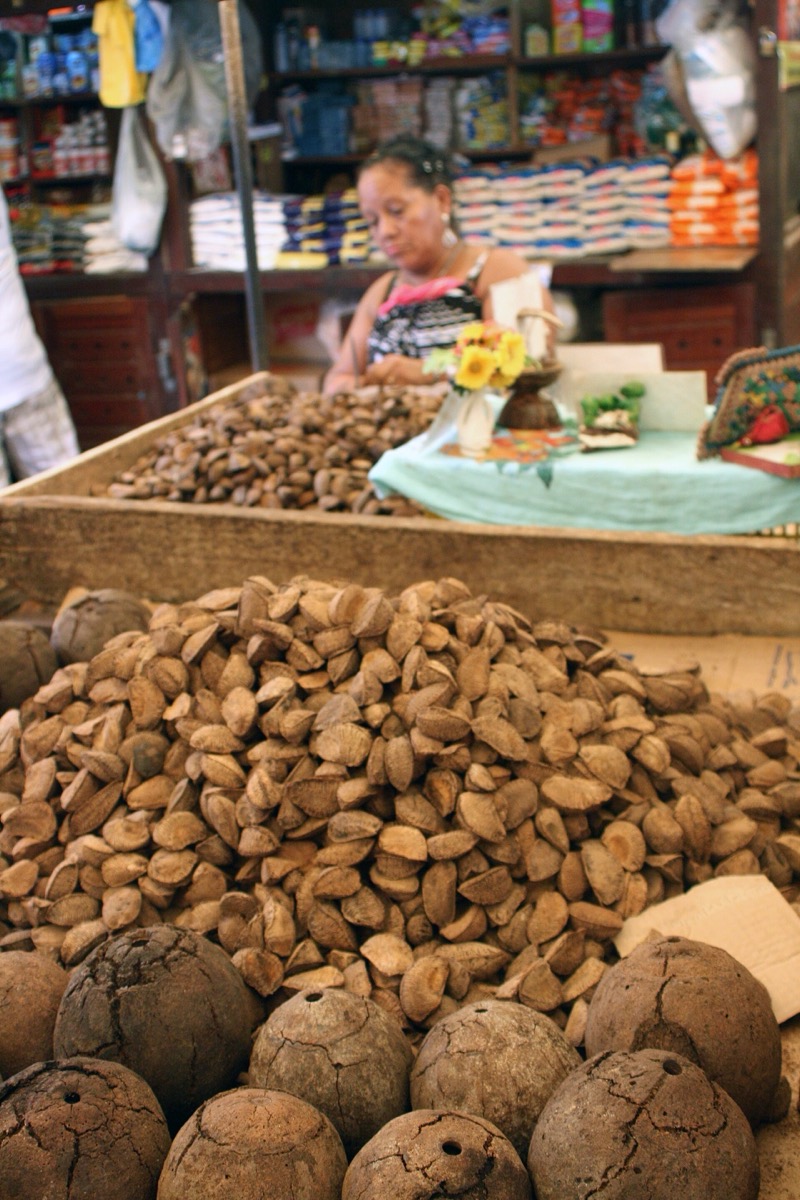
You open a bag of nuts and the big ones are always on top, although the shaking on the way should have mixed them. , a pile of particles, does not behave like a liquid. So what is actually going on in there?
Shaking sorts rather than mixes. During shaking, small grains can fall into that open beneath the large ones, and in the pile can carry particles along different routes. Experiments showed that the density of the particle and the air between the grains also change the direction. So the “Brazil nut effect” is no simple law by which the big one always rises; under other conditions you even get .
A pile of particles does not behave like a liquid: it pours like a liquid and bears weight like a solid, so shaking can separate it instead.
One mechanism is simple: every shake opens a momentary space beneath a large grain, and the small ones get in there first. The large one does not rise under its own power but is pushed up.
Alongside it run convection currents in the pile: the grains move in a circle, up through the middle and down beside the wall. A large grain cannot enter the narrow descending path, so it is stranded on top.
Experiments varying size, density and air pressure showed the direction can flip: a very dense particle, or air trapped between the grains, sends it down. The same separation affects food packaging, pharmaceutical powders and building materials. Several mechanisms act together, and there is no single explanation for every mixture.
wat. Shaking a bag can sort it: size, density and the air between the grains decide whether the large particle rises or sinks.
wat wat
The same separation affects food packaging, pharmaceutical powders and building materials, where a uniform mixture can come apart on the way.
How do we know?
Researchers shook controlled mixtures, varied size, density and air pressure, and measured when a large particle rises and when it sinks.
What is still unknown
Several mechanisms act together, and the importance of each depends on the container, the frequency, the density and the air. There is no single explanation for every mixture.
Learn something?
Where to next
 Why does sand on a vibrating plate draw lines?vibration
 What do elephants hear through the soles of their feet?vibration
 Can a plant tell the difference between wind and a caterpillar?vibration