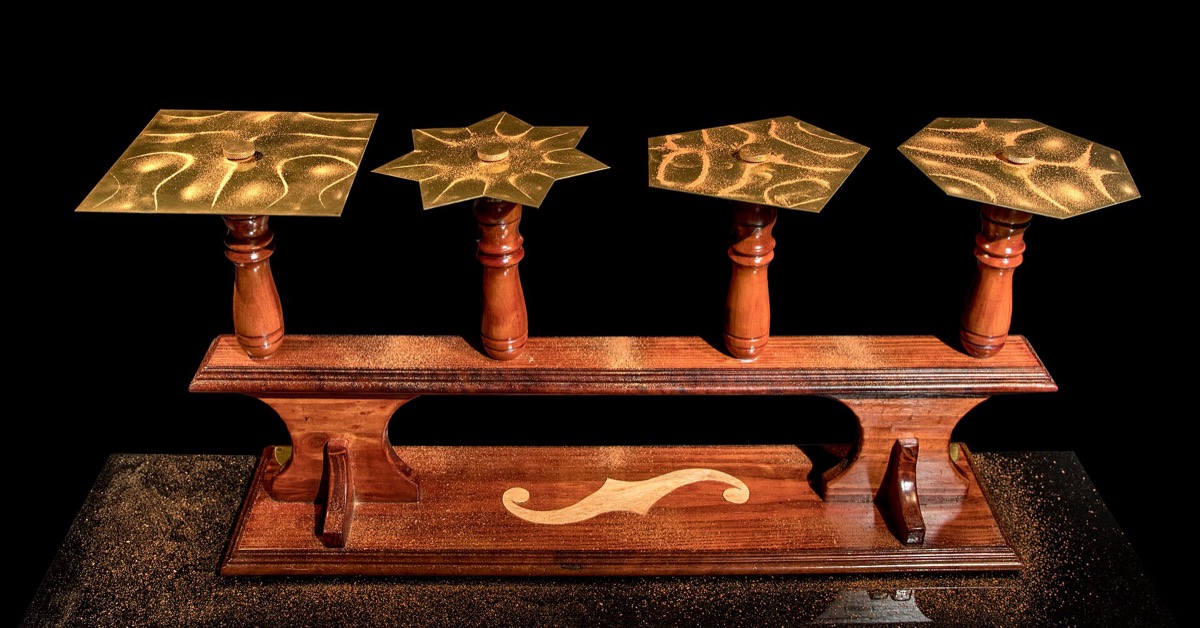
Scatter sand on a metal plate, drive the plate with a tone, and the grains gather into a clean geometric figure. The pattern is the plate telling you where it is not moving. Reproducing one from theory, rather than admiring it, means knowing the plate’s first.
From the impedance of the exciter. The authors found resonant frequencies could be obtained fairly well by probing how the of the oscillator changes with and without the plate attached. The extra mass of the central exciter proved insignificant for those measurements, and the inhomogeneous then supplied a response function that reconstructs the patterns.
The experiment is the classical one with a modern driver: Chladni patterns and resonant frequencies measured for a thin plate excited by an electronically controlled mechanical oscillator.
The first result is methodological. Resonant frequencies can be fairly obtained by probing the variation of the effective impedance of the exciter with and without the thin plate. No hunting by ear or by eye is needed.
A worry about that setup gets addressed directly. The influence of the extra mass from the central exciter is confirmed to be insignificant in measuring the resonant frequencies of the present system, which is the kind of check that makes the rest trustworthy.
On the theoretical side, the inhomogeneous Helmholtz equation yields the response function as a function of the driving wave number. That is what allows the experimental Chladni patterns to be reconstructed rather than merely photographed.
wat. The sand collects on the lines that are standing still, and the figure is the mode made visible.
wat wat
A two-century-old demonstration becomes a test of theory once you can predict which figure a given frequency produces.
How do we know?
Tuan and colleagues measured Chladni nodal line patterns and resonant frequencies on a thin plate driven by an electronically controlled mechanical oscillator. A response function derived from the inhomogeneous Helmholtz equation then reconstructed the patterns.
What is still unknown
Thin plates driven at a central point, in a laboratory; the reconstruction is of the nodal line patterns measured in this setup.
Learn something?
Where to next
 You open a bag of nuts and the big ones are on top again. Why does shaking not mix them?vibration
 Which feather silences an owl in flight? There is no single answeracoustics
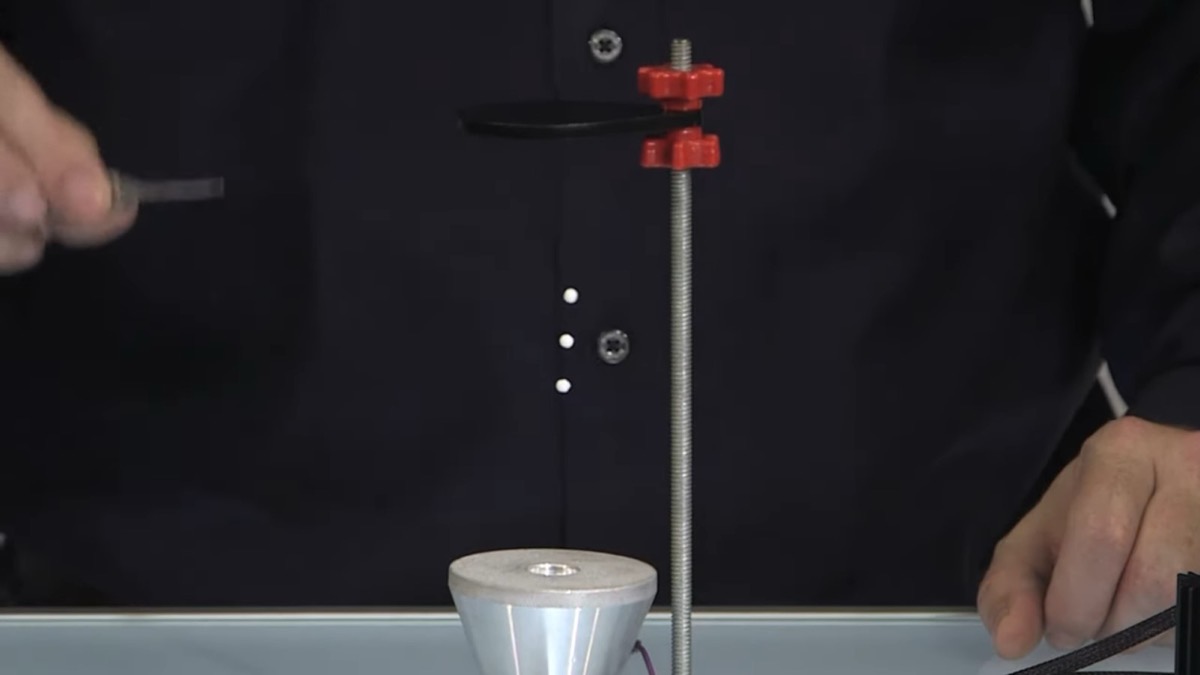 What does a droplet do when sound holds it in mid-air?acoustics