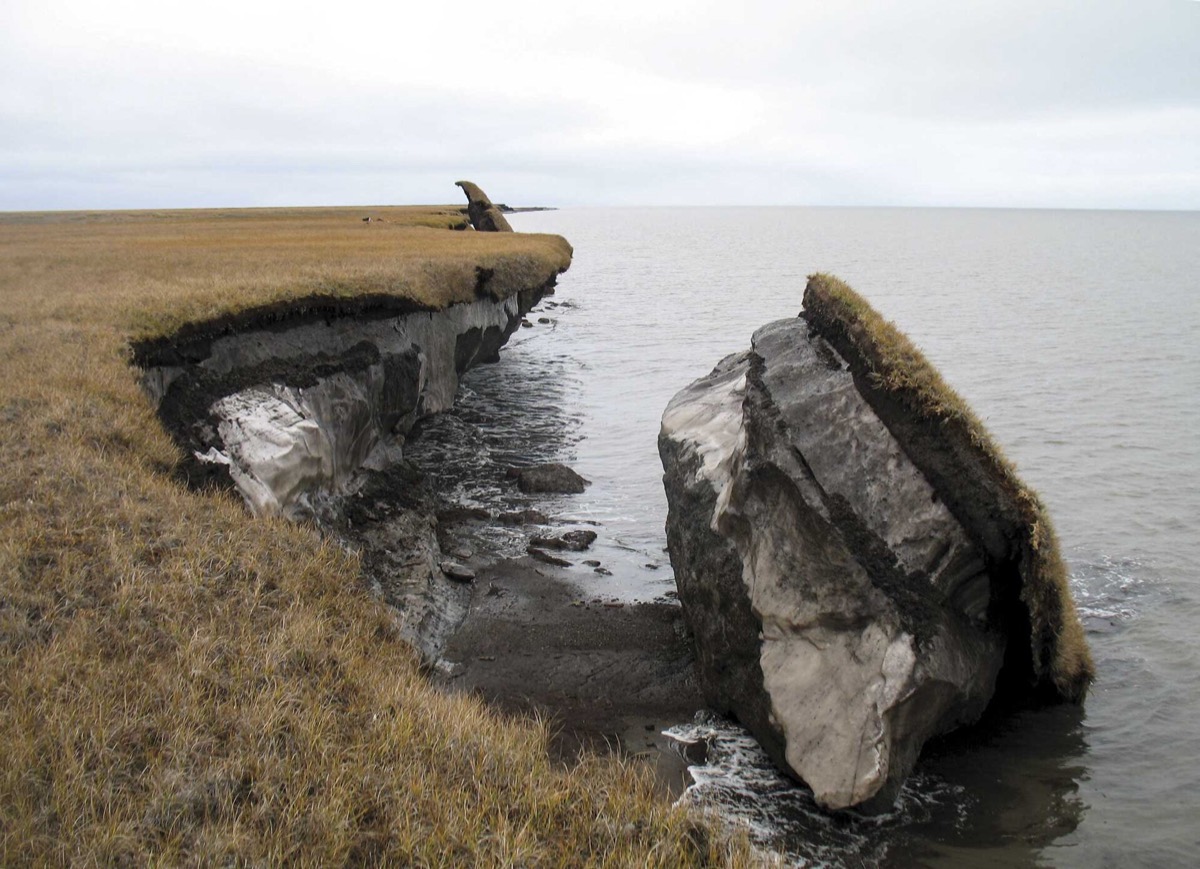
is ground that stays frozen for years on end, and it covers vast areas of Siberia, Alaska and Canada. Locked inside it are the remains of plants and animals that never got the chance to rot. What happens when it thaws?
In the cold, bacterial activity nearly stops, which is why the material was preserved at all. As the ground thaws the bacteria go back to work on it, releasing carbon dioxide and . That warms things further, and the warming thaws more ground: a . What is still not known is the rate, and different models give wide ranges for it.
To see why there is any carbon up there at all, think about rot. A plant that dies is broken down by bacteria, and in the breaking down its carbon returns to the air. In the cold, bacterial activity nearly stops, so in the far north the organic matter did not rot but piled up and froze.
The result is an enormous store. The permafrost of Siberia, Alaska and Canada holds more carbon than the whole atmosphere does today, in the form of plant and animal remains that have lain there for thousands of years.
A thaw does not release that carbon directly; it puts the bacteria back to work. They break down what has been waiting for them, giving off carbon dioxide where there is oxygen and methane in waterlogged ground. That warms things further, and the warming thaws more ground: a reinforcing feedback.
Measuring it stacks several layers: boreholes and monitoring stations for the depth of thaw, towers above the ground for the gases coming off it, and satellites for broad coverage. What is still unknown is the rate, and different models give wide ranges. Which is exactly what makes this a policy question and not only a scientific one, because a source that emits on its own eats into the with nobody having decided.
wat. The organic matter up there never rotted because it was frozen. The moment it thaws, the bacteria carry on from where they stopped.
wat wat
It is one of the sources that could accelerate warming beyond what humans emit directly, which is why it bears on the global carbon budget.
How do we know?
Boreholes and long-term monitoring stations measure how deep the thaw goes, while measurement towers above the ground and satellites measure the gases coming off it.
What is still unknown
Neither the rate of release nor its exact contribution to warming is known precisely, and different models give wide ranges.
Learn something?
Where to next
 Does the Amazon still absorb more carbon than it releases?climate
 Can planting trees warm a place rather than cool it?climate
 If trees cancel almost half the urban heat effect, why does the thermometer barely move?climate